China: Judicial Guidelines to Curtail Activism for Taiwan a Further Blow for Human Rights Protections
July 11, 2024, Statements
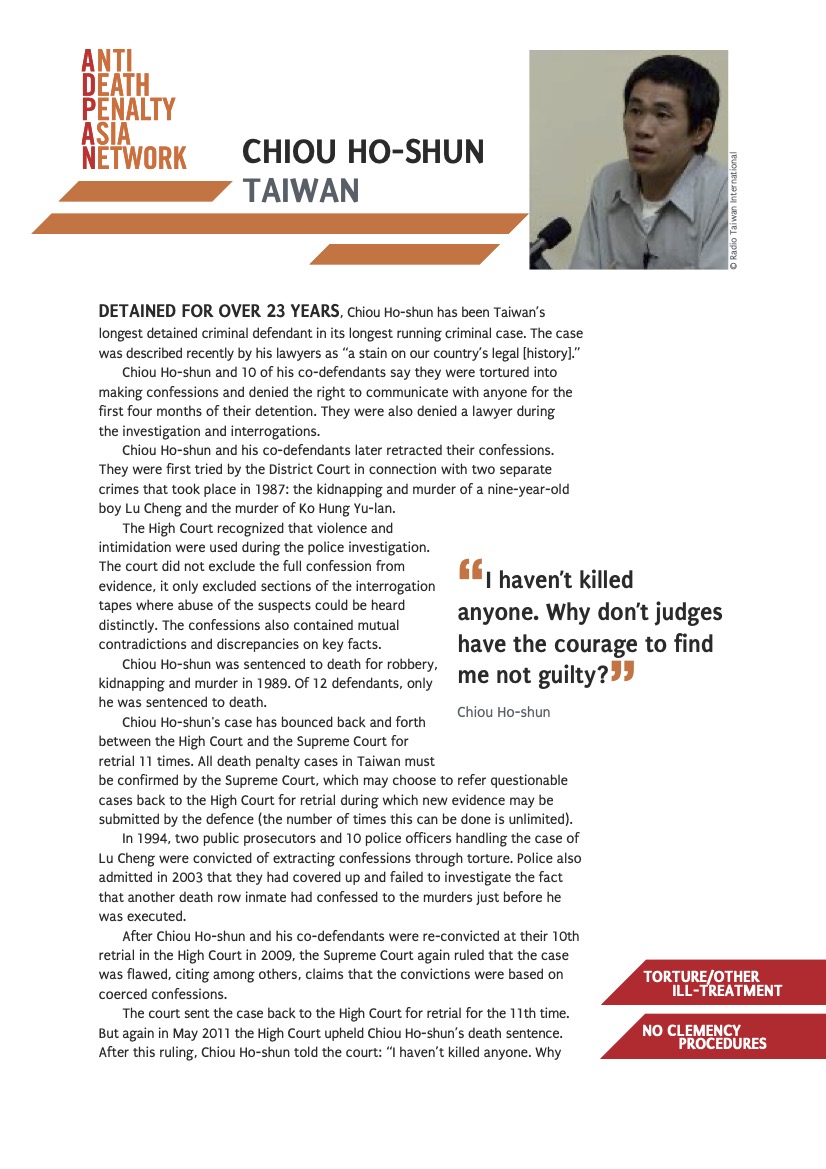
Detained for over 23 years, Chiou Ho-shun has been Taiwan’s longest detained criminal defendant in its longest running criminal case. The case was described recently by his lawyers as “a stain on our country’s legal [history].” Chiou Ho-shun and 10 of his co-defendants say they were tortured into making confessions and denied the right to communicate with anyone for the first four months of their detention. They were also denied a lawyer during the investigation and interrogations.
Chiou Ho-shun and his co-defendants later retracted their confessions. They were first tried by the District Court in connection with two separate crimes that took place in 1987: the kidnapping and murder of a nine-year-old boy Lu Cheng and the murder of Ko Hung Yu-lan.
The High Court recognized that violence and intimidation were used during the police investigation. The court did not exclude the full confession from evidence, it only excluded sections of the interrogation tapes where abuse of the suspects could be heard distinctly. The confessions also contained mutual contradictions and discrepancies on key facts.
Chiou Ho-shun was sentenced to death for robbery, kidnapping and murder in 1989. Of 12 defendants, only he was sentenced to death. Chiou Ho-shun’s case has bounced back and forth between the High Court and the Supreme Court for retrial 11 times. All death penalty cases in Taiwan must be confirmed by the Supreme Court, which may choose to refer questionable cases back to the High Court for retrial during which new evidence may be submitted by the defence (the number of times this can be done is unlimited).
In 1994, two public prosecutors and 10 police officers handling the case of Lu Cheng were convicted of extracting confessions through torture. Police also admitted in 2003 that they had covered up and failed to investigate the fact that another death row inmate had confessed to the murders just before he was executed.
After Chiou Ho-shun and his co-defendants were re-convicted at their 10th retrial in the High Court in 2009, the Supreme Court again ruled that the case was flawed, citing among others, claims that the convictions were based on coerced confessions.
The court sent the case back to the High Court for retrial for the 11th time. But again in May 2011 the High Court upheld Chiou Ho-shun’s death sentence. After this ruling, Chiou Ho-shun told the court: “I haven’t killed anyone. Why don’t judges have the courage to find me not guilty?” On 28 July 2011, Chiou Ho-shun lost his final appeal to the Supreme Court and on 25 August 2011 the Prosecutor General rejected a request to seek an extraordinary appeal for a retrial. Chiou Ho-shun could be executed at any time.
Appeal to the minister of Justice to:
- Stop the execution of Chiou Ho-shun by whatever judicial or other means available.
- Investigate the reports of torture and other ill-treatment and ensure that all statements resulting from such coercion are completely excluded from any re-trial.
- Ensure Chiou Ho-shun is re-tried in proceedings which comply with international fair trial standards.
- Suspend all executions and the imposition of death sentences as a step towards the total abolition of the death penalty.
- Revise laws and change policies and practices to ensure fair trials in line with international standards.
- Ensure that those sentenced to death have an effective opportunity to exercise their right to seek a pardon or commutation of their sentence in line with international standards.