
A tribute to M Ravi, founding member of ADPAN

A tribute to M Ravi, founding member of ADPAN
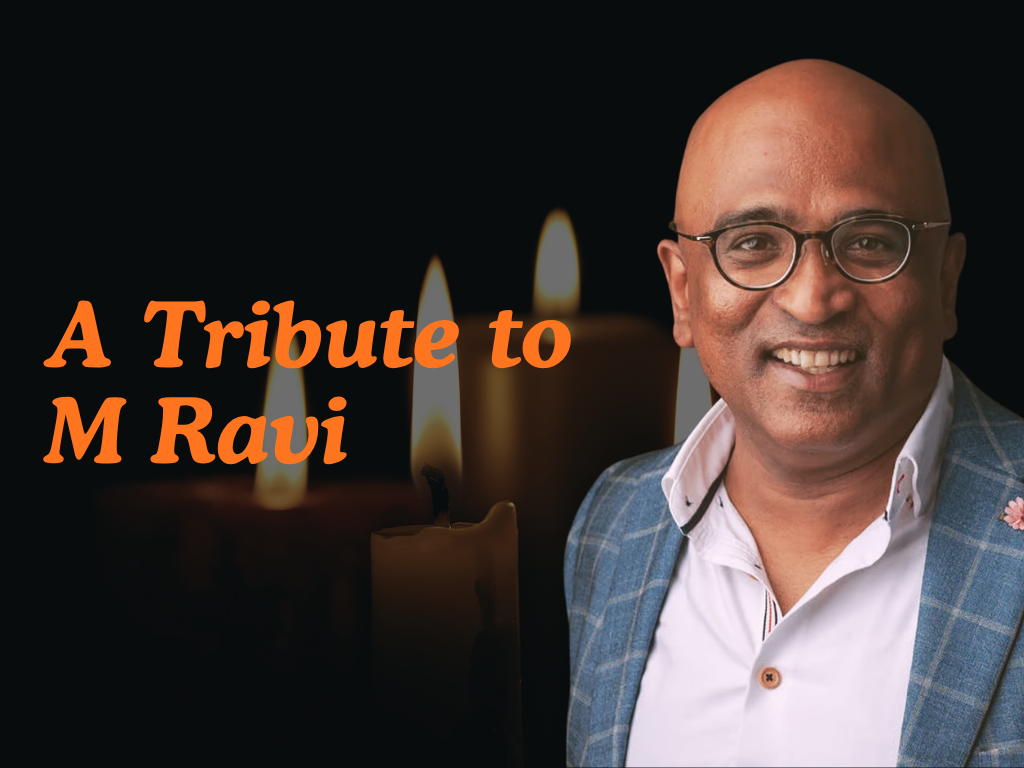
A tribute to M Ravi, founding member of ADPAN

We gather today, across borders, across time zones, across the many causes he devoted his life to — to honour a man who refused to look away.

On behalf of the Anti-Death Penalty Asia Network (ADPAN), we offer these words not only in grief, but in deep and abiding gratitude.

Ravi was a founding member of ADPAN. That founding was not a ceremonial act. It was a declaration of conscience, one he renewed every single day through his work. ADPAN was built on the belief that the death penalty is an affront to human dignity, and Ravi embodied that belief.

He became one of the most prominent legal figures associated with human rights advocacy and constitutional challenges in Singapore. He was particularly known for representing people on death row and his work placed him at the centre of public debate on capital punishment, prosecutorial discretion, and access to justice. 

To us at ADPAN, Ravi was far more than a lawyer. He was the living proof that one person, operating within a system that was often hostile to him, could still shift the moral conversation of an entire nation. Many described him as “perhaps Singapore’s most vocal anti-death penalty advocate.”  We simply called him our friend and our champion.

He was not an easy man but he did not flinch when the truth demanded to be spoken. Like many who knew him, those around him saw more than one Ravi: the fiercely principled advocate; the relentless campaigner; the man who could be generous, warm, and protective; and the man who could also be difficult, combustible, and self-destructive.  But this complexity was inseparable from his courage. The same intensity that sometimes made him difficult rendered him, in a courtroom fighting for a man’s life, utterly formidable.

He was a human rights lawyer because he could not accept certain outcomes as “normal”, especially when a life was on the line, and when the most marginalised were expected to disappear quietly into the machinery of the system. 

That refusal to accept, that refusal to normalise, is indeed the heartbeat of ADPAN’s work. And Ravi gave it a face and a voice.

His advocacy and challenge to the mandatory death sentence was featured in a documentary film. He received recognition from Richard Branson, Amnesty International, the International Bar Association, the World Coalition Against the Death Penalty and Human Rights Watch. In 2023, the International Bar Association recognised him for his “extraordinary dedication to defending human rights and advocating for the decriminalisation of homosexuality and the abolition of the death penalty in the Republic of Singapore.” 

But accolades were never what drove him. What drove him was the knowledge that behind every case file was a human being — frightened, forgotten, often poor, often from communities that the powerful would rather not see. He saw them and stood beside them. He extended empathy and humanity to the families of those on death row, offering solace to people worn down by institutional judgement and shame. 

His work extended beyond capital punishment. Ravi was among the lawyers who took on cases involving LGBT persons and equality-related issues at a time when doing so came with professional and social costs. Many of those efforts were not widely understood or appreciated, but they mattered to the people who needed counsel willing to stand beside them. 

He paid enormous personal costs for his convictions. He faced suspension, disciplinary proceedings, and ultimately disbarment. Despite these challenges, he continued contributing to the legal community and abolitionist movement through speeches, seminars, and consultations. Even stripped of his robes, he remained a lawyer at heart, because lawyering, for Ravi, was never just a profession. It was a calling.

Human Rights Watch described Ravi’s work as having made “Singapore a better, more humane place.” We believe this is true. And we believe his legacy will continue to make it so, through every activist he inspired, every family he gave hope to, and every life that was spared in part because of his relentless advocacy.

Ravi, you gave us your fire. We will carry it forward.

On behalf of ADPAN — our networks across Asia, our member organisations, and every individual who believes that no state should have the power to take a human life, we say: thank you. Thank you for never backing down. Thank you for showing us what it looks like to fight for the voiceless, at great personal cost, without flinching.

Rest now, dear friend. The work continues, because you showed us how.

The Anti-Death Penalty Asia Network (ADPAN)
This tribute was written by our Deputy Co-Convener, Ngeow Chow Ying, on behalf of ADPAN.
ADPAN Forum Brings Together Cross-Border Defenders for Persons on Death Row in the Asia Pacific

ADPAN Forum Brings Together Cross-Border Defenders for Persons on Death Row in the Asia Pacific

ADPAN Forum Brings Together Cross-Border Defenders for Persons on Death Row in the Asia Pacific

The Anti-Death Penalty Asia Network (ADPAN) hosted a timely forum titled ‘Cross-Border Defense for Persons on Death Row in the Asia Pacific’, held in the wake of renewed executions in Singapore and other countries in Asia. Moderated by ADPAN’s Chow Ying Ngeow, the discussion featured distinguished speakers: Justice Lex Lasry AM KC (Australia), Attorney Edre U. Olalia (Philippines), Edward Fitzgerald CBE KC (United Kingdom), and Zaid Malek (Malaysia). Drawing on decades of collective experience in capital defense, the panel reflected on landmark cases such as those of Van Tuong Nguyen, Flor Contemplacion, Mary Jane Veloso, and Malaysians executed in Singapore. The speakers underscored the urgent need for regional cooperation, access to competent legal representation, and cross-border solidarity in defending the rights of those facing the death penalty.

Clemency Petition for Nagaenthran

Clemency Petition for Nagaenthran

Last update: 9 March 2022

Nagaenthran a/l Dharmalingam is a Malaysian on death row in Singapore. He was convicted of trafficking 42.72g of Diamorphine into Singapore.

He was later found to be intellectually disabled with an IQ of 69 and ADHD.

Despite his condition, his appeal against the death penalty has failed and was scheduled for execution in November 2021 before a postponement due to Covid-19.

Current Situation

Legal challenges for Nagaenthran is likely at an end with the hearing on 1 March 2022. He is now awaiting the court’s decision on his appeal.

One of the main argument raised by his lawyers was that Naganenthran has experienced substantial deterioration of his mental capacity during detention and is unfit for execution.

Preliminary response from the court regarding the appeal has not been favourable.

If his appeal is dismissed, he will be back on the death row awaiting execution.

“The prosecutor responded that such inmates should seek clemency from the President instead of going down the legal route. He noted that the law provides for jail time to be imposed in lieu of caning for those found unfit for caning, but there is no such statute for death penalty cases.”

– Excerpt of 1 March 2022 hearing as reported by Today.

What can we do?

Sign the petition at change.org ! Every petition signed sends a message to the Government of Singapore and to the world that we are against this execution and intend to appeal for clemency for Nagaenthran!

You can also send a clemency appeal to the President of Singapore! A sample letter can be downloaded here.


ADPAN Documents on Nagaenthran's Case

Memorandum on Nagaenthran submitted to the Malaysian and Singaporean Government:

English

Background on Nagaenthran case on social media:

Instagram | Twitter | Media Statement


What others are saying about Nagaenthran's case

“When Singapore ratified the Convention on the Rights of Persons with Disabilities (CRPD) in 2013, it committed to protect the rights of the more than quarter-million people with disabilities in the city-state. However, the case of Nagaenthran Dharmalingam, sentenced to death for a nonviolent drug offense, has highlighted Singapore’s failure to make those rights a legal reality. “

Human Rights Watch, 2 March 2022 (Link)

“Over the years, medical experts who assessed Nagaenthran have found that he has borderline functioning intelligence and concurrent cognitive deficits. The UN body on the Convention of Rights of Persons with Disabilities (CRPD), to which Singapore is a party, has stated that the imposition of the death penalty on people whose mental and intellectual disabilities may have impeded their effective defence is prohibited.”

Amnesty International, 4 November 2021 (Link)

“Harm Reduction International (HRI), the International Network of People who Use Drugs (INPUD) and the International Drug Policy Consortium (IDPC), alongside 27 organisations and networks, urge the Singaporean Government to immediately halt the impending execution of Nagaenthran K Dharmalingam; and call on UN entities, the European Union, and all relevant stakeholders to take urgent action.”

Joint Statement by Harm Reduction International, the International Network of People who Use Drugs (INPUD) and the International Drug Policy Consortium (IDPC)(Link)

ADPAN co-partners for submission re Indonesia and the elimination of discrimination against women

ADPAN co-partners for submission re Indonesia and the elimination of discrimination against women

On 15 June 2020, ADPAN co-partnered with a number of organisation to make a submission to the 78th Session of the Committee on the Elimination of Discrimination Against Women with a focus on issues relating to the death penalty. Click here to read the submission entitled ‘Indonesia’s Compliance with the Convention on the Elimination of All Forms of Discrimination Against Women’

NEWS REPORT: Vietnam Assembly Committee Seeks Review of Appeal in Death Row Case

NEWS REPORT: Vietnam Assembly Committee Seeks Review of Appeal in Death Row Case

16 June 2020 

Source:  https://www.rfa.org/english/news/vietnam/assembly-review-06162020224511.html

The judicial committee of Vietnam’s National Assembly on Tuesday agreed to seek a review of a court rejection last month the appeal of a death row prisoner,in a rare case of public disagreement between branches of the one-party communist state.

The majority of the panel’s 40 members agreed to review the decision last month to reject an appeal of the verdict in the case of Ho Duy Hai, who was convicted in 2008 of the murder of two female postal employees in Long An province and given the death penalty, according to state media reports.

On May 8, a 17-member jury rejected the Supreme People’s Procuracy’s petition to throw out the verdict in Hai’s trials and reinvestigate his case, saying he had admitted guilt for his crimes and the basic facts supported the decisions by the courts of first instance and later appeals.

On Monday, Supreme Court Chief Judge Nguyen Hoa Binh reaffirmed the death penalty, telling the assembly that Ho had given 25 statements to the court admitting his guilt.

The majority of the National Assembly Judicial Committee, however, disagreed, according to the online state media outlet Tuoi Tre

They said their evaluation of the investigation and rulings in Hai’s case pointed to serious issues with the potential to change the nature of the case, and that they will petition the assembly standing committee for a review of the May 8 cassation trial’s conclusion.

Hai’s case has stirred public interest in one-party Vietnam, where the assembly typically rubber stamps ruling party decisions.

In a video that went viral on social media after the May 8 ruling against Hai, Hai’s mother Nguyen Thi Loan collapsed, while family members outside the building decried what they said was a lack of justice in Vietnam’s courts.

The National Assembly is the last recourse for Ho in the decades-long case that has seen appeals and a 2014 stay of execution ordered by the then president.

Observers have pointed to several procedural errors in Ho’s case, including that it was largely based on a confession that he later recanted, saying he had been forced to do so by police during his detention.

Additionally, prosecutors lacked crucial evidence, as no time of death for the two victims was ever established, fingerprints at the crime scene did not match Hai’s, and the murder weapons were misplaced by the forensic team.

London-based rights group Amnesty International has cited Hai’s mother as saying that he was tortured in prison, citing his deteriorating health and loss of weight.

In February 2015, the National Assembly’s Committee on Judicial Affairs declared after a reinvestigation into the case that during both the initial trial and the appeal, there had been “serious violations of criminal procedural law.”

The committee urged that the case be reviewed on appeal, but in Dec. 2017, Long An province’s procuracy pushed for execution.

In November last year, Amnesty International sent a petition with 25,000 signatures to President Trong calling for Hai’s acquittal.

Between August 2013 and June 2016, Vietnam executed 429 people, while 1,134 people were given death sentences between July 2011 and June 2016, according to government figures released in 2018.

Reported by RFA’s Vietnamese Service. Translated by Huy Le. Written in English by Paul Eckert.

Taiwan execution casts pall over coronavirus diplomacy with Europe

Taiwan execution casts pall over coronavirus diplomacy with Europe

TAIPEI (Reuters) – Taiwan’s outreach to the European Union has been overshadowed by the bloc’s displeasure at the island’s use of the death penalty, just days after a rare high-profile mention that thanked it for the donation of 6 million masks to battle the coronavirus.

Taiwan is proud of its success in reining in the virus, despite being locked out of bodies such as the World Health Organization under pressure from China, which claims the island as its own, saying it has no right to its own diplomatic ties.

“We really appreciate this gesture of solidarity,” European Commission President Ursula von der Leyen responded on Twitter after President Tsai Ing-wen announced the donation on Wednesday, as part of a “Taiwan can help” campaign.

“The European Union thanks Taiwan for its donation of 5.6 million masks to help fight the coronavirus,” she added.

But within a few hours of Tsai’s announcement, Taiwan’s justice ministry announced the execution of Weng Jen-hsien, convicted of killing six people in a brutal arson attack.

Rights groups in Taiwan, which was under martial law until 1987, criticised the second execution of Tsai’s administration.

“Taiwan can help. Taiwan can also kill,” said the Taiwan Alliance to End the Death Penalty.

The timing was cynical, said E-Ling Chiu, the Taiwan director of rights group Amnesty International.

“The fact that the authorities carried out this execution on the same day they received global praise for donating 10 million masks to help fight COVID-19 in Europe and the USA exposes a cynical attempt to bury bad news,” she said.

More embarrassingly for Taiwan, the European Union called the death penalty “a cruel and inhumane punishment”, and urged it to stop the practice, while also condemning Weng’s crimes.

“The European Union therefore calls on Taiwan to refrain from any future executions, to reinstate and maintain a de facto moratorium, and to pursue a consistent policy towards the abolition of the death penalty,” it said in a statement published in Taiwan on Saturday.

Two diplomatic sources told Reuters that Taiwan’s Foreign Ministry had been caught off guard by the execution news so soon after the mask announcement, and was not pleased at the timing.

The Foreign Ministry referred questions to the Justice Ministry, adding that it was facilitating communication between that ministry and Europe.

The Justice Ministry declined to add to Wednesday’s statement, in which it said the execution had been perfectly legal though acknowledging there might be “different voices” about the death penalty.

Despite Taiwan’s reputation as Asia’s most liberal democracy, the death penalty remains broadly popular, as it does in neighbouring China, where Amnesty estimates thousands are put to death every year, with the figure deemed a state secret.

Angry comments denouncing the criticism flooded the Facebook pages of Amnesty’s Taiwan branch, the Taiwan Alliance to End the Death Penalty and the EU’s office in Taiwan.

Still, executions during Tsai’s tenure are outnumbered by the figure of more than a dozen under her predecessor, and the government says it will continue to consult widely on whether to scrap the system.Taiwan has recorded 373 virus infections and five deaths.

Reporting by Ben Blanchard; Editing by Clarence FernandezOur Standards:The Thomson Reuters Trust Principles.– Reuters, 6/4/2020

29 years on death row, Pakistan woman suffers mental illness

29 years on death row, Pakistan woman suffers mental illness

KATHY GANNON Associated Press 10 April 2020

FILE – In this July 8, 2006 file photo, women prisoners celebrate the news of their release on bail, at Adiala Jail in Rawalpindi, Pakistan. Kanizan Bibi, charged with murdering her employer’s wife and five children, remains a prisoner on death row for the last 29 years. She’s one of more than 600 mentally ill prisoners in Pakistan’s overcrowded prisons. (AP Photo/Anjum Naveed,file)

ISLAMABAD (AP) — Kanizan Bibi was 16 when she was charged with murdering her employer’s wife and five children. The police said she was having an affair with her employer, who was also arrested and later hanged.

Until his execution in 2003, Khan Mohammad swore he and Bibi had never had an affair and had not killed anyone. He maintained his wife and children were killed as payback in a long-running land dispute with his relatives.

Yet Bibi, who was diagnosed with schizophrenia in 2000, remains on death row, where she has been for 29 years.

The Cornell Center on the Death Penalty Worldwide is spearheading efforts along with the independent Justice Project Pakistan to get Bibi released. But the coronavirus pandemic that has shut down most of Pakistan seems to have also shut down Bibi’s chance at freedom.

She’s one of more than 600 mentally ill prisoners in Pakistan’s overcrowded prisons. A March 30 hearing to present yet another psychiatric evaluation was postponed when courts closed.

Most days Bibi can barely dress herself. She hasn’t spoken in more than a decade and her father, before he died in 2016 pleaded in a letter to Pakistan’s president to free his only child.

“My daughter was accused of murder, which was a lie,” he wrote telling of how she was tortured in police custody.

“They hung her from a fan with ropes thicker than her tiny wrists, beating her small frame with all their might. They let mice loose in her pants, which they tied from the ankles so that they could not escape. Kanizan had been terrified of mice her whole life,” he wrote. “I am a poor man and I beg that the death sentence of my daughter be converted into life in prison.”

He never received a reply.

Justice Project Pakistan this week warned of a steep rise in COVID-19 cases in Pakistan’s crowded jails. The Supreme Court of Pakistan this week agreed to release some mentally ill and disabled prisoners to ease conditions, but only those whose sentences are less than three years.

That meant Bibi had to remain in prison.

A land dispute between relatives was at the center of her case. Her employer’s cousins had been feuding with him over land and had originally been arrested for the murders. They pointed to Bibi and accused her of adultery, a crime of shame in conservative Pakistan, saying that’s why she killed her employer’s wife and children. In villages adultery can bring summary executions by family members.

Bibi was accused of involvement in the killings and charged with murder. Unsubstantiated adultery claims and a confession elicited after days of torture were enough for the judge to sentence her to death.

Delphine Lourtau, who heads the Cornell Center on Death Penalty Worldwide said the group’s research showed that women often aren’t just punished for crimes they are being charged with “but also for transgressing gender norms.”

Lourtau said three decades on death row have taken a severe toll on Bibi.

“She has lost touch with reality and is oblivious to her surroundings. There are days when she is unable to eat or dress herself. She trembles, hears voices, and is rarely able to recognize family members,” the Cornell Center said.

___

This story has been corrected to show that the employer’s name was Khan Mohammad, not Sher Mohammad. – Yahoo News, 10/4/2020