SINGAPORE: SPREE OF UNLAWFUL EXECUTIONS CONDEMNED AS CLOSE TO HALF OF PEOPLE ON DEATH ROW SENT TO GALLOWS IN 2026

Amnesty International, the Anti-Death Penalty Asia Network (ADPAN), Capital Punishment Justice Project and Harm Reduction International are alarmed by the unrelenting execution spree by the Singapore authorities, following their announcement of the 15th hanging of 2026 on 23 July. Our organizations are dismayed at the continued violations of safeguards and restrictions on the use of the death penalty set out under international human right law and standards, which render these executions unlawful; and urge the government of Singapore to immediately establish a moratorium on all executions as a first step towards abolition of this cruel punishment.

On 23 July 2026, the Central Narcotics Bureau of Singapore announced the execution of a 35-year-old Singaporean man convicted of a drug-related offence. His was the third execution carried out in July alone; and the 15th since the beginning of 2026. The sustained pace of executions follows an alarming rise in executions in 2025, when the yearly total (17) almost doubled the 2024 total (9). This also means that approximately two thirds of those believed to be under sentence of death at the end of 2024 (at least 40) were executed in 19 months – and close to half of those believed to have remained on death row at the end of 2025, hanged in the first half of this year alone.

All executions carried out in 2026 to date were for drug-related offences. We reiterate that the use of the death penalty for drug-related offences violates international human rights law and standards, which restrict its use to the “most serious crimes”, most recently interpreted as referring to “crimes of extreme gravity involving intentional killing”.  Several UN bodies, including the International Narcotics Control Board, have repeatedly stated that drug-related offences do not meet this threshold, and recommended abolition for these offences.

All men were sentenced to the mandatory death penalty, which removes judges’ power to consider the particular circumstances of the offence and the background of the convicted person.

While very limited information is available for most of these cases, for those whose identity is known to our organizations it has been possible to trace additional violations of international human rights law and standards, including the reliance on the legal presumption of trafficking under the Misuse of Drugs Act, based on the amount of drugs a person is found with. When these legal presumptions are invoked, the burden of proof is shifted onto the defendant to rebut the presumption to the reversed –and therefore higher – legal standard of “on balance of probabilities”. Legal presumptions of guilt violate the right to be presumed innocent – a peremptory norm of customary international law – and other fair trial guarantees under international human rights law that mandate that the burden of proving all charges rests on the prosecution. In addition, presumptions of guilt have also had the effect of lowering the threshold of evidence needed to secure a conviction in capital cases.

In at least one case, the judge had found the man to have been involved only in transporting drugs, meeting the “courier” requirement under the Misuse of Drugs Act. However, the prosecution did not provide him with a certificate confirming that he substantively assisted investigations to disrupt further drug trafficking activities – a second condition to qualify for sentencing discretion in these cases – leaving no option to the judge but to impose the mandatory death penalty. This certificate requirement effectively shifts the sentencing decision to the prosecution in violation of the right to a fair trial.

The requirement effectively places the decision between a life-or-death sentence in the hands of an official who is not a neutral party in the trial and should not have such powers, breaking down the separation that must exist between prosecution and court and violating the principle of “equality of arms”.

We oppose the death penalty unconditionally and renew our call on the Government of Singapore to immediately establish a moratorium on all executions; commute all death sentences; and review national legislation to bring it in line with international human rights law and standards, pending full abolition of the death penalty.

The international community must not remain silent and take action to hold the Singapore government accountable for the repeated violations of the right to life and other breaches of international safeguards and restrictions carried out in capital cases, including in the name of flawed drug control and security narratives.


This statement is co-signed by:

  • Amnesty International
  • Anti-Death Penalty Asia Network (ADPAN)
  • Capital Punishment Justice Project
  • Harm Reduction International

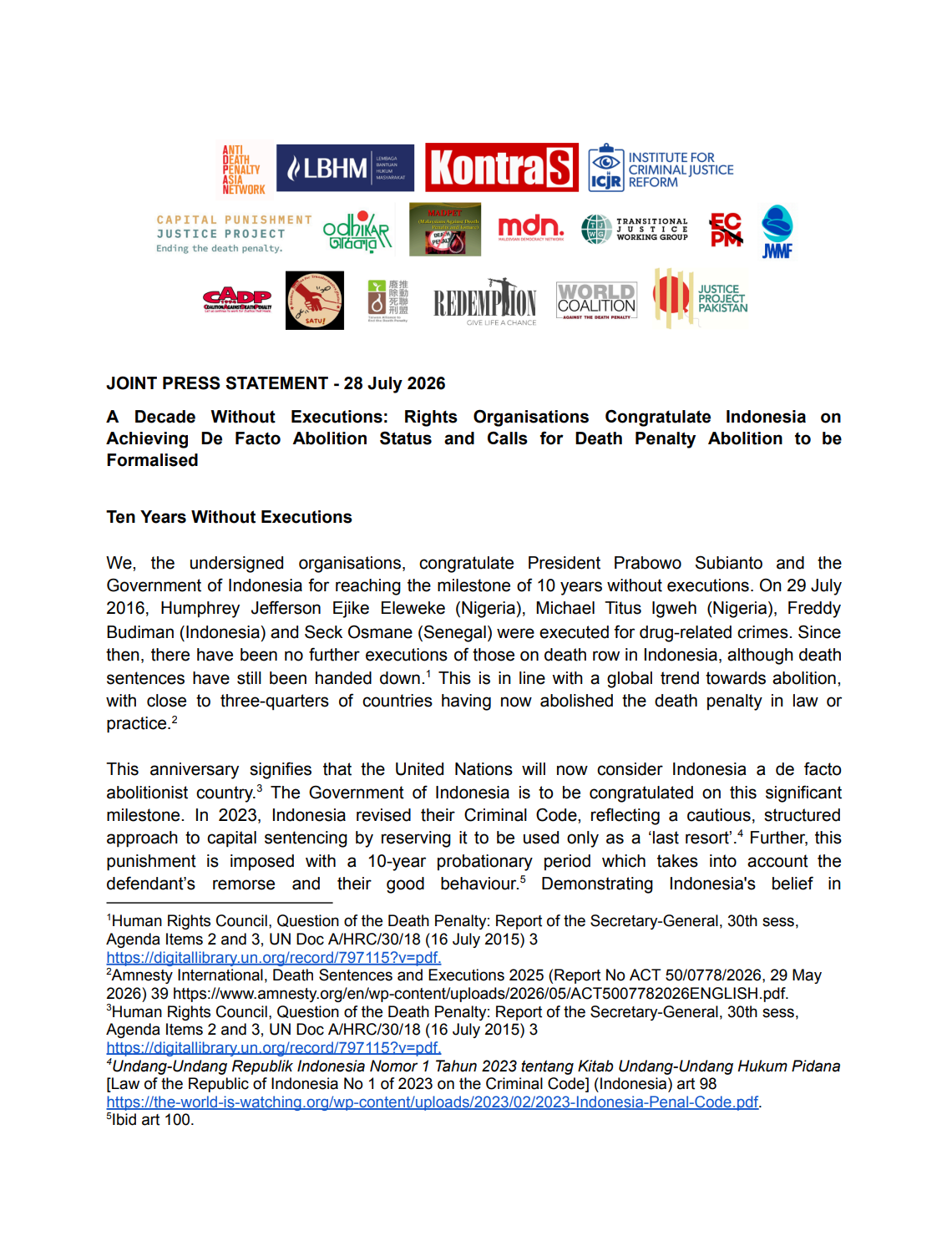
A Decade Without Executions: Rights Organisations Congratulate Indonesia on Achieving De Facto Abolition Status and Calls for Death Penalty Abolition to be Formalised

Ten Years Without Executions

We, the undersigned organisations, congratulate President Prabowo Subianto and the Government of Indonesia for reaching the milestone of 10 years without executions. On 29 July 2016, Humphrey Jefferson Ejike Eleweke (Nigeria), Michael Titus Igweh (Nigeria), Freddy Budiman (Indonesia) and Seck Osmane (Senegal) were executed for drug-related crimes. Since then, there have been no further executions of those on death row in Indonesia, although death sentences have still been handed down. This is in line with a global trend towards abolition, with close to three-quarters of countries having now abolished the death penalty in law or practice.

This anniversary signifies that the United Nations will now consider Indonesia a de facto abolitionist country. The Government of Indonesia is to be congratulated on this significant milestone. In 2023, Indonesia revised their Criminal Code, reflecting a cautious, structured approach to capital sentencing by reserving it to be used only as a ‘last resort’. Further, this punishment is imposed with a 10-year probationary period which takes into account the defendant’s remorse and their good behaviour. Demonstrating Indonesia’s belief in rehabilitation, the government repatriated 11 foreign nationals to their home countries, six of whom were on death row at the time of their release.

Globally, 54 countries remain retentionist. Of this number, 14 are in the Asia-Pacific. The region accounts for the highest number of executions by far. Indonesia’s sustained moratorium on executions and recent reforms have strengthened its position in regional efforts toward death-penalty reform. 

Significant Concerns Remain

Indonesia’s achievement must nevertheless be viewed alongside the continued imposition of capital punishment by its courts and other related issues. According to Amnesty International, in 2025, there were 68 new death sentences, including 56 for drug offences and 12 for murder. As of October 2025, the Ministry of Law and Human Rights in Indonesia reported around 500 persons on death row.

Article 6(2) of the International Covenant on Civil and Political Rights (ICCPR) and Safeguard No.1 of the UN Safeguards guaranteeing protection of the rights of those facing the death penalty, adopted through the UN Economic and Social Council resolution 1984/50, stipulate that the use of the death penalty is to be restricted to only “the most serious crimes”. The UN Human Rights Committee emphasises that “the most serious crimes” are to be read restrictively and apply only to exceptionally grave offences that involve “intentional killing”. Accordingly, crimes such as drug offences, while serious in nature, “can never serve the basis, within the framework of article 6” for a sentence of death to be imposed. The UN Special Rapporteur on extrajudicial, summary or arbitrary executions echoes this sentiment, stating that “the death penalty may not be imposed for drug-related offences”. Thus, the death penalty for drug offences undoubtedly breaches international law.

Moreover, the Indonesian government and parliament are now discussing the Bill on the Procedure for the Implementation of the Death Penalty, proposed as a replacement of the 1964 Execution Law. The bill establishes a framework where executions may be carried out if commutation fails and there are no more legal avenues available to persons on death row. The latest draft of the bill still contains problematic articles, especially the lack of monitoring and redress mechanisms during the process of execution.

Human Rights Defenders Must Be Protected

Finally, the Indonesian government must take further steps to protect human rights defenders and ensure they can operate without fear for their safety. On 12 March 2026, Andrie Yunus, an activist with the rights group KontraS, was subject to an acid attack in Jakarta after recording a podcast which detailed the militarisation of civil and political affairs in Indonesia. This targeted attack, which caused “severe and permanent injuries requiring long-term treatment”, occurred despite “the UN Declaration on Human Rights Defenders affirmation that everyone has the right, individually and in association with others, to promote and strive for the protection and realization of human rights and fundamental freedoms”. 

There are also still many legal barriers that might impact the work of human rights defenders in Indonesia. The Criminal Code contains articles that might limit the work of human right defenders in calling out government, such as public defamation articles to governmental institutions or to the President/Vice-President. There have been indications that the government is preparing a new law to combat disinformation and foreign propaganda. Depending on how terms like ‘disinformation’ and ‘foreign propaganda’ are defined, such an effort might exacerbate the suppression of free speech.

We call on Indonesia to ensure that they are abiding by their international obligations stipulated in the ICCPR, especially to “ensure effective protection for individuals exercising their rights to freedom of expression, association, and peaceful advocacy”. Failing to do so undermines the progress Indonesia has made in human rights. We encourage all countries to prevent such attacks from occurring in order to safeguard democratic institutions and ensure justice and accountability.

Our Call to Indonesia

We congratulate the Government of Indonesia on reaching 10 years without an execution. This milestone should become the foundation for decisive and irreversible progress towards full abolition. To be genuinely abolitionist, Indonesia must move beyond a de facto status and remove the death penalty from its laws and practice.

We call on Indonesia to:

  1. Formally abolish the death penalty in law and remove it as a sentencing option for all offences, especially those not amounting to the ‘most serious crimes’ under international law, interpreted as crimes of extreme gravity involving intentional killing.
  2. Formalise the moratorium pending abolition by adopting an official and legally binding moratorium on all executions and on the imposition of new death sentences.
  3. Ratify the Second Optional Protocol to the ICCPR, aiming at the abolition of the death penalty, to ensure its permanent abolition. 
  4. Review and commute existing death sentences, with particular priority given to individuals who have spent more than 10 years on death row.
  5. Ensure protection and an enabling environment for human rights defenders to continue their work.
  6. Support the global movement towards abolition by voting in favour of future United Nations General Assembly resolutions calling for a universal moratorium on executions and Human Rights Council Resolutions concerning the question of the death penalty.

This statement is co-signed by:

  1. Anti-Death Penalty Asia Network (ADPAN)
  2. Lembaga Bantuan Hukum Masyarakat (LBHM)
  3. The Commission for Disappeared and Victims of Violence (KontraS)
  4. Institute for Criminal Justice Reform (ICJR)
  5. Capital Punishment Justice Project (CPJP)
  6. Odhikar (Bangladesh)
  7. Malaysians Against Death Penalty and Torture (MADPET)
  8. Maldivian Democracy Network (MDN)
  9. Transitional Justice Working Group (TJWG)
  10. Together Against the Death Penalty (ECPM)
  11. Julian Wagner Memorial Fund (JWMF)
  12. Coalition Against the Death Penalty (CADP)
  13. Student Actions for Transformative jUstice (SATU)
  14. Taiwan Alliance to End the Death Penalty (TAEDP)
  15. Redemption Pakistan
  16. World Coalition Against the Death Penalty (WCADP)
  17. Justice Project Pakistan (JPP)

ADPAN Condemns Acid Attack against Indonesian Human Rights Defender Andrie Yunus

ADPAN Condemns Acid Attack against Indonesian Human Rights Defender Andrie Yunus

PRESS STATEMENT

15 March 2026,  Statements

The Anti-Death Penalty Asia Network (ADPAN) condemns in the strongest sense possible the acid attack against human rights defender Andrie Yunus, the Deputy Coordinator for External Affairs of KontraS (Komisi untuk Orang Hilang dan Korban Tindak Kekerasan), that took place on 12 March 2026 in Central Jakarta, Indonesia. KontraS is a member of ADPAN and one of Indonesia’s leading human rights organisations. ADPAN stands in solidarity with Andrie, KontraS, our members in Indonesia, and Indonesian civil society. We extend our deepest support to Andrie and his family during this incredibly difficult time.

According to information received by ADPAN, Andrie was the victim of a targeted acid attack shortly after taping a podcast episode discussing the rise of militarism in Indonesia. Medical reports indicate the severity of the assault, with burns covering approximately 24% of his body. This act of violence has left him in critical condition, requiring extensive medical intervention and long-term recovery. KontraS has also reported that surveillance was observed at their office in Jakarta prior to the incident.

International law recognizes the vital role played by human rights defenders in promoting and protecting fundamental freedoms. The UN Declaration on Human Rights Defenders affirms that everyone has the right, individually and in association with others, to promote and strive for the protection and realization of human rights and fundamental freedoms. The Declaration further requires states to take all necessary measures to ensure the protection of individuals against violence, threats, retaliation, discrimination, pressure, or any other arbitrary action arising from their legitimate human rights work.

We call on Indonesia to abide by its international legal obligations under the International Covenant on Civil and Political Rights. These obligations include the duty to ensure effective protection for individuals exercising their rights to freedom of expression, association, and peaceful advocacy. Indonesia must conduct a prompt, impartial, and effective investigation, hold the perpetrators accountable for the attack, and take appropriate measures to prevent similar acts of violence from recurring. 

We also calls on Indonesian authorities to:

  • Ensure that Andrie Yunus receives appropriate medical treatment and all necessary support for his recovery;
  • Investigate the case thoroughly and bring the perpetrators to justice;
  • Take effective measures to protect human rights defenders and guarantee a safe environment for civil society in Indonesia to operate without fear of violence or intimidation; and
  • Demonstrate a clear commitment to transparency, accountability, and the protection of fundamental freedoms.

ADPAN urges the international community to closely monitor the developments and to support efforts to ensure accountability and protection for human rights defenders. Attacks against those who peacefully advocate for human rights must never be tolerated. The protection of human rights defenders is essential to safeguarding democratic institutions and ensuring that justice and accountability remain possible.

Contact:

Anti-Death Penalty Asia Network (ADPAN)

communications@adpan.org 

ADPAN co-partners for submission re Indonesia and the elimination of discrimination against women

ADPAN co-partners for submission re Indonesia and the elimination of discrimination against women

On 15 June 2020, ADPAN co-partnered with a number of organisation to make a submission to the 78th Session of the Committee on the Elimination of Discrimination Against Women with a focus on issues relating to the death penalty. Click here to read the submission entitled ‘Indonesia’s Compliance with the Convention on the Elimination of All Forms of Discrimination Against Women’