STATEMENTS

Singapore: Drop Charges against Civil Society Activists and Protect Peaceful Assembly
28 September 2026, Statements
We, the undersigned, stand in solidarity with the Transformative Justice Collective (TJC) and other civil society advocates in Singapore. We express grave concern about reports of criminal proceedings in connection with anti-death penalty and pro-Palestine advocacy. We urge the Singaporean authorities to withdraw the charges relating to peaceful advocacy and uphold freedom of expression and peaceful assembly.
From Death Row to Freedom: Celebrating the Absolute Pardon of Mary Jane Veloso, a Human Trafficking Survivor Formerly on Death Row
25 September 2026, Statements
We commend Philippine President Ferdinand R. Marcos, Jr.’s decision to grant absolute pardon to Mary Jane Veloso, just days before the World Day Against the Death Penalty. ADPAN congratulates her lawyers and legal team, fellow civil society organisations and advocacy groups, including the National Union of Peoples Lawyers (NUPL), Migrante, Indonesian Migrant Workers Union (JBMI), Beranda Migran, Lembaga Bantuan Hukum Masyarakat (LBHM), other ADPAN members in Indonesia and Malaysia, and countless individuals, organisations, and the public for their perseverance and for standing with us in securing this victory. This is a testament to what sustained cross-border advocacy can achieve to protect human life, support affected families, and uplift local communities.

Justice, Not Executions: Nepal Must Stand Firm on Death Penalty Abolition
15 September 2026, Statements
In light of recent parliamentary debates and renewed calls by some lawmakers to reinstate the death penalty in Nepal, the Anti-Death Penalty Asia Network (ADPAN) strongly opposes any return to capital punishment and urges the government and Parliament to uphold the constitutional prohibition against the death penalty. As a party to the Second Optional Protocol to the International Covenant on Civil and Political Rights (ICCPR), aiming at the permanent abolition of the death penalty, Nepal is bound to uphold abolition. Reinstatement would not merely reverse the protection guaranteed by its Federal Constitution, it would also violate Nepal’s international obligations, which no constitutional amendment should set aside.
Vietnam: Proposed Penal Code Reforms Mark Welcome Step Toward Capital Punishment Rollback, But Looming Executions Underline Need for Full Abolition
10 September 2026, Statements
The Vietnamese Ministry of Public Security has proposed the removal of the death penalty for several crimes under draft revisions to the Criminal Code, expected to be tabled for a final vote by the National Assembly in October. The Anti-Death Penalty Asia Network (ADPAN) strongly welcomes the intention to rollback the use of capital punishment in the country and urges Vietnam to abolish it completely. In light of this encouraging momentum, ADPAN views the ruling in the VN10 case trial in Ho Chi Minh City, where 11 defendants have already been reportedly sentenced to death out of 227 individuals tried in the drug trafficking operation, as a critical opportunity for Vietnam to put these progressive principles into immediate practice, commute these sentences, and pave the way for complete abolition.

Singapore: Spree of Unlawful Executions Condemned as Close to Half of People on Death Row Sent to Gallows in 2026
31 July 2026, Statements
Amnesty International, the Anti-Death Penalty Asia Network (ADPAN), Capital Punishment Justice Project and Harm Reduction International are alarmed by the unrelenting execution spree by the Singapore authorities, following their announcement of the 15th hanging of 2026 on 23 July. Our organizations are dismayed at the continued violations of safeguards and restrictions on the use of the death penalty set out under international human right law and standards, which render these executions unlawful; and urge the government of Singapore to immediately establish a moratorium on all executions as a first step towards abolition of this cruel punishment.

A Decade Without Executions: Rights Organisations Congratulate Indonesia on Achieving De Facto Abolition Status and Calls for Death Penalty Abolition to be Formalised
28 July 2026, Statements
We, the undersigned organisations, congratulate President Prabowo Subianto and the Government of Indonesia for reaching the milestone of 10 years without executions. On 29 July 2016, Humphrey Jefferson Ejike Eleweke (Nigeria), Michael Titus Igweh (Nigeria), Freddy Budiman (Indonesia) and Seck Osmane (Senegal) were executed for drug-related crimes. Since then, there have been no further executions of those on death row in Indonesia, although death sentences have still been handed down. This is in line with a global trend towards abolition, with close to three-quarters of countries having now abolished the death penalty in law or practice.

ADPAN Welcomes Cambodia's Decision to Accede to International Anti-Death Penalty Treaty, Preventing its Return
15 July 2026, Statements
At the 9th World Congress Against the Death Penalty in Paris, Cambodia announced a historic move to permanently lock in its abolitionist status by ratifying the Second Optional Protocol to the International Covenant on Civil and Political Rights (ICCPR). The Anti-Death Penalty Asia Network (ADPAN) strongly welcomes this decision which ensures that capital punishment can never be reintroduced in the country.

2026 WORLD DRUG DAY: OVER 60 ORGANISATIONS URGE UNODC AND CND TO TAKE URGENT ACTIONS TO END UNLAWFUL USE OF THE DEATH PENALTY FOR DRUG-RELATED OFFENSES
25 June 2026, Statements
On the occasion of the 2026 International Day against Drug Abuse and Illicit Trafficking (World Drug Day) and the Support Don’t Punish Global Day of Action on 26 June, 63 national, regional and international organisations call on the UN Office on Drugs and Crime (UNODC), the Commission on Narcotic Drugs (CND) and its Member States to unequivocally condemn the use of the death penalty for drug-related offences and to uphold international human rights obligations, including by adopting concrete measures to restrict the use of the death penalty with a view to its full abolition. We further urge UNODC to ensure that none of its technical assistance, capacity-building, or support to drug law enforcement in retentionist States risk contributing, directly or indirectly, to the investigation, prosecution, conviction or sentencing of individuals to death for drug-related offences.
Two Decades Later: The Philippines Celebrates the 20th Anniversary of Death Penalty Abolition
24 June 2026, Statements
MANILA – Today marks 20 years since the Philippines abolished the death penalty, a historic milestone for the nation as the first Southeast Asian country to legally end capital punishment and ratify the Second Optional Protocol to the International Covenant on Civil and Political Rights, the international treaty abolishing the death penalty in the world. The Anti-Death Penalty Asia Network (ADPAN) commends this enduring achievement and urges the Philippines to maintain its unwavering commitment to the spirit of abolition despite attempts to reintroduce capital punishment.

BANGLADESH: Ensure Justice, Reparation for Victims, and Guarantees of Non-Recurrence of Enforced Disappearances
26 May 2026, Statements
We, the undersigned organizations, urge the Government of Bangladesh to ensure truth, justice, and reparation for victims and their families and guarantees of non-recurrence of enforced disappearances in observance of the International Week of the Disappeared.
Maldives: Withdraw Proposed Death Penalty Bill
17 April 2026, Statements
The Maldives government should withdraw plans to introduce a bill to end the longstanding moratorium on the death penalty in the country, 10 Maldivian and international human rights organizations said today. The authorities should also seek to repeal recent amendments to the Drugs Act of 2011 that allow capital punishment for drug-related offenses, maintain the moratorium on executions, and move to fully abolish the death penalty.
Death Penalty is Not the Answer to Ensuring Road Safety in Malaysia
14 April 2026, Statements
Malaysia was recently shaken with two driving under the influence (DUI) related accidents that took place in Klang and Segamat, resulting in the deaths of four people: a father and three members of a family. The former was caused by a driver who was reportedly under the influence of drugs and alcohol, while the latter by a driver who tested positive for methamphetamine. Both have since been charged with murder under Section 302 of the Penal Code, which carries the death penalty or imprisonment.
ADPAN Condemns Acid Attack against Indonesian Human Rights Defender Andrie Yunus
15 March 2026, Statements
The Anti-Death Penalty Asia Network (ADPAN) condemns in the strongest sense possible the acid attack against human rights defender Andrie Yunus, the Deputy Coordinator for External Affairs of KontraS (Komisi untuk Orang Hilang dan Korban Tindak Kekerasan), that took place on 12 March 2026 in Central Jakarta, Indonesia. KontraS is a member of ADPAN and one of Indonesia’s leading human rights organisations. ADPAN stands in solidarity with Andrie, KontraS, our members in Indonesia, and Indonesian civil society. We extend our deepest support to Andrie and his family during this incredibly difficult time.
Singapore: Malaysian Man Hanged In Unlawful Drug-Related Execution As Rights Of Those On Death Row Violated
18 February 2026, Statements
The undersigned organizations condemn in the strongest terms the execution of Malaysian Lingkesvaran Rajendaren in Singapore on 11 February 2026. In violation of international human rights law and standards, he was sentenced to the mandatory death penalty for a drug related offence; and his execution proceeded after the Supreme Court rejected two appeals, as he sought judicial review of his claims of unfair proceedings at trial and ill-treatment while on death row, among other concerns. We renew our call on the government of Singapore to urgently establish a moratorium on executions as a first step towards full abolition of this cruel punishment.
International Human Rights Groups Oppose the Death Penalty for Former South Korean President Yoon Suk-Yeol Who is on Trial for Insurgency
29 January 2026, Statements
The Anti-Death Penalty Asia Network (ADPAN) and partner civil society organizations oppose the decision of South Korean prosecutors to seek the death penalty for former President Yoon Suk-Yeol during the final hearing of his trial for insurgency on 13 January 2026. ADPAN and partners oppose the death penalty in all circumstances. Pending full abolition, states have a duty to uphold their international commitments.

ADPAN And Partner Human Rights Organizations Denounce The Expansion Of The Death Penalty For Drug Offenses In The Maldives
9 Dec 2025, Statements
The Anti-Death Penalty Asia Network (ADPAN) and partner human rights organizations denounce the decision of the People’s Majlis (Parliament of the Maldives) to expand the scope of the death penalty to drug-trafficking offenses through amendments to the Drugs Act.
ADPAN urges Bangladesh to Reconsider Death Penalty Clause in New Enforced Disappearance Ordinance
18 Nov 2025, Statements
The Anti-Death Penalty Asia Network (ADPAN) expresses serious concern over the recent passage by the Bangladesh Interim Government of an Ordinance that permits the imposition of the death penalty for the crime of enforced disappearance. We agree that the objectives of “The Prevention, Remedy, and Protection against Enforced Disappearance Ordinance” are legitimate to address past violations and prevent them from reoccurring. We also note that it seeks to prohibit the operation of secret detention centers such as the so-called Aynaghar, a long-standing concern for victims and human rights groups.
However, the protection of human rights must never come at the expense of other human rights. The pursuit of justice for one violation cannot justify the creation of another. Legal measures must comply with international human rights obligations. By prescribing capital punishment, the Ordinance violates Bangladesh’s obligations under international law and undermines the very ideals it seeks to advance. The death penalty is an inhumane punishment that violates the right to life.
Singapore: Cruel And Unlawful Drug-Related Execution Of Malaysian Man Renews Urgency For Moratorium On Executions
27 Sept 2025, Statements
Amnesty International and the Anti-Death Penalty Asia Network condemn in the strongest terms the execution in Singapore of Malaysian national Datchinamurthy a/l Kataiah on 25 September 2025 and are alarmed at the continued violations of international human rights law and standards associated with the use of the death penalty in the country.[1] We renew our call on the government of Singapore to urgently establish a moratorium on executions as a first step towards full abolition of this cruel punishment.
cruel anguish as execution temporarily stayed
Datchinamurthy a/l Kataiah was set to be executed at 6am on 25 September 2025, following a shortened notice period that started on 21 September. According to information received by our organizations, just over five hours before it was due to be carried out, the execution was temporarily stayed to allow the President of Singapore, Tharman Shanmugaratnam, to consider his clemency request. The family was later notified that the execution would proceed at approximately 1.40pm, after the appeal was rejected.[2]
The last-minute stay of execution left Datchinamurthy a/l Kataiah and his relatives in excruciating anguish for approximately seven hours.

Malaysia and Singapore at a Crossroads: Stop Executions, Uphold Human Rights - Joint Press Statement
22 Sept 2025, Statements
As five men are now believed to be at imminent risk in Singapore, we, the undersigned civil society organisations, call on the Singaporean authorities to immediately halt all executions. We also urge the Malaysian government to take all possible steps to protect the rights of its nationals facing execution in Singapore and to press for a complete end to the death penalty, at home and internationally.
Among those who are at imminent risk of execution are Datchinamurthy a/l Kataiah, Pannir Selvam Pranthaman, Saminathan a/l Selvaraju, Lingkesvaran Rajendaren and Jumaat bin Mohamed Sayed. All of them were sentenced to death for drug trafficking, and have each spent seven to ten years on death row. While Jumaat is a Singaporean, the other four are Malaysians. The five of them had their most recent appeals dismissed, after many years of struggle for justice against all odds.

Malaysia dan Singapura di persimpangan: Hentikan hukuman mati, tegakkan hak asasi manusia - Kenyataan media bersama
22 Sept 2025, Statements
Memandangkan lima banduan lelaki kini dipercayai berisiko di Singapura, kami, pertubuhan masyarakat sivil yang bertandatangan di bawah, menyeru pihak berkuasa Singapura untuk menghentikan serta-merta semua hukuman mati. Kami juga menggesa kerajaan Malaysia untuk mengambil semua langkah yang mungkin untuk melindungi hak rakyatnya yang berhadapan dengan hukuman mati di Singapura dan mendesak supaya hukuman mati dihentikan sepenuhnya, di Malaysia dan di peringkat antarabangsa.
Antara mereka yang berisiko pelaksanaan hukuman mati ialah Datchinamurthy a/l Kataiah, Pannir Selvam Pranthaman, Saminathan a/l Selvaraju, Lingkesvaran Rajendaren dan Jumaat bin Mohamed Sayed. Kesemua mereka dijatuhi hukuman mati kerana didakwa mengedar dadah, dan masing-masing telah menjalani kehidupan selama tujuh hingga sepuluh tahun sebagai banduan akhir. Sementara Jumaat adalah warga Singapura, empat lagi adalah warga Malaysia. Rayuan terkini kelima-lima mereka telah ditolak, selepas bertahun-tahun mereka berjuang mengatasi segala kemungkinan untuk mendapatkan keadilan.
International Solidarity Protecting the Right to Protest: International Solidarity with Indonesia #StopPoliceBrutality!
31 August 2025, Statements
On 28th and 29th August 2025, tens of thousands of Indonesian workers protested across provinces and sub districts such as Manokwari, Semarang, Solo, Magelang, Medan, Bengkulu, and Tegal with the epicenter of protest in front of the House of Representatives (DPR) in Jakarta. Protesters demanded a minimum wage increase of 8.5 – 10% for 2026, a halt to mass layoffs, the abolition of outsourcing, comprehensive tax reform, the enactment of a new labor law in line with Constitutional Court Decision No. 168/2024, as well as the passage of the Asset Confiscation Bill and revision of the Election Law. These demands reflect workers’ fundamental rights to decent work, social protection, and democratic participation.

Singapore: Call for Death Penalty Moratorium Renewed After First Clemency Since 1998 and Third Execution in Three Weeks
22 August 2025, Statements
In a welcome move, on 14 August 2025 the President of Singapore, Tharman Shanmugaratnam, granted the first clemency in a death penalty case in the country since 1998. However, it is gravely concerning that this positive outcome came closely after the announcement of the third execution being carried out by the Singapore authorities within a period of three weeks – all for drug-related offences. The use of the death penalty for drug-related offences violates international human rights law and standards. The undersigned organizations urge the Government of Singapore to immediately establish a moratorium on all executions, and commute all existing death sentences as the first critical steps towards fully abolishing the death penalty.
first clemency in close to three decades exposes need to repeal requirement for certificates of substantial assistance
On 14 August, the President of Singapore, Tharman Shanmugaratnam, acting on advice from the Cabinet commuted the death sentence of a 33-year-old man from Singapore, reducing it to life imprisonment. This was the first clemency granted in a death penalty case in close to 30 years, a decision that is as welcome as long-overdue.
The Maldives: Reject Introduction of Death Penalty for Drug Trafficking and Abolish This Punishment Once and for All
13 August 2025, Statements
We, the undersigned nine organizations, are alarmed by the statement of Dr. Mohamed Muizzu, President of the Republic of the Maldives, on 30 July 2025 indicating that he had instructed legislative amendments to introduce the death penalty for drug trafficking.
We oppose the death penalty unconditionally, for all cases and under any circumstances. The Maldives is a state party to the International Covenant on Civil and Political Rights and the expansion of the scope of the death penalty for drug trafficking would result in new violations of international law and standards, adding to the ones already documented on the use of this punishment in this country. It would also set the Maldives against regional and global trends, which have been defined by 113 countries being now fully abolitionist; and several retentionist countries specifically ending the use of the death penalty for drug trafficking. There is no conclusive evidence that the death penalty has a unique deterrent effect on crime.
We urge the Government to desist from pursuing these amendments, as well as the Members of the People’s Majlis of the Maldives to reject any attempts to expand the scope of this cruel punishment. We further call on the authorities of the Maldives to take prompt steps to abolish this cruel punishment once and for all and commute all existing death sentences as a matter of urgency…

2025 World Drug Day: UNODC and CND Must Take Urgent Action to End Unlawful Use of the Death Penalty for Drug-Related Offences
25 June 2025, Statements
On the occasion of the 2025 International Day against Drug Abuse and Illicit Trafficking, also known as World Drug Day, on 26 June – which also marks the Support. Don’t Punish Global Day of Action – we, the undersigned 70 organizations, call on the UN Office on Drugs and Crime (UNODC) and the Commission on Narcotic Drugs (CND) to unequivocally condemn the use of the death penalty for drug-related offences and take concrete steps to ensure that international human rights safeguards restricting the imposition of this cruel punishment are fully implemented, with a view to its full abolition. The continued failure to take a stand against the death penalty by these UN bodies mandated to oversee the development and implementation of international drug policies contributes to a lack of transparency and accountability for these human rights violations, and risks being interpreted as tolerance or even complicity at a critical moment when drug-related executions are in an unprecedented rise.
Tonga: Government must not extend the death penalty to drug-related offences
11 June 2025, Statements
We, the undersigned organisations, are gravely concerned about a debate held in Tonga’s Parliament late last month, which suggests the country may be considering extending the death penalty to drug-related offences. News reports and a press release from the Parliament of Tonga reported that the debate was held on 28 May 2024 in the Fale Alea ‘O Tonga Chambers, Tonga’s Legislative Assembly.
While the debate participants rejected this proposal by a strong margin of 38 to 8, the consideration of the use of the death penalty for drug-related offences is both unsettling and cause for great concern. As the last state in the Pacific to retain the death penalty in law, Tonga is classified by Amnesty International as ‘abolitionist in practice’, having not imposed a death sentence or carried out an execution since 1982…
Thailand’s Compliance with the Convention on the Elimination of All Forms of Discrimination Against Women: The Death Penalty
19 May 2025, Statements
The Advocates for Human Rights (The Advocates) is a volunteer-based non-governmental organization committed to the impartial promotion and protection of international human rights standards and the rule of law since its founding in 1983. The Advocates conducts a range of programs to promote human rights in the United States and around the world, including monitoring and fact finding, direct legal representation, education and training, and publication. The Advocates is the primary provider of legal services to low-income asylum seekers in the Upper Midwest region of the United States. The Advocates is committed to ensuring human rights protection for women around the world. The Advocates has published more than 25 reports on violence against women as a human rights issue, provided consultation and commentary of draft laws on domestic violence, and trained lawyers, police, prosecutors, judges, and other law enforcement personnel to effectively implement new and existing laws on domestic violence. In 1991, The Advocates adopted a formal commitment to oppose the death penalty worldwide and organized a death penalty project to provide pro bono assistance on post-conviction appeals, as well as education and advocacy to end capital punishment. The Advocates currently holds a seat on the Steering Committee of the World Coalition against the Death Penalty.
Bangladesh: The Interim Government Must Ensure the Ordinance on Enforced Disappearances Aligns With International Standards Following Robust Public Consultations
15 May 2025, Statements
We – the undersigned human rights organisations – express our serious concerns about Bangladesh’s draft Enforced Disappearance Prevention and Redress Ordinance 2025. While it is critical to enact a law to hold perpetrators accountable for enforced disappearances, the current draft contains provisions that fail to adhere to international standards. The Interim Government took laudable steps in acceding to the United Nations International Convention for the Protection of All Persons from Enforced Disappearance and establishing the Commission of Inquiry on Enforced Disappearances. However, the draft Ordinance’s definition of enforced disappearances is not compatible with the Convention, among other serious flaws. We are alarmed by reports that the draft Ordinance is progressing without adequate public consultations.

ADPAN Statement on Malaysia's Progress in Death Penalty Reform and Indefinite Juvenile Detention
13 March 2025, Statements
The Anti-Death Penalty Asia Network (ADPAN) commends Malaysia’s historic steps towards reducing the use of the death penalty. Shifting from a mandatory sentencing framework to a discretionary one has had a significant impact: recent parliamentary data reveals that, after resentencing hearings took place between November 2023 and October 2024, the number of people on death row dramatically declined from more than 1300 to 140. Allowing the Federal Court of Malaysia to review each sentence and to consider mitigating factors has given second chances to many people previously condemned to death and signals a crucial move away from capital punishment as a default.
Further, this has paved the way for better compliance with international human rights standards and the adoption of a rehabilitative, rather than a punitive, approach to justice. ADPAN commends the work of the dedicated capital defence lawyers, the Malaysian Bar, civil society organisations, and others whose efforts ensured that all those eligible for resentencing were able to be represented before the Court.

Letter to the U.N. Secretary-General in Advance of His Visit to Bangladesh
10 March 2025, Statements
His Excellency António Guterres
Secretary-General of the United Nations
Dear Secretary-General:
As human rights organizations, we write to respectfully urge you to do everything in your power to provide U.N. support to Bangladesh during this critical period in the country’s political transition.
Bangladesh is now undergoing unprecedented changes following widespread protests that led to the ouster of Sheikh Hasina’s Awami League government in August 2024. As concluded by the February 2025 fact-finding report of the U.N. Office of the High Commissioner for Human Rights (OHCHR), Bangladeshi security forces engaged in extrajudicial killings and other abuses to suppress the protests with the approval and direction of top political leaders. These actions were the culmination of fifteen years of gross human rights violations by security forces under Hasina’s government, including extrajudicial killings, enforced disappearances, torture, and arbitrary detention of human rights defenders, members of the political opposition, journalists, and other perceived critics…
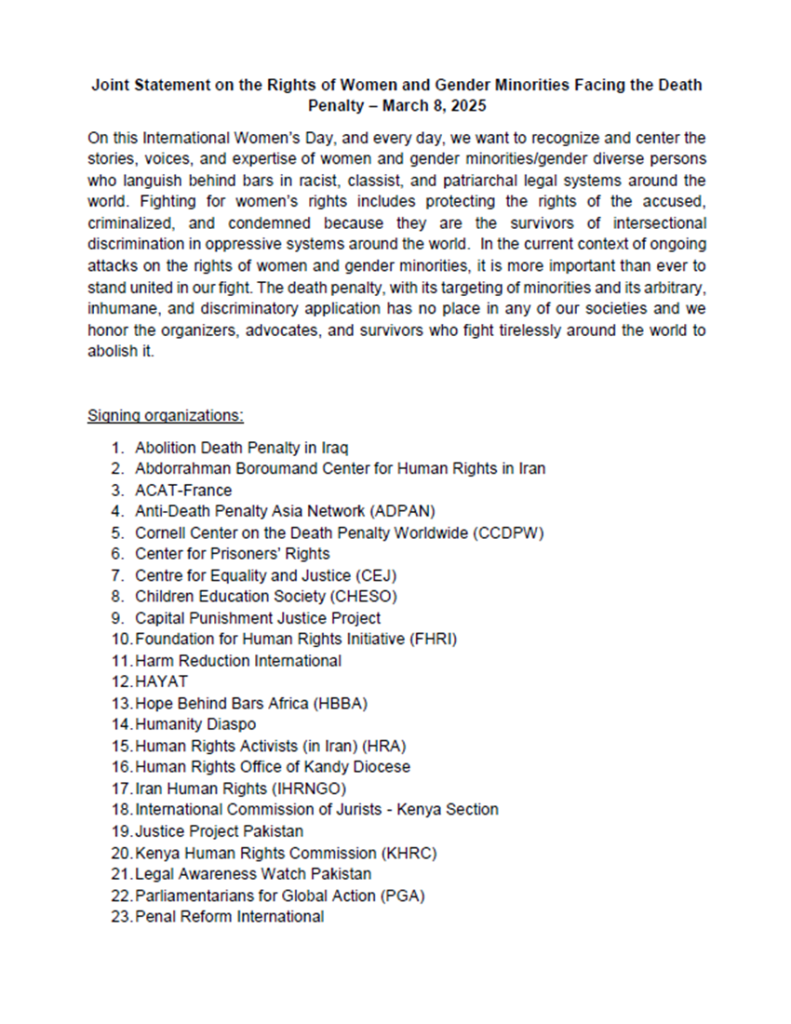
Joint Statement on the Rights of Women and Gender Minorities Facing the Death Penalty
08 March 2025, Statements
On this International Women’s Day, and every day, we want to recognize and center the stories, voices, and expertise of women and gender minorities/gender diverse persons who languish behind bars in racist, classist, and patriarchal legal systems around the world. Fighting for women’s rights includes protecting the rights of the accused, criminalized, and condemned because they are the survivors of intersectional discrimination in oppressive systems around the world. In the current context of ongoing attacks on the rights of women and gender minorities, it is more important than ever to stand united in our fight. The death penalty, with its targeting of minorities and its arbitrary, inhumane, and discriminatory application has no place in any of our societies and we honor the organizers, advocates, and survivors who fight tirelessly around the world to abolish it.
Enforced Disappearances in Bangladesh: Government must hold perpetrators accountable, ensure justice and reparation for victims, survivors, and their families
August 29, 2024, Statements
Bangkok/ Dhaka/ Geneva/ Manila/ Melbourne/ Paris/ Washington, D.C.; (29 August 2024) – In commemoration of the International Day of the Victims of Enforced Disappearances on 30 August, we–the undersigned organisations–express solidarity with the families of the disappeared in Bangladesh and across the world.
Under the deposed Sheikh Hasina administration, Bangladeshi law enforcement agencies and security forces systematically committed enforced disappearances.
Enforced disappearances were used to suppress political opposition, silence dissent, and create a climate of fear in the country. In the past decade, families of those who had been subjected to enforced disappearance were systematically denied legal redress.
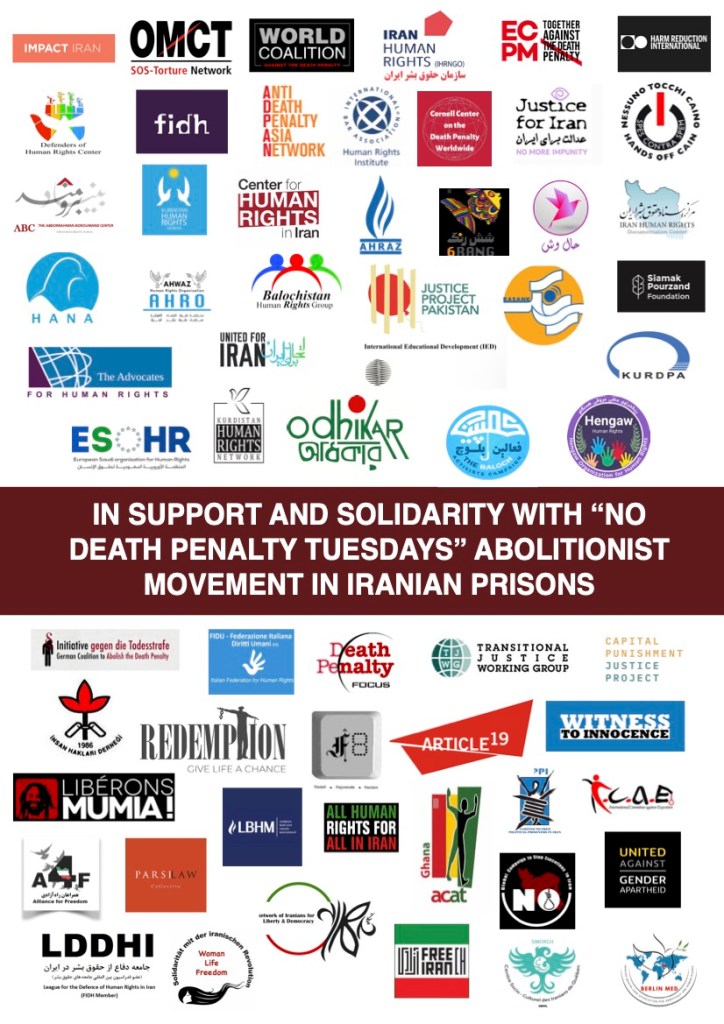
68 Organisations Declare Support for “No Death Penalty Tuesdays” Abolitionist Movement in Iran
August 28, 2024, Statements
Iran Human Rights (IHRNGO); August 28, 2024: Iran Human Rights and 67 human rights organisations from four continents have signed a joint statement in support and solidarity with the “No Death Penalty Tuesdays” weekly hunger strikes in Iranian prisons. In the statement, they call for “an immediate halt on all executions with a view to abolish the death penalty in Iran and urge the international community to support the growing abolition movement in Iran.”
IHRNGO Director, Mahmood Amiry-Moghaddam said: “The resilience of prisoners fighting against the death penalty in Iran has impressed and inspired the abolitionist movement worldwide. Our message to these courageous individuals is that we have heard your voices and will stand with you until this inhumane punishment is abolished.”

ADPAN stands in solidarity with the freedom-loving people of Bangladesh and congratulates Adilur Rahman Khan in his new role in the interim Bangladesh government
August 09, 2024, Statements
Kuala Lumpur, Malaysia, 9 August 2024 – ADPAN, a network of organizations and individuals in 22 countries working to abolish the death penalty in Asia-Pacific, expresses unwavering solidarity with the freedom-loving people of Bangladesh in their ongoing struggle for justice and human rights, and welcomes Adilur Rahman Khan’s appointment as adviser to the interim government of Bangladesh.
Adilur Rahman Khan, a human rights lawyer and activist, has been an active member of the executive committee of ADPAN, and ADPAN assures him of its full support and cooperation in his efforts to ensure justice and accountability in the country as he steps into his new role.
ADPAN remains steadfast in its mission to abolish the death penalty and looks forward to working with the future Governments in Bangladesh in making this vision a reality.
Inquiry into Australia's efforts to advocate for the worldwide abolition of the death penalty
August 21, 2024, Statements
The submission thanks the Human Rights Subcommittee for conducting an inquiry into Australia’s efforts to advocate for the global abolition of the death penalty. Australia’s stance as an abolitionist state has solidified over time, with the 2018 Strategy for Abolition of the Death Penalty marking a significant commitment to leading global efforts to end capital punishment. The submission reviews the Australian Government’s progress since the last inquiry and identifies areas for improvement to ensure consistent opposition to the death penalty. Persistent issues, such as concerns about extradition and the role of Australian authorities in supporting death penalty prosecutions abroad, are highlighted as needing urgent attention. The submission also emphasizes the challenges faced by Australians assisting loved ones facing the death penalty overseas and urges the Subcommittee to recommend solutions to address these concerns effectively.
Criminalize extrajudicial killing, and charge law enforcement officers involved in the killing in Court, for it is Court that decides guilt and whether any defence including self defence will succeed
August 19, 2024, Statements
Indian authorities have arbitrarily detained Kashmiri human rights defender Khurram Parvez for over 1,000 days. Khurram remains incarcerated in a maximum-security prison in Delhi, India, in reprisal for his vital and commendable human rights work. We, the undersigned organisations, call once again for his immediate and unconditional release. We further demand an end to the Indian authorities’ relentless repression targeting Kashmiri human rights defenders, journalists, scholars and dissidents.
Khurram is the Program Coordinator of the Jammu Kashmir Coalition of Civil Society (JKCCS), a civil society organisation in Indian-administered Kashmir that has, due to repression, ceased to operate. He is also the Deputy Secretary-General of the International Federation for Human Rights (FIDH) and the Chairperson of the Asian Federation against Involuntary Disappearances (AFAD). His longstanding human rights work has earned him widespread international recognition, including the Martin Ennals Award (2023) and the Reebok Human Rights Award (2006).

India: Release Khurram Parvez Kashmiri human rights defender arbitrarily detained for 1,000 days
August 19, 2024, Statements
Indian authorities have arbitrarily detained Kashmiri human rights defender Khurram Parvez for over 1,000 days. Khurram remains incarcerated in a maximum-security prison in Delhi, India, in reprisal for his vital and commendable human rights work. We, the undersigned organisations, call once again for his immediate and unconditional release. We further demand an end to the Indian authorities’ relentless repression targeting Kashmiri human rights defenders, journalists, scholars and dissidents.
Khurram is the Program Coordinator of the Jammu Kashmir Coalition of Civil Society (JKCCS), a civil society organisation in Indian-administered Kashmir that has, due to repression, ceased to operate. He is also the Deputy Secretary-General of the International Federation for Human Rights (FIDH) and the Chairperson of the Asian Federation against Involuntary Disappearances (AFAD). His longstanding human rights work has earned him widespread international recognition, including the Martin Ennals Award (2023) and the Reebok Human Rights Award (2006).
Re: Open Letter with Urgent Action Required regarding the Condemnation of Bangladesh Government's Brutal Crackdown and Manipulation Efforts
August 05, 2024, Statements
Ahead of this joint letter, the World Coalition Against the Death Penalty would like to express its deepest condolences to the Government and people of Malawi for the passing of Vice President Mr. Saulos Chilima on 11 June 2024.
The World Coalition Against the Death Penalty is an alliance of more than 170 NGOs, bar associations, local authorities, and unions, whose aim is to strengthen the international dimension of the fight against the death penalty. The last few years have been marked by many advances in the abolitionist movement at the global level. This abolitionist momentum is particularly evident on the African continent. In recent years, fourteen African States have abolished the death penalty for all crimes: Rwanda in 2007, Togo and Burundi in 2009, Gabon in 2010, Benin in 2012, Congo and Madagascar in 2015, Guinea in 2016, Burkina Faso in 2018, Chad in 2020, Sierra Leone in 2021, and Central African Republic, Equatorial Guinea for ordinary crimes, and Zambia in 2022. In 2023, Ghana adopted a law to abolish the death penalty for ordinary crimes. Today, 27 out of 55 African Union Member States have abolished the death penalty in law and 15 States have a de jure or de facto moratorium on executions…
Joint Open Letter to the Minister of Justice of Malawi on the abolition of the death penalty
July 26, 2024, Statements
Ahead of this joint letter, the World Coalition Against the Death Penalty would like to express its deepest condolences to the Government and people of Malawi for the passing of Vice President Mr. Saulos Chilima on 11 June 2024.
The World Coalition Against the Death Penalty is an alliance of more than 170 NGOs, bar associations, local authorities, and unions, whose aim is to strengthen the international dimension of the fight against the death penalty. The last few years have been marked by many advances in the abolitionist movement at the global level. This abolitionist momentum is particularly evident on the African continent. In recent years, fourteen African States have abolished the death penalty for all crimes: Rwanda in 2007, Togo and Burundi in 2009, Gabon in 2010, Benin in 2012, Congo and Madagascar in 2015, Guinea in 2016, Burkina Faso in 2018, Chad in 2020, Sierra Leone in 2021, and Central African Republic, Equatorial Guinea for ordinary crimes, and Zambia in 2022. In 2023, Ghana adopted a law to abolish the death penalty for ordinary crimes. Today, 27 out of 55 African Union Member States have abolished the death penalty in law and 15 States have a de jure or de facto moratorium on executions…
BANGLADESH: Brutal Crackdowns on Student Protesters Resulting in Fatalities Warrant Accountability
July 19, 2024, Statements
The undersigned human rights organizations express our serious concerns over ongoing, brutal crackdowns on protesters in Bangladesh by law enforcement agencies, security forces, and members of the ruling party. Students across the country are protesting against a system of quotas in the recruitment of public servants. The government of Bangladesh has deployed Police, Rapid Action Battalion (RAB), and Border Guards-Bangladesh (BGB) to quell the protests in major cities around the country. We urge the Government to immediately cease these crackdowns on student protests.
Credible information analyzed by human rights groups and media reports confirms that at least 33 people have been killed, including a journalist, since the protests commenced on 15 July, while scores were seriously injured. Law enforcement agencies and security forces have been seen driving armored personnel carriers (APCs), and local and international media have reported on the use of teargas, sound grenades, rubber and pellet bullets, and water cannons against protesters. Media reports indicate that members of the Bangladesh Chhatra League (BCL), the ruling party’s student wing, were seen beating protesters, including women students, with both blunt and sharp weapons and guns. The government has shut down universities and other educational institutions, with students ordered to vacate the dormitories…
Strengthening the Abolitionist Movement: Launch of the Global Consortium for Death Penalty Abolition
July 10, 2024, Statements
Despite a growing number of countries worldwide joining the abolitionist movement every year, bringing the prospect of universal abolition closer to reality, the death penalty remains a significant human rights concern. In 2023 alone, Amnesty International recorded 1,153 executions (excluding China, North Korea and Viet Nam, due to unavailable data), marking a 31% increase from the previous year and the highest number since 2015. These executions were carried out by only 16 countries, the fewest on record according to Amnesty International.
Not only is the death penalty a violation of the fundamental right to life, but too often, these executions are related to offences that do not meet the threshold of the “most serious crimes,” according to international human rights law and standards. They also disproportionately affect the most vulnerable communities, including ethnic minorities, people living in poverty, individuals with mental disabilities, as well as the LGBTQI+ community. Furthermore, and despite the increasing isolation of retentionist countries, the abolitionist movement is deeply concerned about threats of potential resumption of executions in countries currently applying moratoriums…
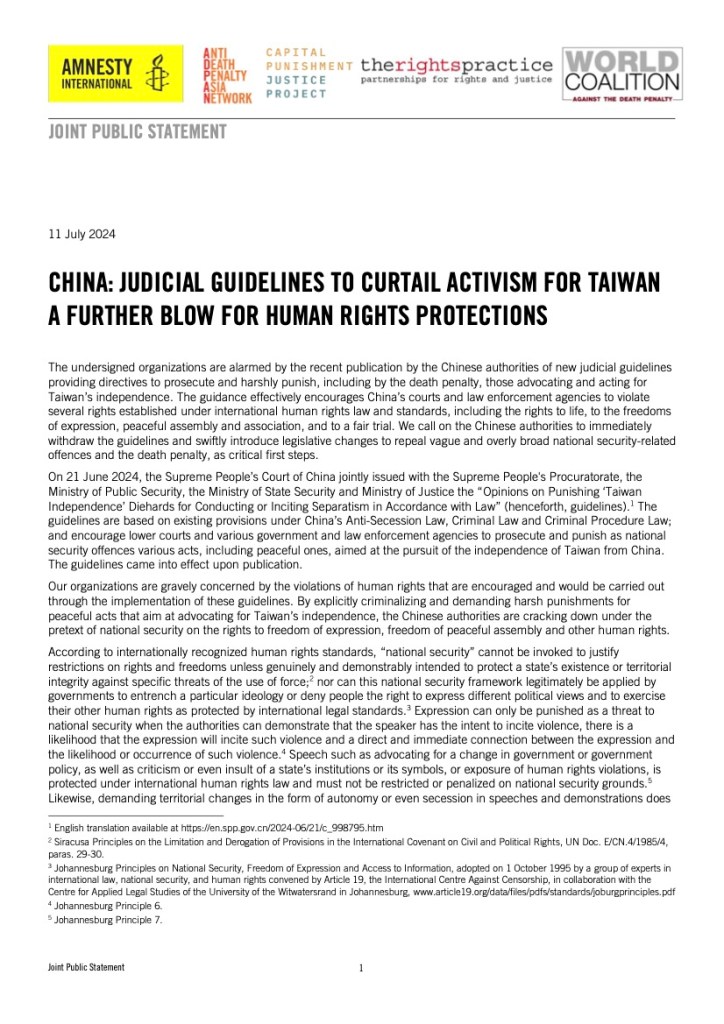
China: Judicial Guidelines to Curtail Activism for Taiwan a Further Blow for Human Rights Protections
July 11, 2024, Statements
The undersigned organizations are alarmed by the recent publication by the Chinese authorities of new judicial guidelines providing directives to prosecute and harshly punish, including by the death penalty, those advocating and acting for Taiwan’s independence. The guidance effectively encourages China’s courts and law enforcement agencies to violate several rights established under international human rights law and standards, including the rights to life, to the freedoms of expression, peaceful assembly and association, and to a fair trial. We call on the Chinese authorities to immediately withdraw the guidelines and swiftly introduce legislative changes to repeal vague and overly broad national security-related offences and the death penalty, as critical first steps.
On 21 June 2024, the Supreme People’s Court of China jointly issued with the Supreme People’s Procuratorate, the Ministry of Public Security, the Ministry of State Security and Ministry of Justice the “Opinions on Punishing ‘Taiwan Independence’ Diehards for Conducting or Inciting Separatism in Accordance with Law” (henceforth, guidelines).1 The guidelines are based on existing provisions under China’s Anti-Secession Law, Criminal Law and Criminal Procedure Law; and encourage lower courts and various government and law enforcement agencies to prosecute and punish as national security offences various acts, including peaceful ones, aimed at the pursuit of the independence of Taiwan from China. The guidelines came into effect upon publication…
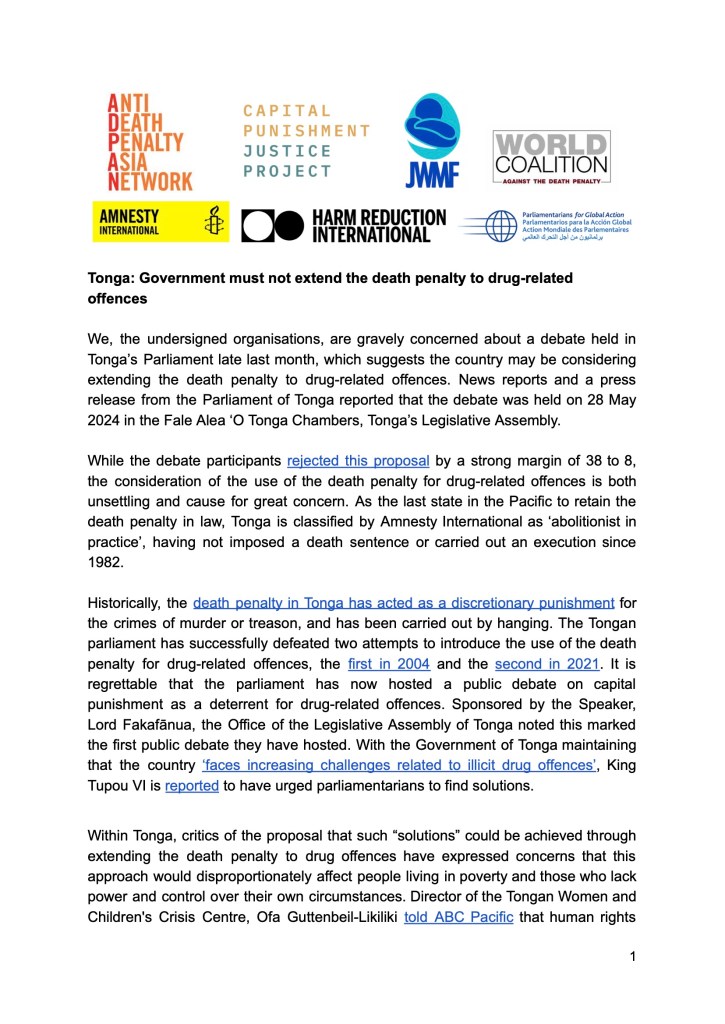
Tonga: Government must not extend the death penalty to drug-related offences
June 11, 2024, Statements
The undersigned organizations express grave concern over a debate in Tonga’s Parliament on May 28, 2024, which considered extending the death penalty to drug-related offences. Despite the proposal being strongly rejected (38 to 8), the discussion itself is troubling. Tonga, the last Pacific state retaining the death penalty, has not executed anyone since 1982 and is deemed ‘abolitionist in practice’ by Amnesty International. Historically reserved for murder or treason, the death penalty’s extension to drug offences has been previously defeated in 2004 and 2021. Critics, including Ofa Guttenbeil-Likiliki of the Tongan Women and Children’s Crisis Centre, argue this measure would disproportionately affect the poor and powerless, advocating for human rights-based, harm reduction-focused drug policies instead. The organizations urge Tonga to align with the global trend towards abolition, evidenced by the 125 countries voting for a death penalty moratorium at the UN in December 2022, and to adopt international protocols against the death penalty, seeking humane solutions for drug-related crimes.
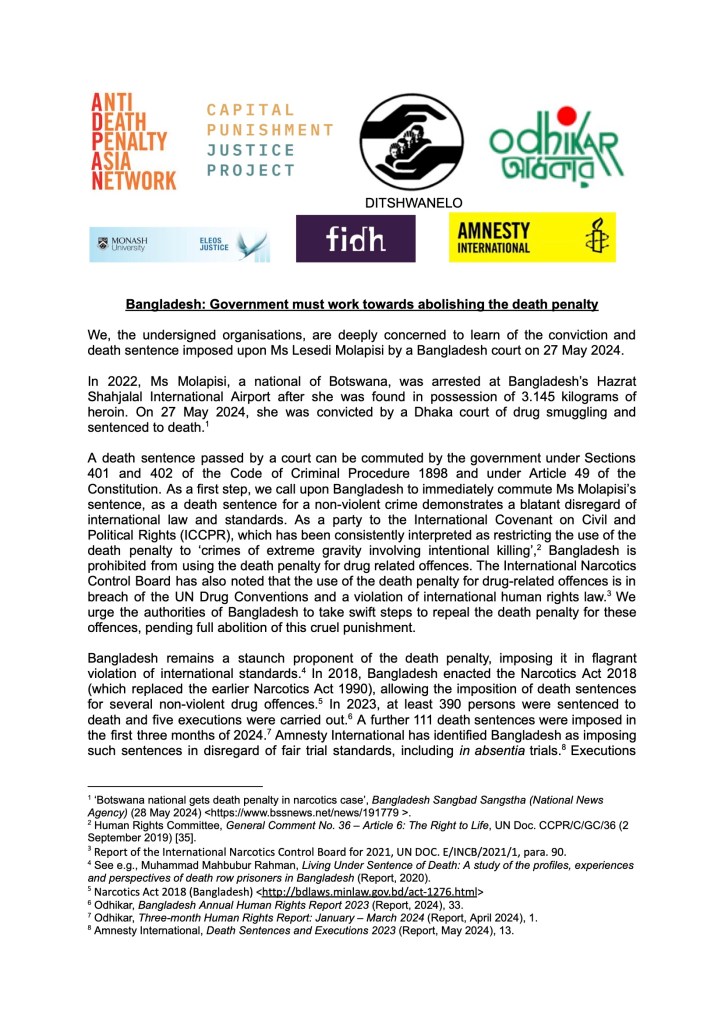
Bangladesh: Government must work towards abolishing the death penalty
June 05, 2024, Statements
The undersigned organizations express deep concern over the conviction and death sentence imposed on Ms. Lesedi Molapisi by a Bangladesh court on May 27, 2024, for drug smuggling. Ms. Molapisi, a Botswana national, was arrested in 2022 at Hazrat Shahjalal International Airport with 3.145 kilograms of heroin. The organizations call on Bangladesh to commute her sentence, as the death penalty for non-violent crimes violates international law, including the International Covenant on Civil and Political Rights, which restricts the death penalty to extreme crimes involving intentional killing. Bangladesh, which continues to impose the death penalty in violation of international standards, sentenced at least 390 people to death and executed five in 2023, with over 2,400 currently on death row under harsh conditions. The organizations urge Bangladesh to abolish the death penalty for drug offences, ensure fair trials, and follow the global trend toward abolition, starting with a moratorium on executions.

Escalating Concerns Over the Lives of Minors Threatened with Death in Saudi Arabia
April 29, 2024, Statements
In Saudi Arabia, concerns are escalating over the fate of minors facing the death penalty, particularly Yousif Al-Manasif and Ali Al-Mubaiouq, whose sentences have been upheld by the Specialized Criminal Court of Appeal. The Supreme Court’s confirmation is the last step before execution, which is authorized by the king’s signature. This situation highlights the ongoing human rights violations, including torture and unfair trials, and contradicts Saudi Arabia’s international commitments to child rights and its own public statements on halting juvenile death sentences. The execution of Mustafa Al-Darwish in June 2021 and the continued approval of death sentences for minors reveal the stark reality behind Saudi Arabia’s promises of reform in its use of the death penalty.

Statement on Execution Warrants in Singapore
April 30, 2024, Statements
The Anti-Death Penalty Asia Network (ADPAN) released a statement on April 30, 2024, expressing concern over the expedited judicial processes in Singapore, especially in cases involving the death penalty. They emphasize the importance of fair trial rights and transparency in decision-making by the Attorney General’s Chambers (AGC). ADPAN also highlights the global trend towards a moratorium on the death penalty, as evidenced by the United Nations General Assembly resolution, and calls on Singapore to halt executions and declare a moratorium on capital punishment, particularly for drug offenses which do not meet the ‘most serious crimes’ threshold as per international law.
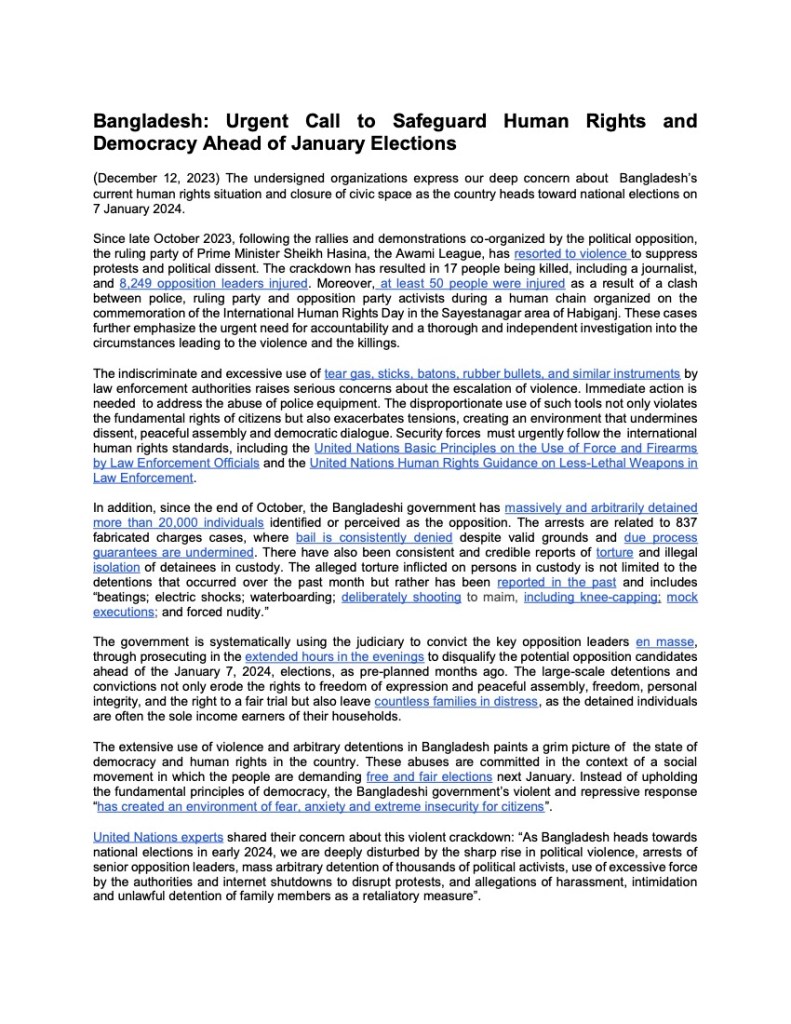
Bangladesh: Urgent Call to Safeguard Human Rights and Democracy Ahead of January Elections
December 12, 2023, Statements
The Anti-Death Penalty Asia Network (ADPAN) has issued a statement expressing deep concern over the human rights situation in Bangladesh ahead of the January 2024 elections. The statement highlights the violent suppression of protests by the ruling Awami League, resulting in deaths and injuries, including a journalist. It also points out the excessive use of force by law enforcement, mass arbitrary detentions, fabricated charges, and reports of torture. ADPAN calls for an immediate halt to the violence, release of arbitrarily detained individuals, and a thorough investigation into human rights violations. Additionally, concerns are raised about the draft Data Protection Act, which could lead to widespread surveillance and infringement of privacy rights. ADPAN urges the international community to monitor the situation and advocate for the protection of fundamental rights in Bangladesh1.

Statement on the Execution of two Filipinos in China for Drug Trafficking
December 04, 2023, Statements
The Anti-Death Penalty Asia Network (ADPAN) and the Coalition Against the Death Penalty (CADP) have expressed deep sorrow over the execution of two Filipinos in China for drug trafficking1. They extend their condolences to the families of the executed and acknowledge the Philippine Government’s efforts to appeal for clemency2. ADPAN and CADP call for greater transparency from both China and the Philippines regarding the status of death row inmates and their legal rights. They emphasize the need for public information to foster community engagement and better solutions for societal issues, arguing that secret executions hinder justice and crime prevention. The statement also urges the UN Office on Drugs and Crime (UNODC) to advocate for human rights-based approaches to drug control and to remind member states of their obligations under international human rights law, highlighting that the death penalty for drug offenses does not align with the ‘most serious crime’ threshold3.
Statement in Commemoration of the 21st World Day against the Death Penalty
October 10, 2023, Statements
The Anti-Death Penalty Asia Network (ADPAN) observes the 21st World Day against the Death Penalty, advocating for the abolition of this punishment in the Asia Pacific1. Significant milestones include Malaysia’s abolition of the mandatory death penalty and Papua New Guinea’s total abolition in 2022. ADPAN criticizes the ‘sovereignty clause’ proposed at the UN as a pretext for capital punishment, highlighting the death penalty’s human rights violations, lack of deterrence, and the irreversible damage it causes to individuals and their families. The network calls for a global moratorium on executions, urging states to pursue policies that lead to the death penalty’s eventual eradication.
Joint Statement Regarding the Executions in Singapore
July 25, 2023, Statements
The Anti-Death Penalty Asia Network (ADPAN) has released a joint statement condemning the scheduled executions in Singapore for drug offenses, highlighting that such actions contravene international law which reserves the death penalty for the ‘most serious crimes’ like intentional killing. The statement criticizes Singapore’s capital drug laws for disproportionately affecting marginalized groups and low-level traffickers, rather than disrupting drug cartels. It urges the Singaporean government to halt these executions and align with the global trend towards abolishing the death penalty, as evidenced by recent legislative changes in countries like Thailand and Malaysia. ADPAN also calls on the international community and the UN Office on Drugs and Crime to reject the notion that capital punishment is permissible for drug offenses under UN Drug Conventions.
Statement on Merri Utami’s Commuted Death Sentence
April 15, 2023, Statements
The Anti-Death Penalty Asia Network (ADPAN) congratulates Merri Utami, her family, and their dedicated lawyers from Lembaga Bantuan Hukum Masyarakat Legal Aid Institute (LBHM) for their tenacious fight to release Merri Utami from her death sentence. On 27 February 2023, President Joko Widodo granted Merri Utami’s clemency application, commuting her sentence from death to life imprisonment. This is the first grant of clemency President Joko Widodo gave to drugs offences since he became President of Indonesia in 2014. Merri Utami was sentenced to death by Tangerang District Court in November 2001 for drug offences. It is clear she was a victim of a syndicate of illicit drugs trafficking whose role and weight of the sentence was unfairly equated with the ring leaders. In July 2016, Merri Utami was taken from the Tangerang Women’s Prison to an isolation cell in Nusakambangan prison for an execution. While placed in a solitary confinement, the Supreme Court rejected her Judicial Review (PK) application. LBHM then applied for clemency on 26 July 2016 to President Joko Widodo while Merri Utami was being prepared for an execution. A few days later, the Prosecutor’s Office declared that Merri Utami’s execution was postponed.
Statement of Solidarity with M Ravi
March 31, 2023, Statements
The Anti-Death Penalty Asia Network (ADPAN) stands in solidarity with M. Ravi, a capital defense lawyer and human rights defender in Singapore with over twenty years of experience. On 21 March 2023, the Court of Three Judges imposed a five-year suspension under Section 83(1)(b) of the Legal Profession Act 1986, also ordering him to pay the costs of the Law Society’s application. This decision comes amid numerous disciplinary hearings and police investigations against M. Ravi, who has been fined over $70,000 Singapore dollars for his work on death penalty cases, most of which were pro bono. The suspension of a capital defense lawyer for their public comments, for the maximum possible length of time, sends a chilling message to capital defense lawyers in Singapore. As the United Nations Special Rapporteur for Judges and Lawyers, Margaret Satterthwaite, has noted, “Lawyers, like everyone, are entitled to freedom of expression.” It has been observed that these lawyers fear taking on ‘late-stage’ appeals due to potential cost sanctions. Since April 2022, there have been several cases where individuals facing imminent execution spent their final days unrepresented, pleading for their lives. In August 2022, 24 persons on death row filed an unsuccessful joint Constitutional challenge on the grounds of lack of access to counsel, all of whom appeared unrepresented.
Malaysia - Abolition of The Mandatory Death Penalty: A Good Step Forward
March 31, 2023, Statements
The Anti-Death Penalty Asia Network (ADPAN) welcomes the proposed bill by the Malaysian government to abolish the mandatory death penalty.
The mandatory death penalty deprives the court of the necessary discretion to hear and provide fair punishment based on aggravating and mitigating circumstances which has consigned countless persons who do not deserve the death penalty to death row. This is apparent when comparing the 1,324 death row inmates to other countries in the Asia Pacific, such as Indonesia (355+), India (539+), and Thailand (510+). Malaysia, for its size, has a significantly disproportionately high number of people on death row.

Singapore: It’s Time for Meaningful Engagement with Civil Society on the Death Penalty
October 31, 2022, Statements
On 22nd October, the Ministry of Home Affairs’ (MHA) in Singapore shared its response to Sir Richard Branson’s Blog Post on 10th October in conjunction with the 20th World Day Against the Death Penalty. The content of the MHA response was not new, evidenced by references to their earlier statements, their self-proclaimed ‘Facts of the Case of Nagaenthran a/l K Dharmalingam’ and quotes given by Minister K. Shanmugam in media interviews.
The Anti-Death Penalty Asia Network (ADPAN) – a regional network of anti-death penalty advocates – takes up the opportunity to respond to key errors reiterated in the MHA press release.
Abolish the Death Penalty and Its Arbitrary Use to Punish LGBTIQ Persons
October 10, 2022, Statements
On the 20th World Day Against the Death Penalty, ILGA Asia and the Anti-Death Penalty Asia Network (ADPAN) condemn the death penalty and its arbitrary use to punish LGBTIQ persons in Asia and call for its unconditional abolition.
As of today, nearly 70 countries around the world still criminalise consensual same-sex sexual conduct. Furthermore, 11 countries – Afghanistan, Brunei Darussalam, Iran, Mauritania, Nigeria, Pakistan, Qatar, Saudi Arabia, Somalia, the United Arab Emirates and Yemen – of which 8 are in Asia, retain the death penalty as a possible punishment for same-sex sexual conduct. The use of criminal sanctions, including capital punishment against lesbian, gay, bisexual, transgender, intersex and queer (LGBTIQ) individuals is rampant in Asia, especially against those from disadvantaged socio-economic backgrounds and/or belonging to racial, ethnic or religious minority groups. Moreover, limited access to legal aid and legal representation, as well as bias within the criminal justice system, has a detrimental impact on LGBTIQ people’s ability to be guaranteed a fair trial.
Singapore: Malaysian Drug Courier Scheduled for Execution
June 30, 2022, Statements
The Anti-Death Penalty Asia Network (ADPAN) is concerned with the scheduled execution of Kalwant Singh, a young Malaysian individual convicted of drug trafficking in Singapore in 2016. His execution has been scheduled to take place on 7 July 2022.
Kalwant Singh was convicted of possession of 60.15 grams of diamorphine and trafficking 120.9 grams of diamorphine. Kalwant was 23 years old at the time of the offence. A co-accused was also convicted of possessing the same 120.9 grams of diamorphine, for the purposes of trafficking. Both the Trial Court and Court of Appeal found that Kalwant Singh and his co-accused were acting as nothing more than a courier. While the co-accused was granted a Certificate of Substantive Assistance by police, he was sentenced to life imprisonment and fifteen strokes of the cane. Kalwant Singh received the death penalty.

Malaysia: Abolition of Mandatory Death Penalty A Progressive Step Forward
June 10, 2022, Statements
Anti-Death Penalty Asia Network (ADPAN) welcomes the announcement by the Malaysian government that it will be reviewing and abolishing the mandatory death penalty in Malaysia.
The mandatory death penalty regime does not provide justice as it deprives judges of the discretion to sentence based on the situation of each individual offender. This regime has resulted in absurd sentences that have led to public outcries, such as those involving Hairun Jalmani, a single mother sentenced to death for drug trafficking in Tawau, and Mainthan Arumugam, a person on death row for a murder that never happened.
In addition to abolishing the mandatory death penalty, critical reform, including but not limited to mental health and criminal culpability; redefining drug offenses to account for drug mules and other exploited individuals within the drug trade; and strengthening rehabilitative justice and victim support system needs to be considered.
ADPAN Condemns Myanmar Death Sentence Imposed on Political Opponents
June 9, 2022, Statements
The Anti-Death Penalty Asia Network (ADPAN) is appalled by the rejection of the appeal by activist Khaw Min Yu and lawmaker Phyo Zeya Thaw and two other political prisoners against the death sentence imposed by a military tribunal.
Since the military coup, Myanmar has witnessed a rise in the number of death sentences issued by military tribunals, accompanied by a growing prevalence of extrajudicial killings involving protestors and pro democracy activists in Myanmar. In addition to violence resulting directly from the coup, the military junta has resumed its military campaigns across Myanmar, leading to large-scale killings, arbitrary detentions and displacement of civilians in several states.
The Tatmadaw has no legitimacy as a government and must cease the atrocities committed against the people of Myanmar. Execution of world-renowned human rights activists, lawmakers and political actors will only further contribute to the Tatmadaw’s besmirched history of human rights violations and atrocities and deprive the Myanmar of the peace, stability and growth it deserves.
Singapore: Execution of Nagaenthran Violation of International Law
April 28, 2022, Statements
The Anti-Death Penalty Asia Network (ADPAN) condemns the execution of Nagaenthran K Dharmalingam by the Singaporean government on the morning of 27 April 2022 at Changi Prison.
Nagaenthran was a young man convicted of trafficking 42.72 grams of diamorphine (heroin). Nagaenthran had an intellectual disability and a diagnosis of Attention Deficit Hyperactivity Disorder (ADHD). His execution in Singapore was conducted in defiance of international law and norms prohibiting the execution of a person with intellectual or psychosocial disability (United Nations Convention on the Rights of Persons with Disabilities). In addition, the execution also failed to meet the international threshold of the ‘most serious crimes’ as the offence of which Nagaenthran was convicted of was a non-violent drug offence.
Since the execution was scheduled for October 2021 until his execution today, the Singapore government has refused to acknowledge the undisputed fact that Nagaenthran’s IQ of 69, a level which is internationally recognised as an intellectual disability. Concerns raised about his recent mental health condition and his vulnerability to further deterioration in detention, particularly solitary confinement, have not been addressed by the Singapore government in any form. It is a great shame that until the end, there was no independent assessment of Nagaenthran’s mental condition.
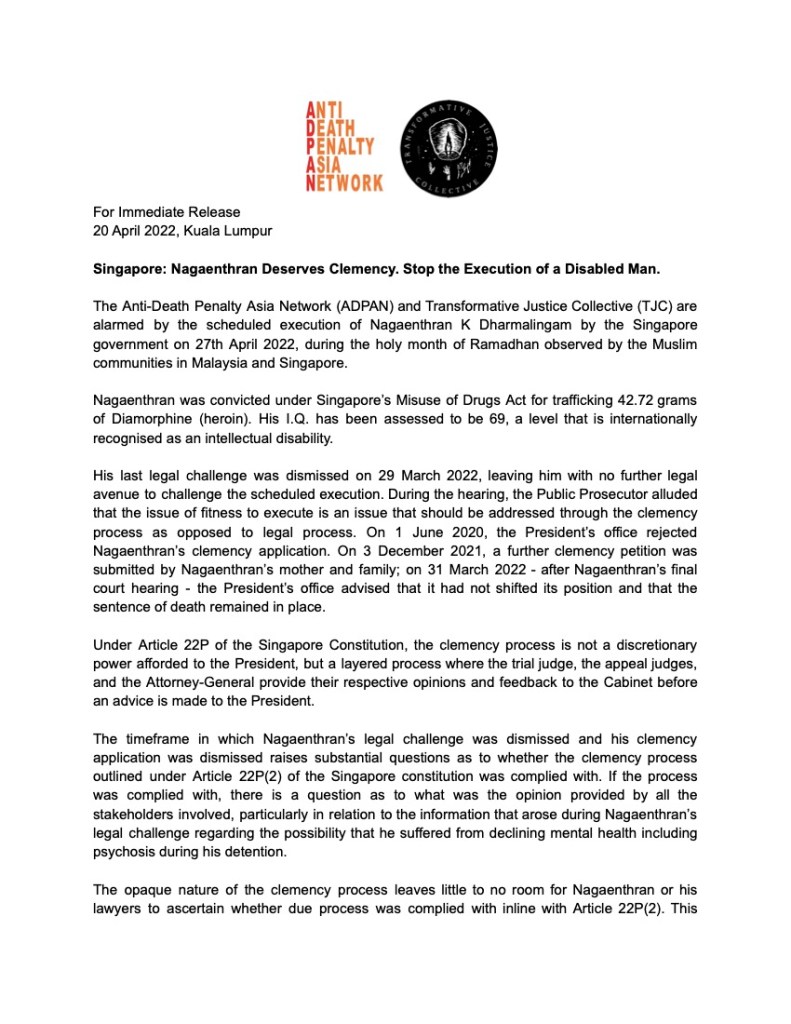
Singapore: Nagaenthran Deserves Clemency. Stop the Execution of a Disabled Man.
April 28, 2022, Statements
The Anti-Death Penalty Asia Network (ADPAN) and Transformative Justice Collective (TJC) are alarmed by the scheduled execution of Nagaenthran K Dharmalingam by the Singapore government on 27th April 2022, during the holy month of Ramadhan observed by the Muslim communities in Malaysia and Singapore.
Nagaenthran was convicted under Singapore’s Misuse of Drugs Act for trafficking 42.72 grams of Diamorphine (heroin). His I.Q. has been assessed to be 69, a level that is internationally recognised as an intellectual disability.
His last legal challenge was dismissed on 29 March 2022, leaving him with no further legal avenue to challenge the scheduled execution. During the hearing, the Public Prosecutor alluded that the issue of fitness to execute is an issue that should be addressed through the clemency process as opposed to legal process. On 1 June 2020, the President’s office rejected Nagaenthran’s clemency application. On 3 December 2021, a further clemency petition was submitted by Nagaenthran’s mother and family; on 31 March 2022 – after Nagaenthran’s final court hearing – the President’s office advised that it had not shifted its position and that the sentence of death remained in place.
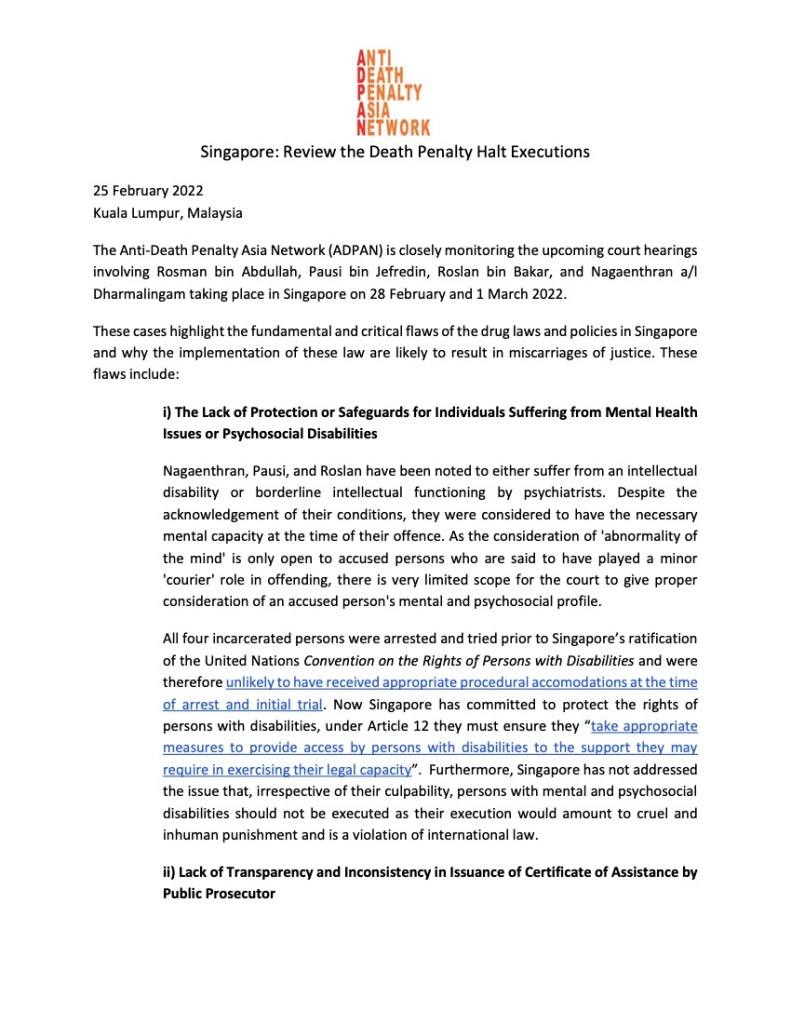
Singapore: Review the Death Penalty Halt Executions
April 28, 2022, Statements
The Anti-Death Penalty Asia Network (ADPAN) is closely monitoring the upcoming court hearings involving Rosman bin Abdullah, Pausi bin Jefredin, Roslan bin Bakar, and Nagaenthran a/l Dharmalingam taking place in Singapore on 28 February and 1 March 2022.
These cases highlight the fundamental and critical flaws of the drug laws and policies in Singapore and why the implementation of these law are likely to result in miscarriages of justice. These flaws include:
i) The Lack of Protection or Safeguards for Individuals Suffering from Mental Health Issues or Psychosocial Disabilities
Nagaenthran, Pausi, and Roslan have been noted to either suffer from an intellectual disability or borderline intellectual functioning by psychiatrists. Despite the acknowledgement of their conditions, they were considered to have the necessary mental capacity at the time of their offence. As the consideration of ‘abnormality of the mind’ is only open to accused persons who are said to have played a minor ‘courier’ role in offending, there is very limited scope for the court to give proper consideration of an accused person’s mental and psychosocial profile.
BANGLADESH: Immediate Moratorium on Executions Must be Imposed
November. 30, 2021, Statements
We the undersigned civil society organizations condemn attempts1 by Bangladeshi authorities to proceed with the execution of Shukur Ali, in violation of his right to a fair trial and in total disregard of due process.
On 7 November 2021, it was reported that the prisons authorities sought to proceed with the execution of Mr. Shukur Ali who was convicted in 2004 for the abduction, rape and murder of a 13-year-old girl, despite the fact that the release of his appeal-verdict by the in August 2021 was still pending. On 7 November, the Supreme Court ordered to halt Mr. Shukur Ali’s execution until it releases the full text of the judgement after the schedule execution was circulated publicly through the media.
This incident would not be the first of its kind in Bangladesh as recently published reports2suggest that two convicts – namely Abdul Mokim and Golam Rasul Jharu – were executed in Jessore Central Jail on 16 November 2017 while their appeals were pending before the Supreme Court of Bangladesh. Such cases are a violation of a person’s right to life and the right to a fair trial and due process. These planned executions are also in violation of Article 35 (3) of the Constitution of Bangladesh as the due process of law was denied to the convicts prior to the execution of the capital punishment.
Singapore – Imminent Execution of Rosman Abdullah
November. 20, 2022, Statements
We the undersigned civil society organizations condemn attempts1 by Bangladeshi authorities to proceed with the execution of Shukur Ali, in violation of his right to a fair trial and in total disregard of due process.
On 7 November 2021, it was reported that the prisons authorities sought to proceed with the execution of Mr. Shukur Ali who was convicted in 2004 for the abduction, rape and murder of a 13-year-old girl, despite the fact that the release of his appeal-verdict by the in August 2021 was still pending. On 7 November, the Supreme Court ordered to halt Mr. Shukur Ali’s execution until it releases the full text of the judgement after the schedule execution was circulated publicly through the media.
This incident would not be the first of its kind in Bangladesh as recently published reports2suggest that two convicts – namely Abdul Mokim and Golam Rasul Jharu – were executed in Jessore Central Jail on 16 November 2017 while their appeals were pending before the Supreme Court of Bangladesh. Such cases are a violation of a person’s right to life and the right to a fair trial and due process. These planned executions are also in violation of Article 35 (3) of the Constitution of Bangladesh as the due process of law was denied to the convicts prior to the execution of the capital punishment.
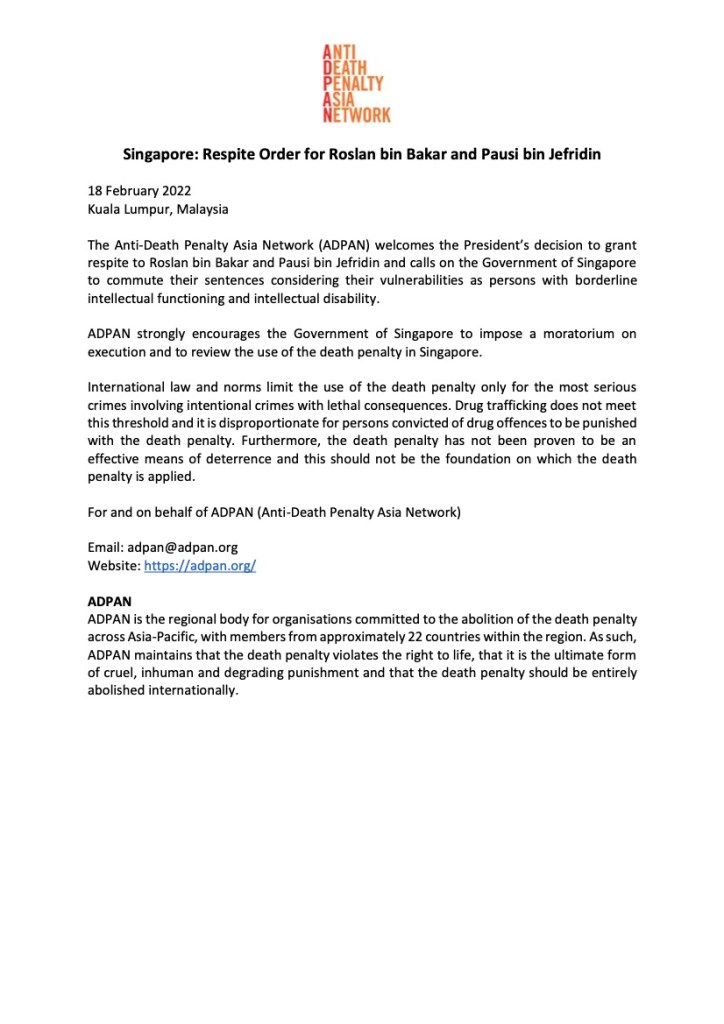
Singapore: Respite Order for Roslan bin Bakar and Pausi bin Jefridin
February. 18, 2022, Statements
The Anti-Death Penalty Asia Network (ADPAN) welcomes the President’s decision to grant respite to Roslan bin Bakar and Pausi bin Jefridin and calls on the Government of Singapore to commute their sentences considering their vulnerabilities as persons with borderline intellectual functioning and intellectual disability.
ADPAN strongly encourages the Government of Singapore to impose a moratorium on execution and to review the use of the death penalty in Singapore.
International law and norms limit the use of the death penalty only for the most serious crimes involving intentional crimes with lethal consequences. Drug trafficking does not meet this threshold and it is disproportionate for persons convicted of drug offences to be punished with the death penalty. Furthermore, the death penalty has not been proven to be an effective means of deterrence and this should not be the foundation on which the death penalty is applied.
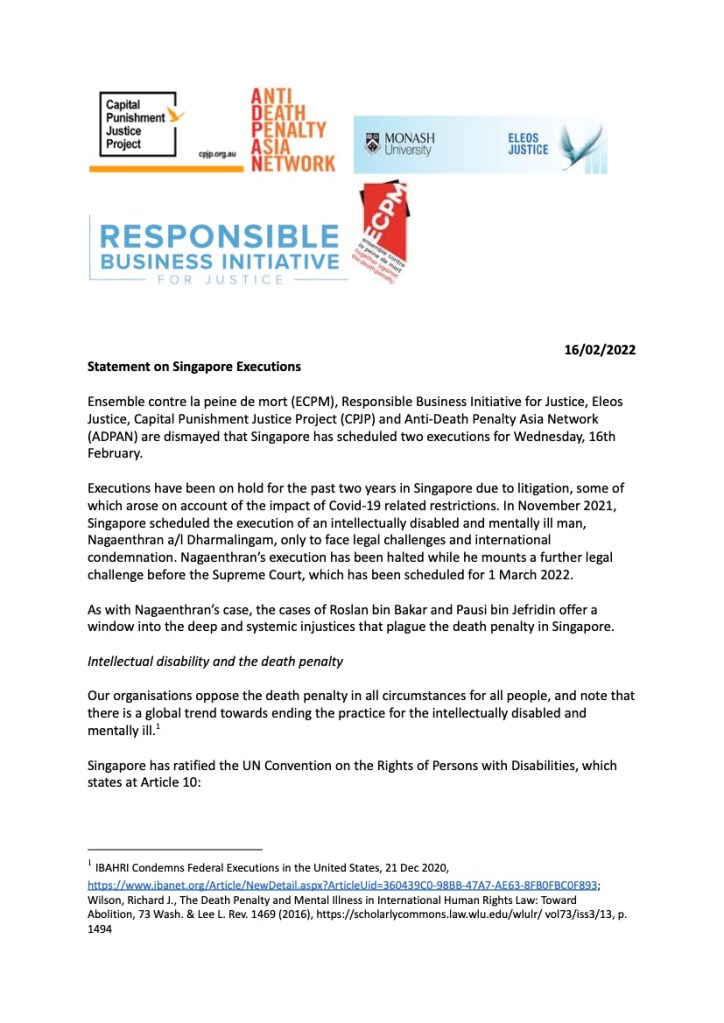
Statement on Singapore Executions
February. 16, 2022, Statements
Ensemble contre la peine de mort (ECPM), Responsible Business Initiative for Justice, Eleos Justice, Capital Punishment Justice Project (CPJP) and Anti-Death Penalty Asia Network (ADPAN) are dismayed that Singapore has scheduled two executions for Wednesday, 16th February. Executions have been on hold for the past two years in Singapore due to litigation, some of which arose on account of the impact of Covid-19 related restrictions. In November 2021, Singapore scheduled the execution of an intellectually disabled and mentally ill man, Nagaenthran a/l Dharmalingam, only to face legal challenges and international condemnation. Nagaenthran’s execution has been halted while he mounts a further legal challenge before the Supreme Court, which has been scheduled for 1 March 2022. As with Nagaenthran’s case, the cases of Roslan bin Bakar and Pausi bin Jefridin offer a window into the deep and systemic injustices that plague the death penalty in Singapore.
A Joint Statement by Capital Punishment Justice Project, Eleos Justice And Anti-Death Penalty Asia Network Upon the Occasion of the Repeal of The Death Penalty by the Parliament of Papua New Guinea
January 24, 2022, Statements
Capital Punishment Justice Project (CPJP), Eleos Justice and Anti-Death Penalty Asia Network (ADPAN) commend the decision on 21 January 2022 by the Parliament of Papua New Guinea (PNG) to repeal the death penalty. This is a moment of historical importance for the global anti-death penalty movement, and it is also a significant victory for human rights in the Asia Pacific region.
The repeal of the death penalty ends months of uncertainty and concern that executions may resume in PNG, following the 30 July 2021 judgment of the Supreme Court of Papua New Guinea, which paved the way for the possibility that the near 70-year moratorium on executions would end.
Despite the Supreme Court having quashed the National Court’s temporary stay of executions for all people sentenced to death, and despite the reintroduction of the death penalty in 1991, PNG’s government has decided that there is a different and better way to forge ahead and that the death penalty is both inhumane and is not effective as a deterrent for serious crime. We endorse Prime Minister James Marape’s statement, that made reference to ‘other global trends and studies’, noting that the death penalty ‘is not an effective deterrent to serious crime and offences’. We also endorse the statement of PNG’s Justice Minister Bryan Kramer who noted that it was not possible for PNG to carry out the death penalty in a humane way.

Joint Statement on Sentencing of Sri Lankan Prison Superintendent to the Death Penalty
January 12, 2022, Statements
On 12 January 2022, the Colombo High Court Special Trial-at-Bar sentenced former Welikada Magazine Prison Superintendent Emil Ranjan Lamahewage to death. Mr. Lamahewage was sentenced in relation to the 2012 Welikada Prison incident in which 27 prisoners were killed and approximately 50 were injured. In 2015, a Committee of Inquiry recommended charging a number of senior officials. Ultimately only two prison officials were charged and only Mr. Lamaherwage was convicted.
The undersigned strongly condemn the ongoing use of the death penalty in Sri Lanka. Whilst Sri Lanka has observed a de facto moratorium on executions since 1976, 1,284 people remained on death row as of September 2020. Despite the long-standing moratorium, the courts continue to impose the death sentence in relation to 22 capital offences.
Prison conditions for prisoners on death row in Sri Lanka are particularly harsh; the 2020 Prison Study by the Human Rights Commission of Sri Lanka describes the living conditions as “appalling and poor”, detailing testimony of those living on death row in conditions with severe overcrowding, poor sanitation, very limited access to health care and being locked in cells for 23 hours a day. These conditions contravene the United Nations’ Standard Minimum Rules for the Treatment of Prisoners (the Nelson Mandela Rules).
Joint statement on the killing of Priyantha Kumara
December 08, 2021, Statements
We, the undersigned, condemn the brutal murder of Priyantha Kumara on 3 December 2021 in Sialkot, Pakistan. Kumara, a Sri Lankan national, was lynched and his body set alight by a mob after allegations of blasphemy were reportedly levelled against him.
Kumara’s murder is not an isolated incident, but the latest episode of an ongoing and increasing pandemic of violence perpetrated in the name of religion. According to the Centre for Social Justice (Pakistan), at least 81
people accused of blasphemy have been extralegally killed in Pakistan since 1994.
The spike in such violence coincides with blasphemy becoming a capital offence under Pakistani law. Blasphemy has been criminalised in Pakistan since Partition; however, the introduction of the discretionary death penalty for blasphemy in 1986 (which became mandatory in 1991) appears to have inflamed religious tensions in the country. Since then, the number of blasphemy accusations has soared, with the Centre for Social Justice (Pakistan) documenting a record 200 cases in 2020 alone. It has been suggested that the State’s strict anti-death penalty stance—of which the hundreds of death sentences meted out are illustrative—and paradoxical reluctance to carry out executions on this basis have encouraged civilians to take matters into their own hands, inspiring vigilante justice.
Arbitrary Arrest and Detention of Khurram Parvez
November 24, 2021, Statements
The Anti-Death Penalty Asia Network (ADPAN) is concerned with the arbitrary arrest and detention of Khurram Parvez by the National Investigation Agency (NIA).
Khurram Parvez is a prominent human rights defender, Coordinator of JKCCS, the Chairperson of the Asian Federation Against Involuntary Disappearances (AFAD) and the Association of Parents of Disappeared Persons (APDP) and by extension a member of ADPAN.
The arrest memo provided to family members indicate that Khurram potentially face charges of “criminal conspiracy”, “waging war against the government of India”, “punishment for conspiracy to wage war against the government of India” (Sections 120B, 121, and 121A of the Indian Penal Code, respectively), and “raising funds for terror activities”, “punishment for conspiracy”, “recruiting any person or persons for commission of a terrorist act”, “offence relating to membership of a terrorist organisation” and “offence of raising funds for terrorist organisations” (Sections 17, 18, 18B, 38, and 40 of the Unlawful Activities (Prevention) Act (UAPA), respectively).

Singapore: Execution of Person with Intellectual Disabilities a Violation of International Law
October 29, 2021, Statements
The Anti-Death Penalty Asia Network (ADPAN) is gravely concerned with the imminent execution of Nagaenthran a/l K Dharmalingam in Singapore.
Nagaenthran was convicted under Singapore’s Misuse of Drugs Act for trafficking 42.72 grams of Diamorphine (heroin). His I.Q. has been assessed to be 69, a level that is internationally recognised as an intellectual disability. During his trial, his defence raised evidence that he suffers from intellectual disabilities that impair his rationality and ability to assess risk. The defence was dismissed despite psychiatric assessment highlighting his inability to make judgments, decision making, impulse control and ability to assess future consequences. The assessment notes that his condition was influenced by severe alcohol use disorder, severe attention deficit hyperactivity disorder and borderline intellectual functioning.
In Nagaenthran’s case, it is apparent that his mental health and intellectual disabilities have contributed to his involvement in the offence, and this factor should have been considered in his conviction and sentence. Failure to do so indicates a systemic failure in Singapore’s criminal justice system to recognise the effect and impact of mental health conditions or intellectual disabilities in a person’s culpability and capacity to commit a criminal offence.

Myanmar: Death Penalty by Military Tribunal Contravenes International Law
July 26, 2021, Statements
The Anti-Death Penalty Asia Network (ADPAN) strongly condemns the imposition of the death penalty by the military tribunal in Myanmar.
Civilians should not be made to stand trial by a military tribunal. A trial by a military tribunal at this juncture reeks of political interference by the military junta which usurped the democratic government of Myanmar earlier in the year. The imposition of the death penalty by a military tribunal can only be interpreted as further attempts to intimidate and cowl political opponents to the junta.
There are grave concerns that the military tribunal does not observe internationally recognized fair trial processes. Apart from trials shrouded in secrecy, there are no avenues for those sentenced to appeal the decision to an appropriate judicial body. The only avenue for appeal is through Senior General, Min Aung Hlaing via the prison with no avenue for legal intervention by lawyers. The onerous conditions and limited avenues for appeal cast further doubt on the legitimacy of the legal process adopted by the military junta.

Global Moratorium on the Death Penalty
December 18, 2020, Statements
Anti-Death Penalty Asia Network (ADPAN) welcomes the latest United Nations General Assembly vote for the global moratorium on the death penalty. With this vote, the world moves ever closer to a consensus that rejects the death penalty with more member states in favour of a global moratorium.
ADPAN applauds the continued commitment for a global moratorium by states and acknowledges the vote of support for the first time by South Korea, Djibouti, and Lebanon. It is regrettable that countries in the Asia region continue to be the most resistant to the adoption of the global trend towards total abolition of the death penalty.

Moratorium on Death Penalty Pending Marijuana Reclassification
December 07, 2020, Statements
The Anti-Death Penalty Asia Network (ADPAN) welcomes the recent development in the United Nations Commission on Narcotic Drugs on 2 December 2020 where marijuana and its derivative were removed from Schedule IV of the 1961 Single Convention on Narcotic Drugs.
The removal of marijuana from the strictest control schedule reflects the shifting trends and modern understanding of the use of marijuana as part of medical therapy and recreational use across the globe. With this change at the global level, nation states must consider this development to take positive steps to review, implement or when appropriate, expedite changes to the legal status of marijuana within their own jurisdictions.
ADPAN calls for all Asia-Pacific states to immediately take heed of the development and implement the necessary legal measures and reform to reflect the change in policy at the global level. Countries where drug laws carry the death penalty for possession or trafficking of marijuana must immediately implement a moratorium on executions and ensure individuals on death row whose cases involve marijuana possession or trafficking are not executed pending the adoption of the new classification for marijuana globally and domestically.
ADPAN Encourages Bangladesh to Reconsider Expanding the Application of the Death Penalty to Rape
November 20, 2020, Statements
In response to campaigns for perpetrators of recent cases of extreme sexual violence to be ‘brought to justice’, the Bangladesh government proposed an amendment to section 9(1) of the Suppression of Violence Against Women and Children Act 2000, which would introduce the death penalty as a punishment for single-perpetrator rape. The crime of rape was previously punishable by death but only in the context of multi-perpetrator rape and where a victim died as a consequence of single-perpetrator rape.
The Anti-Death Penalty Asia Network (ADPAN) shares the outrage expressed by the community in relation to violence against women. We also recognise the need for justice in response to the heinous nature of sexual crimes and their lasting and devastating impact on victim-survivors.
However, we are greatly concerned with the regional response to this issue. We have seen nations give into the ‘temptati[on]’ of imposing ‘draconian punishments’ on those who commit these ‘monstrous acts’.1 We have seen India extend the category of crimes attracting the death penalty to include the rape of children under the age of 12.23 We have seen Pakistan issue an ordinance for the amendment of the Women and Children Repression (Prevention) Act so as to introduce the death penalty for crimes of rape of children and women with aggravating factors,4 and we have also seen Pakistan put forward proposals of chemical castration, televised hangings and making the crime non-compoundable.5 These proposed legislative changes, and those proposed by Bangladesh would be in violations of international standards under the Conventions against Torture and Other Cruel, Inhuman or Degrading Treatment or Punishment, and breach the rights afforded by the International Covenant on Civil and Political Rights.

Pakistan: Accountability and Conviction of Perpetrators to Achieve Justice for Victim Survivors, Not The Death Penalty
November 27, 2020, Statements
Anti-Death Penalty Asia Network (ADPAN) expresses its deepest concern over the recent announcement of the government of Pakistan to introduce the death penalty as a mean to address the rising incidents of rape and child sexual abuse in the country.
The debate around the use of public execution and castration of offenders in the wake of violence against women and children suggests the willful ignorance of the state of its international obligations under various human rights treaties that it has ratified. The narrative adopted by the state can be seen as an attempt to deflect public scrutiny of the state’s failure in protecting victim-survivor of sexual offences and the criminal justice system that is unable to achieve justice against perpetrators
ADPAN believes that the death penalty is cruel, inhuman and against all norms of civility. The punishment has also failed to show any effectiveness in deterring future crimes. Pakistan’s continued and unabated use of death penalty in the past echoes the global trend where it is not the severity but the certainty of punishment that reduces crime in society.
Pakistan penal code is already replete with more than 27 offences that carry the death penalty and prescribing the death penalty for yet another offence will not deter and prevent future crimes. Introduction of the death penalty to sexual offences will only violate international human rights and it will not bring justice to the victim-survivors.
The Philippines: On World Day Against the Death Penalty, Congress Encouraged to Reject Attempts to Reintroduce Death Penalty
November 27, 2020, Statements
On the 18th World Day Against the Death Penalty, the undersigned seven organizations express their concern at proposed legislative measures that would reintroduce the death penalty in the Philippines and call on its Congress to uphold the country’s international law obligations and oppose the adoption of draft legislation to this aim.
10 October marks the World Day Against the Death Penalty, a global day of action which sees actors from all walks of life and many countries join together to say no to the death penalty. On this occasion, civil society organizations from the Philippines and internationally share their alarm at the 24 draft laws which are currently pending before Committees of the House of Representatives and of the Senate of the Philippines. These laws aim to reintroduce the death penalty as the punishment for several offences including murder, rape, drug trafficking, plunder and kidnapping. The adoption of any such laws would violate the country’s obligations under international human rights law.
Following the abolition of the death penalty for the second time in 2006, on 20 November 2007 the Philippines ratified the Second Optional Protocol to the International Covenant on Civil and Political Rights that categorically prohibits executions and commits the country to the abolition of this punishment. These obligations cannot be withdrawn at any time. In the words of the UN Human Rights Committee, abolition of the death penalty is “legally irrevocable.” Furthermore, the UN Human Rights Committee has concluded that States parties may not transform an offence, which upon ratification of the Covenant, or at any time thereafter, did not entail the death penalty, into a capital offence.1
ADPAN Calls on Singapore to Immediately Halt ALL Executions
November 27, 2020, Statements
On the 18th World Day Against the Death Penalty, the undersigned seven organizations express their concern at proposed legislative measures that would reintroduce the death penalty in the Philippines and call on its Congress to uphold the country’s international law obligations and oppose the adoption of draft legislation to this aim.
10 October marks the World Day Against the Death Penalty, a global day of action which sees actors from all walks of life and many countries join together to say no to the death penalty. On this occasion, civil society organizations from the Philippines and internationally share their alarm at the 24 draft laws which are currently pending before Committees of the House of Representatives and of the Senate of the Philippines. These laws aim to reintroduce the death penalty as the punishment for several offences including murder, rape, drug trafficking, plunder and kidnapping. The adoption of any such laws would violate the country’s obligations under international human rights law.
ADPAN Calls on Singapore to Immediately Halt the Imminent Execution of Syed Suhail Bin Syed Zin
September 20, 2020, Statements
The Anti-Death Penalty Asia Network (ADPAN) urgently calls upon the Government of Singapore to stop the execution of Syed Suhail Bin Syed Zin who is scheduled to be hanged at Changi Prison on Friday 18 September having being convicted of drug offences.
Singapore is a sovereign nation which rightly recognises the fundamental liberties of the person and the right to life and liberty in Part IV of its Constitution. To engage in state-sanctioned killing of prisoners, regardless of the nature of their offending, is an affront to the universal right to life and accordingly undermines the inherent dignity of all people. Singapore is in a position to adopt the recommendations of UN member states and ratify the International Covenant on Civil and Political Rights (ICCPR) and the Second Optional Protocol to the ICCPR. By doing so, Singapore could promote the fundamental liberties which it protects in its Constitution and acknowledge that the persistence of the death penalty is an inherent contradiction to the ‘enhancement of human dignity and progressive development of human rights’. ADPAN calls for the Government of Singapore to exercise its sovereign powers and immediately stay the execution of Syed Suhail.
ADPAN’s Statement in Support of the Victims of Enforced Disappearances
August 30, 2020, Statements
The Anti-Death Penalty Asia Network (ADPAN) urgently calls upon the Government of Singapore to stop the execution of Syed Suhail Bin Syed Zin who is scheduled to be hanged at Changi Prison on Friday 18 September having being convicted of drug offences.
Singapore is a sovereign nation which rightly recognises the fundamental liberties of the person and the right to life and liberty in Part IV of its Constitution. To engage in state-sanctioned killing of prisoners, regardless of the nature of their offending, is an affront to the universal right to life and accordingly undermines the inherent dignity of all people. Singapore is in a position to adopt the recommendations of UN member states and ratify the International Covenant on Civil and Political Rights (ICCPR) and the Second Optional Protocol to the ICCPR. By doing so, Singapore could promote the fundamental liberties which it protects in its Constitution and acknowledge that the persistence of the death penalty is an inherent contradiction to the ‘enhancement of human dignity and progressive development of human rights’. ADPAN calls for the Government of Singapore to exercise its sovereign powers and immediately stay the execution of Syed Suhail.
ADPAN Opposes President Rodrigo Duterte’s Call to Reinstate the Death Penalty in the Philippines
July 31, 2020, Statements
The Anti-Death Penalty Asia Network (ADPAN), who advocates the abolition of the death penalty, is appalled by the anti-human rights position taken by the Philippines President who is trying to reimpose the death penalty. In his State of the National Address (SONA) on 27 July 2020, President Duterte’s called for the reimposition of the death penalty in the Philippines for drug-related offences. In his address, President Duterte expressed support for “the swift passage of a law reviving the death penalty by lethal injection for crimes specified under the Comprehensive Dangerous[Drugs] Act of 2002.” He added that this change will “not only help us deter criminality but also save our children from the dangers posed by illegal and dangerous drugs”.
Since the beginning of his administration in 2016, President Duterte has waged a damaging campaign against drugs, which resulted in extra-judicial killings and a denial of the fundamental right to a fair trial. An estimated 5,600 people have died in this ‘drug war’; however, some organisations estimate that the number of deaths could exceed 27,000. Despite widespread condemnation from both local groups and the international community, the comments made during the SONA reflect President Duterte’s relentless attempts to undermine fundamental human rights.
COVID-19: Calling for a Worldwide Moratorium on the Death Penalty During the Pandemic
June 8, 2020, Statements
“When the whole world is trying hard to save lives from COVID-19, an execution by the state is contradictory and perverse” said Kevin Miguel Rivera Medina, President of the World Coalition Against the Death Penalty.
In a statement released today, ADPAN and the World Coalition Against the Death Penalty call on all countries that still use the death penalty to impose a moratorium on death sentences and executions on the ground that fair trials and fair legal representation are impossible to maintain during the COVID-19 pandemic.
“While some countries now sentence people to death by videoconference, as in Nigeria or Singapore, in others the prison restrictions have seriously infringed the rights of those awaiting execution because courts are stalled and law firms are closed. Options to help people whose lives are at risk are decreasing.”
Statement in Relation to the Imposition of the Death Penalty by Remote Court Hearings
June 8, 2020, Statements
The Anti-Death Penalty Asia Network (ADPAN) expresses grave and serious concern in relation to recent decisions taken by courts in Singapore and Nigeria to hand down the death penalty over video conference.
In Nigeria, on 4 May 2020 Olalekan Hameed was sentenced to death for allegedly murdering his employer’s mother, and in Singapore on 15 May 2020, Punithan Genasan was sentenced to death for his alleged role in a heroin transaction. Both sentences were provided via a Zoom remote video call, and both men have been sentenced to death by hanging.
The use of video conferencing technology like Zoom to hand down the death penalty, a sentence with absolute finality, has been labelled as particularly callous by observers. When an accused faces a potential sentence of death, the need to uphold their access to the highest standard of fair trial rights is paramount. A court hearing that takes place via video conferencing, raises a number of concerns including the accused’s ability to understand the Court’s findings; their ability to properly instruct legal counsel and their access to interpreters where necessary.
China: Judicial Guidelines to Curtail Activism for Taiwan a Further Blow for Human Rights Protections
June 8, 2020, Statements
Detained for over 23 years, Chiou Ho-shun has been Taiwan’s longest detained criminal defendant in its longest running criminal case. The case was described recently by his lawyers as “a stain on our country’s legal [history].” Chiou Ho-shun and 10 of his co-defendants say they were tortured into making confessions and denied the right to communicate with anyone for the first four months of their detention. They were also denied a lawyer during the investigation and interrogations.
Chiou Ho-shun and his co-defendants later retracted their confessions. They were first tried by the District Court in connection with two separate crimes that took place in 1987: the kidnapping and murder of a nine-year-old boy Lu Cheng and the murder of Ko Hung Yu-lan.
The High Court recognized that violence and intimidation were used during the police investigation. The court did not exclude the full confession from evidence, it only excluded sections of the interrogation tapes where abuse of the suspects could be heard distinctly. The confessions also contained mutual contradictions and discrepancies on key facts.

Adpan Condemns Singapore’s Use of Police Harassment in Curbing Public Scrutiny of the Judiciary and Discussions of Court Cases
march 15, 2020, Statements
The Anti-Death Penalty Asia Network (ADPAN) stands in solidarity with Singapore’s human rights lawyer Mr M Ravi, the Chief Editor of The Online Citizen (TOC) Mr Terry Xu, TOC writer Ms Danisha Hakeem and Mr Mohan Rajangam, all of who are currently under investigation for possible contempt of Court under Section 3(1)(b) of the state’s Administration of Justice (Protection) Act.
It was reported in media articles that police, acting under the authorisation of the Attorney General, raided the office of Mr Ravi and the home of Mr Xu, seizing their mobile devices and computers. Mr Xu was held at Cantonment Police Station for questioning by the Criminal Investigation Division (CID) for about 7 hours on Friday 13 March 2020.
It appears that the investigation commenced after some articles were published by The Online Citizen questioning the role of the Singapore State Court in Mr Mohan’s extradition to Malaysia. It has been reported that Mr Mohan was arrested on 21 March 2015 and extradited to Malaysia following the endorsement of a Malaysian arrest warrant by a magistrate in Singapore, for an offence that he maintains he did not commit. He reportedly spent four months in custody before being released by Malaysian authorities without charge.
Statement on the Health and Safety of Prisoners During the COVID-19 Pandemic
April 9, 2020, Statements
As the global population grapples with the impact of the ongoing Covid-19 pandemic, the Anti-Death Penalty Asia Network (ADPAN) reminds Governments in the Asia Pacific and around the world of their obligations to ensure that prison conditions won’t facilitate the spread of the disease for the safety of prisoners, staff and visitors.
It is well documented that prisons in many countries across the world are overpopulated. Prisons in some jurisdictions are also known for their failure to provide a hygienic environment and in some cases, adequate medical care especially for inmates on death row. Such neglect can have huge implications on the health and safety of prisoners who face a high risk of infection if prisons become epicenters of this fatal disease.
We support the call of the UN High Commissioner for Human Rights Michelle Bachelet for States to adhere to their obligations under international human rights law “to work to prevent foreseeable threats to public health and ensure that all who need vital medical care can receive it”.
ADPAN Calls on India to Immediately Halt the Imminent Executions of Akshay Thakur, Mukesh Singh, Vinay Sharma and Pawan Gupta.
January 21, 2020, Statements
The undersigned organizations are alarmed by the recent publication by the Chinese authorities of new judicial guidelines providing directives to prosecute and harshly punish, including by the death penalty, those advocating and acting for Taiwan’s independence. The guidance effectively encourages China’s courts and law enforcement agencies to violate several rights established under international human rights law and standards, including the rights to life, to the freedoms of expression, peaceful assembly and association, and to a fair trial. We call on the Chinese authorities to immediately withdraw the guidelines and swiftly introduce legislative changes to repeal vague and overly broad national security-related offences and the death penalty, as critical first steps.
On 21 June 2024, the Supreme People’s Court of China jointly issued with the Supreme People’s Procuratorate, the Ministry of Public Security, the Ministry of State Security and Ministry of Justice the “Opinions on Punishing ‘Taiwan Independence’ Diehards for Conducting or Inciting Separatism in Accordance with Law” (henceforth, guidelines).1 The guidelines are based on existing provisions under China’s Anti-Secession Law, Criminal Law and Criminal Procedure Law; and encourage lower courts and various government and law enforcement agencies to prosecute and punish as national security offences various acts, including peaceful ones, aimed at the pursuit of the independence of Taiwan from China. The guidelines came into effect upon publication.
