Statement on Singapore Executions

Statement on Singapore Executions

February 16, 2022, Statements

Ensemble contre la peine de mort (ECPM), Responsible Business Initiative for Justice, Eleos Justice, Capital Punishment Justice Project (CPJP) and Anti-Death Penalty Asia Network (ADPAN) are dismayed that Singapore has scheduled two executions for Wednesday, 16th February. 

Executions have been on hold for the past two years in Singapore due to litigation, some of which arose on account of the impact of Covid-19 related restrictions. In November 2021, Singapore scheduled the execution of an intellectually disabled and mentally ill man, Nagaenthran a/l Dharmalingam, only to face legal challenges and international condemnation. Nagaenthran’s execution has been halted while he mounts a further legal challenge before the Supreme Court, which has been scheduled for 1 March 2022. 

As with Nagaenthran’s case, the cases of Roslan bin Bakar and Pausi bin Jefridin offer a window into the deep and systemic injustices that plague the death penalty in Singapore. 

Intellectual disability and the death penalty 

Our organisations oppose the death penalty in all circumstances for all people, and note that there is a global trend towards ending the practice for the intellectually disabled and mentally ill.1 

Singapore has ratified the UN Convention on the Rights of Persons with Disabilities, which states at Article 10: 

Every human being has the inherent right to life and shall take all necessary measures to ensure its effective enjoyment by persons with disabilities on an equal basis with others.” 

The UN General Assembly in Resolutions 71/187 of 2 February 2017; 73/185 of 17 December 2018; 75/183 of 16 December 2020 has “call[ed] upon States not to impose capital punishment on persons with mental or intellectual disabilities.” 

In 2017, the High Court of Singapore acknowledged that both Roslan and Pausi had IQ levels of lower than 70 at the time of the alleged commission of the offence. This indicates a significant impairment in the intellectual functioning of both individuals.2 

Neither Roslan nor Pausi have had an independent psychiatric or medical assessment in recent years, and it is not possible to know how severe their intellectual disabilities are at this point, or whether they have become mentally ill while on death row. However, it is well accepted that without appropriate psychosocial support, intellectual disability may worsen over time. 

At minimum, Singapore must facilitate access to independent psychiatrists and medical practitioners in order to assess the psychiatric and physiological conditions of those on its death row and to provide them with an appropriate standard of care. Surely if Singapore’s Court of Appeal is unwilling to execute a person afflicted with Covid-19 then that same ‘sense of logic, common sense and humanity’ that Justice Andrew Phang spoke of in November in Nagaenthran’s hearing ought to apply to those with intellectual disabilities or severe mental illness.

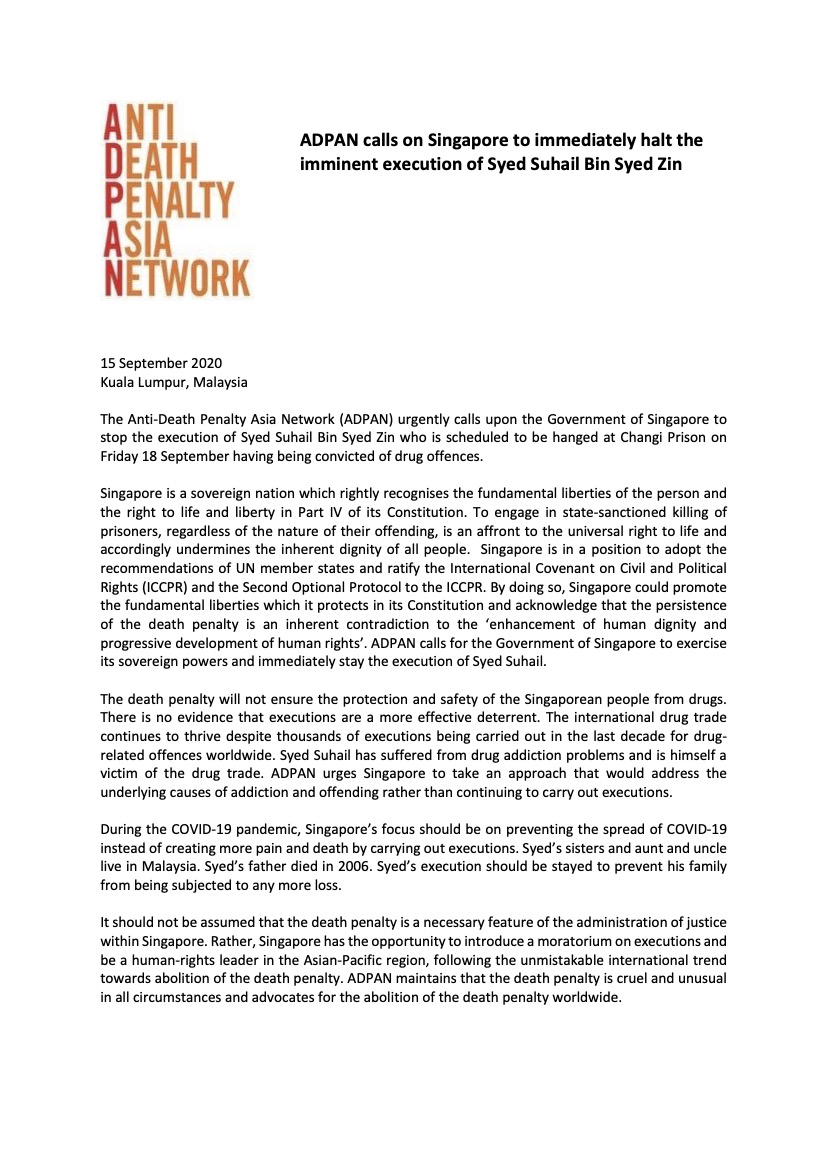
ADPAN Calls on Singapore to Immediately Halt the Imminent Execution of Syed Suhail Bin Syed Zin

ADPAN Calls on Singapore to Immediately Halt the Imminent Execution of Syed Suhail Bin Syed Zin

September 20, 2020, Statements

The Anti-Death Penalty Asia Network (ADPAN) urgently calls upon the Government of Singapore to  stop the execution of Syed Suhail Bin Syed Zin who is scheduled to be hanged at Changi Prison on  Friday 18 September having being convicted of drug offences. 

Singapore is a sovereign nation which rightly recognises the fundamental liberties of the person and  the right to life and liberty in Part IV of its Constitution. To engage in state-sanctioned killing of  prisoners, regardless of the nature of their offending, is an affront to the universal right to life and  accordingly undermines the inherent dignity of all people. Singapore is in a position to adopt the  recommendations of UN member states and ratify the International Covenant on Civil and Political  Rights (ICCPR) and the Second Optional Protocol to the ICCPR. By doing so, Singapore could promote  the fundamental liberties which it protects in its Constitution and acknowledge that the persistence  of the death penalty is an inherent contradiction to the ‘enhancement of human dignity and  progressive development of human rights’. ADPAN calls for the Government of Singapore to exercise  its sovereign powers and immediately stay the execution of Syed Suhail. 

The death penalty will not ensure the protection and safety of the Singaporean people from drugs.  There is no evidence that executions are a more effective deterrent. The international drug trade  continues to thrive despite thousands of executions being carried out in the last decade for drug related offences worldwide. Syed Suhail has suffered from drug addiction problems and is himself a  victim of the drug trade. ADPAN urges Singapore to take an approach that would address the  underlying causes of addiction and offending rather than continuing to carry out executions.  

During the COVID-19 pandemic, Singapore’s focus should be on preventing the spread of COVID-19  instead of creating more pain and death by carrying out executions. Syed’s sisters and aunt and uncle live in Malaysia. Syed’s father died in 2006. Syed’s execution should be stayed to prevent his family  from being subjected to any more loss. 

It should not be assumed that the death penalty is a necessary feature of the administration of justice  within Singapore. Rather, Singapore has the opportunity to introduce a moratorium on executions and  be a human-rights leader in the Asian-Pacific region, following the unmistakable international trend  towards abolition of the death penalty. ADPAN maintains that the death penalty is cruel and unusual  in all circumstances and advocates for the abolition of the death penalty worldwide.  

Proceeding with the execution of Syed Suhail Bin Syed Zin would only illustrate the inherent futility of  the death penalty. ADPAN calls on the Government of Singapore takes action immediately, consistent  with the exercise of its sovereign powers, to prevent Syed’s unnecessary death. 

ADPAN condemns Singapore’s use of police harassment in curbing public scrutiny of the judiciary and discussions of court cases

ADPAN condemns Singapore’s use of police harassment in curbing public scrutiny of the judiciary and discussions of court cases

The Anti-Death Penalty Asia Network (ADPAN) stands in solidarity with Singapore’s human rights lawyer Mr M Ravi, the Chief Editor of The Online Citizen (TOC) Mr Terry Xu, TOC writer Ms Danisha Hakeem and Mr Mohan Rajangam, all of who are currently under investigation for possible contempt of Court under Section 3(1)(b) of the state’s Administration of Justice (Protection) Act.

It was reported in media articles that police, acting under the authorisation of the Attorney-General, raided the office of Mr Ravi and the home of Mr Xu, seizing their mobile devices and computers. Mr Xu was held at Cantonment Police Station for questioning by the Criminal Investigation Division (CID) for about 7 hours on Friday 13 March 2020.

It appears that the investigation commenced after some articles were published by The Online Citizen questioning the role of the Singapore State Court in Mr Mohan’s extradition to Malaysia. It has been reported that Mr Mohan was arrested on 21 March 2015 and extradited to Malaysia following the endorsement of a Malaysian arrest warrant by a magistrate in Singapore, for an offence that he maintains he did not commit. He reportedly spent four months in custody before being released by Malaysian authorities without charge.

ADPAN holds strong to the view that public institutions must be transparent in order to be accountable, including being open to scrutiny and review.  Public questioning or discussion regarding court cases ought not automatically be considered ‘prejudicing or interfering’ with court proceedings. Judicial officers have a duty to act independently from pressure from the public, media or the Executive.

The use of police powers that have the effect of unduly harassing individuals who publicly express their opinions or discusses such matters, including the seizure of mobile devices and computers and extended police questioning send the wrong message to the public in the exercise of legitimate dissent on government policies and actions. Rather, we strongly recommend the use of public platforms for the Government or institutions to clarify matters that impact on society including outcomes arising from the country’s justice system.

For more information:

State Court loses notes of evidence in regards to the transfer of Mohan Rajangam to Malaysian authorities – https://www.theonlinecitizen.com/2020/03/04/state-court-loses-notes-of-evidence-in-regards-to-transfer-of-mohan-rajangam-to-malaysian-authorities/

TOC editor, lawyer M Ravi among 4 investigated for contempt of court – https://www.todayonline.com/singapore/toc-editor-lawyer-m-ravi-among-4-investigated-contempt-court?fbclid=IwAR1hhF8SjHFlbe_wKAXSOxCkKubhKSXVlJAdoQ6Y0Kg0NL8i3fAAViYybHI

TOC editor and lawyer being investigated for prejudicing ongoing court proceedings – https://www.straitstimes.com/singapore/courts-crime/toc-editor-and-lawyer-being-investigated-for-prejudicing-ongoing-court

SINGAPORE CASE STUDY: YONG VUI KONG

Singapore Case Study: Yong Vui Kong

“When we say mandatory death sentence it means basically judges don’t have discretion. Just close your eyes… and execute. Don’t have to look at the person’s background and all that.” M. Ravi, Yong Vui Kong’s lawyer.

Yong Vui Kong, a Malaysian man, was arrested in Singapore in 2007, aged 19, for possessing 47g of heroin. Yong had dropped out of school early and had turned to petty crime as a way of earning money. At that time, under Singapore’s Misuse of Drugs Act, anyone found guilty of possessing more than 15g of heroin is presumed to be guilty of drug trafficking, for which the death penalty is mandatory. As Yong was not able to counter this presumption, the High Court convicted him in 2008 and he was sentenced to death. The court had no discretion to consider mitigating circumstances or pass a lesser sentence. 

Lawyers filed an appeal against his conviction but Yong withdrew it in April 2009, saying that he had embraced Buddhism and wanted to acknowledge his crime. Yong petitioned Singapore’s president for clemency on the basis of his youth but this was rejected in November 2009. 

Yong’s lawyer, M. Ravi, appealed against Yong’s sentence by challenging the constitutionality of the mandatory death penalty for drug trafficking and seeking judicial review of the clemency process. But in May 2010, the Court of Appeal rejected the appeal. This was the third time it had rejected such a challenge since 1980. The Court ruled that the right to life in the Singapore Constitution did not imply a ban on inhuman punishment. It rejected the argument that customary international law prohibits mandatory death sentences as an inhuman punishment or a violation of the right to life. 

The application for judicial review of the clemency process had argued that the power to grant pardon had been prejudiced by public comments about the case made by the Law Minister, thereby undermining accepted principles of procedural fairness. This was dismissed by the High Court in August 2010. The Court of Appeal dismissed an appeal against the High Court’s decision in April 2011, clearing the way for Yong’s execution. The President can only exercise clemency following advice from the Cabinet and thus has little discretion in granting pardons. Clemency for a death sentence in Singapore has reportedly been granted only six times since independence in 1965. 

UPDATE: 

On 14 November 2013, Yong became the first person on Singapore’s death row to have their sentence reduced to life imprisonment and caning under the 2012 amendments to the Misuse of Drugs Act

ADPAN: When Justice Fails – Thousands executed in Asia after unfair trials, (2011), p19-20 (https://adpandotnet.files.wordpress.com/2011/11/adpan-unfair-trials-asa-010232100-final-pdf.pdf