PUBLICATIONS
The Republic of Korea’s Compliance with International Convention for the Protection of All Persons from Enforced Disappearance
Submitted by Transitional Justice Working Group (TJWG), The Advocates for Human Rights (TAHR), a non-governmental organization in special consultative status with ECOSOC since 1996, and Anti-Death Penalty Asia Network (ADPAN) for the 30th Session of the Committee on Enforced Disappearances.
Download it here: English
ADPAN Biennial Report [2024-2025]
This Biennial Report, prepared for presentation at the ADPAN General Assembly in December 2025, provides an overview of the network’s key initiatives and achievements from September 2024 to November 2025. It outlines ADPAN’s impact in enhancing regional collaboration, amplifying abolitionist advocacy, and deepening public and institutional engagement on death penalty reform and related human rights concerns. Throughout this period, ADPAN advanced its work on death penalty abolition, fair trial rights, and access to justice by convening conferences, leading solidarity actions, and driving intersectional campaigns that connect abolition with gender justice, migration, trafficking, and drug policy reform.
Download it here: English
A review of the ‘discretionary’ death penalty for drug trafficking in Malaysia
On 10 June 2022, Wan Junaidi Tuanku Jaafar, the Minister in the Prime Minister’s Department, announced the government’s decision to give the judiciary discretion in the sentencing of 11 offences which currently carry the mandatory death penalty.1 In November 2017, the Dangerous Drugs Act 1952 was amended to introduce section 39B(2A), allowing judicial discretion in the sentencing of drug trafficking offences which previously mandated a death sentence. The government appears not to have included drug trafficking under s39B(2A) as one of the 11 offences currently under review. However, this discretion is so limited that in practice, the death penalty drug trafficking remains mandatory in the vast majority cases, resulting in the continued use of the death penalty for drug trafficking.
This briefing note prepared by the Anti-Death Penalty Asia Network (ADPAN) and Eleos Justice at Monash University outlines the current judicial practice concerning s39B(2A), highlights reasons behind the lack of discretion afforded to judges and other problems with the provisions, and proposes amendments to remedy these shortcomings, including the removal of the death penalty for drug trafficking.
Download it here: English
A Deadly Distraction: Why the Death Penalty is not the Answer to Rape in South Asia
Joint report by Eleos Justice, Anti-Death Penalty Asia Network and the South Asia Middle East Network. Since 2010, persons convicted of rape offences were executed in at least 9 countries, including India and Pakistan. Moreover, public protests against the rape epidemic, which led governments to introduce capital rape laws, illustrates the need to shine a spotlight in South Asia. The report examines the use of the death penalty for rape in four South Asian countries: Bangladesh, India, Pakistan and Sri Lanka and explores ways that anti-death penalty activists can challenge this concerning trend.
Download it here: English
The Clemency Process in East and Southeast Asia
How stringent are clemency processes in the East and Southeast Asia region? What countries have seen to be more lenient in granting clemency? What are the current issues that surround the processes in these countries? In our newest release, ADPAN’s latest report breakdown what the clemency processes are like in the region, ranging from information regarding the procedures and laws governing retentionist countries in the region to discussions of contentious issues that have arisen in the processes and suggestions of reform. Download it here: English
Malaysia's Compliance with the Convention on the Elimination of All Forms of Discrimination Against Women in Relation to the Death Penalty
for the 88th Session of the Committee on the Elimination of Discrimination Against Women (May 2024)
ADPAN Country Report 2021
ADPAN Country Report on the Death Penalty in Asia Pacific, covering East Asia, Southeast Asia and South Asia. Report first published in October 2021 with revision in December 2021. Download it here: English
Guidebook on the Death Penalty, Pardon Petition and Clemency Process in Malaysia
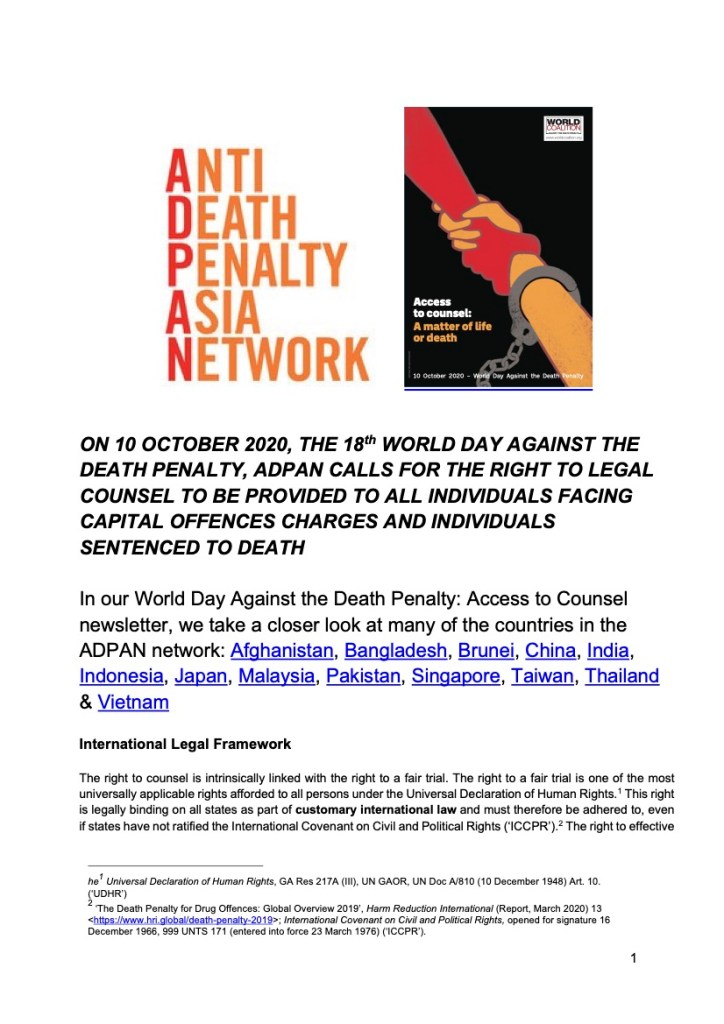
ADPAN's World Day Against the Death Penalty
On 10 October 2020, the 18th World Day Against the Death Penalty, ADPAN calls for the right to legal counsel to be provided to all individuals facing capital offences charges and individuals sentenced to death
10 October marks the World Day Against the Death Penalty, a global day of action which sees actors from all walks of life and many countries join together to say NO to the death penalty.
We take a closer look at Access to Counsel including case studies in many of the countries in the ADPAN network including Afghanistan, Bangladesh, Brunei, China, India, Indonesia, Japan, Malaysia, Pakistan, Singapore, Taiwan, Thailand & Vietnam
Please find ADPAN’s 18th World Day Against Death Penalty Newsletter here.
Please view the World Coalition Against the Death Penalty’s video Right to Legal Representation for Those Facing Death Penalty (subtitled) here
For more resources to mark World Day Against the Death Penalty, check out the official World Day Against Death Penalty webpage here
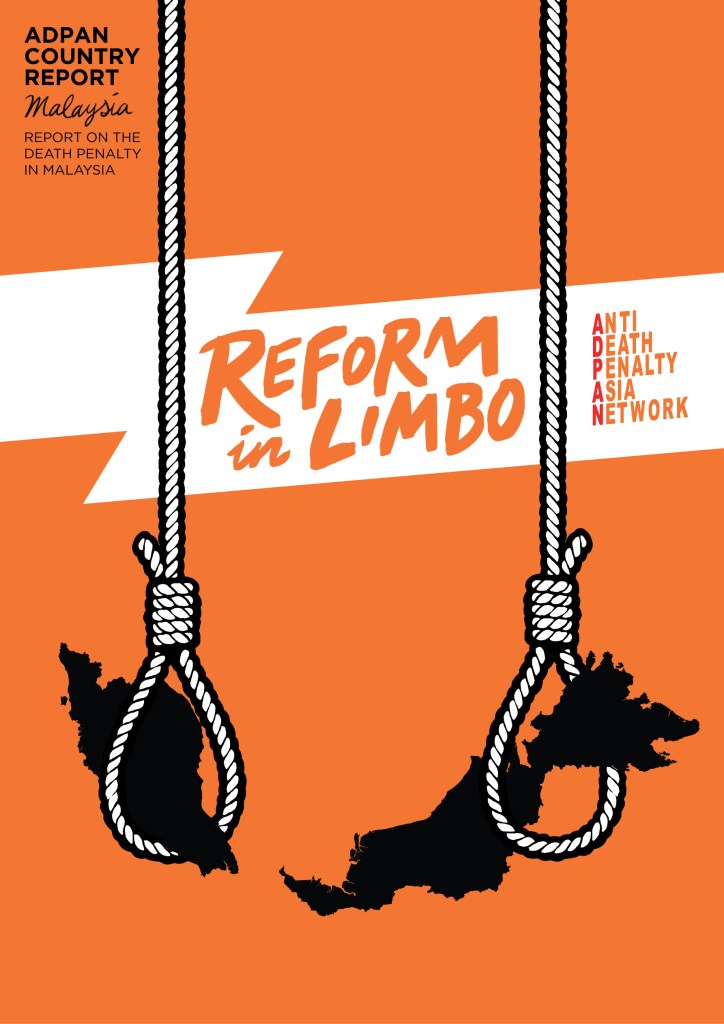
ADPAN Country Report: Malaysia Reform in Limbo
ADPAN is launching our first thematic country report on the death penalty. The report covers the key developments related to the death penalty in Malaysia and detailed information on individuals on death row. The report can be downloaded below. EN: Country Report Malaysia Reform in Limbo.
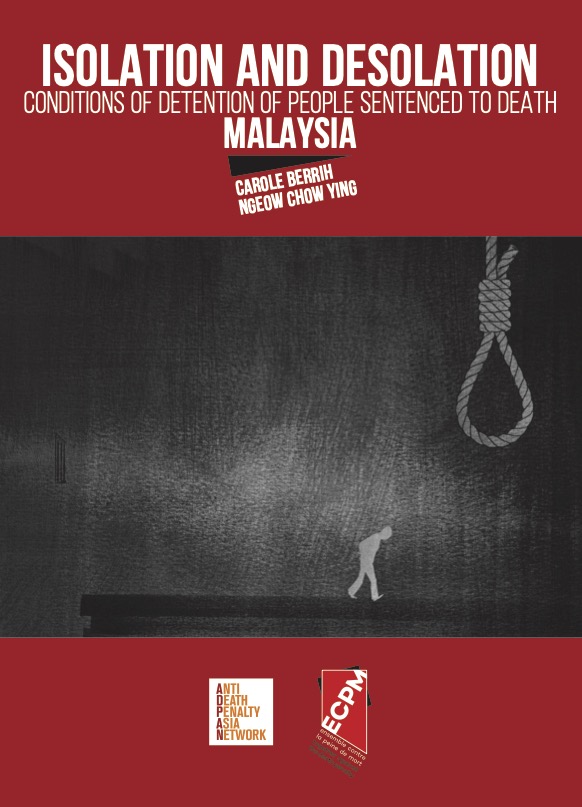
Isolation and Desolation: Conditions of detention of people sentenced to death Malaysia
Carole Berrih and Ngeow Chow Ying, 2020
Launched on 29 April 2020, this report is derived from a fact-finding mission carried out in Malaysia from July 2019 to February 2020 by ADPAN and ECPM (Together Against the Death Penalty). It was led by an ADPAN member and two lawyers from the Malaysian Bar Council, who conducted semi-directive individual interviews with death row prisoners, relatives of people sentenced to death, faith-based organisations providing religious counselling in prison, lawyers and psychiatrists in Malaysia. Carole Berrih, the author of the report, accurately uses all the accounts collected and puts them in the context of the country’s criminal and penitentiary systems.
This report is part of the “Fact-Finding mission on death row” collection which aims to make an assessment of the living conditions on death row in various countries across the world. The goal is both to report on the reality of death row and to engage public opinion.
Produced by ADPAN and ECPM (IEDHR Project)
Isolation and Desolation: Conditions of detention of people sentenced to death Malaysia
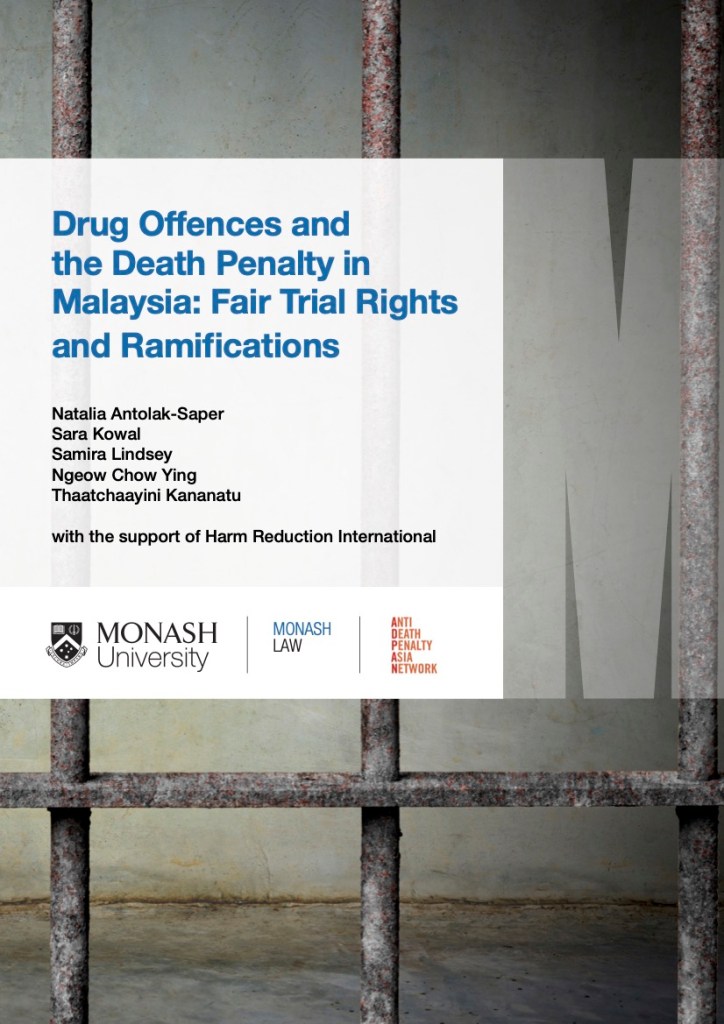
Drug offences & the death penalty in Malaysia: Fair Trial Rights and Ramifications
Natalia Antolak-Saper, Sara Kowal, Samira Lindsey, Ngeow Chow Ying, Thaatchaayini Kananatu, 2020
There are approximately 1280 people currently on death row in Malaysia.
A majority of these people have been convicted of drug-related offences. Many face socio-economic disadvantage, nationality and language barriers.
Harm Reduction International, Monash University and the Anti-Death Penalty Asian Network (ADPAN) have come together to investigate how the Malaysian criminal justice system affords people charged with drug-related capital offences access to justice and fair trial rights, from the stage of arrest through to death row.
Drug Offences and the Death Penalty in Malaysia: Fair Trial Rights and Ramifications
To view the launch event, click here
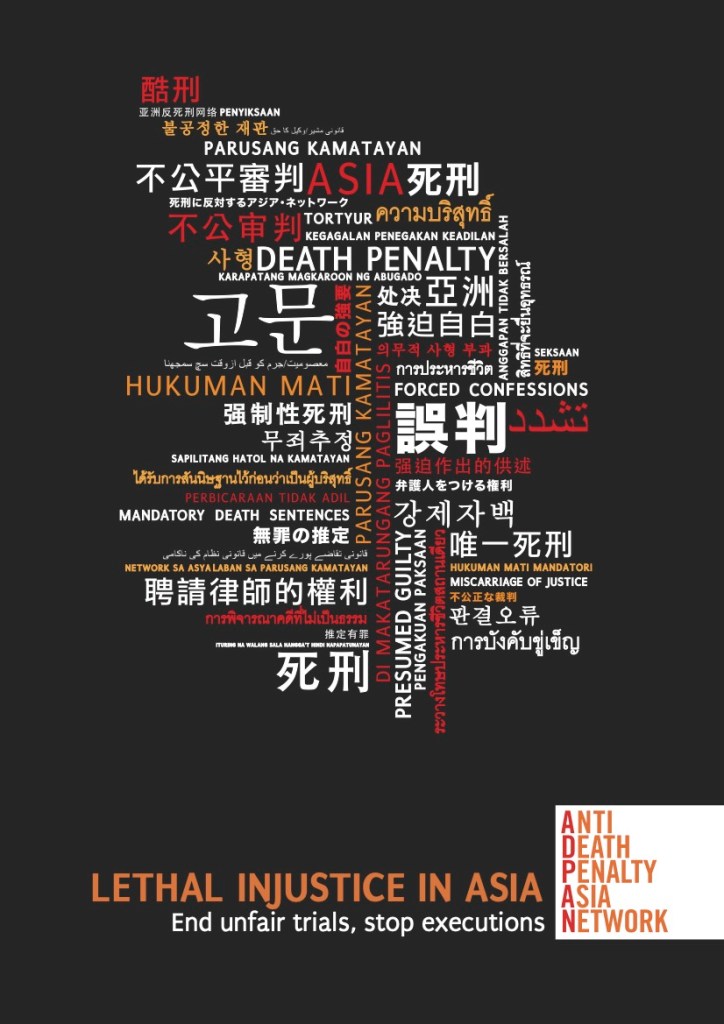
Unfair Trials Report
On 6 December 2011 the Anti-Death Penalty Asia Network launched two major reports that explain why unfair convictions are so common in Asia-Pacific, where governments execute more people than the rest of the world combined, and details the stories behind the statistics.
The death penalty, even with the most stringent fair trials safeguards in place, will inevitability claim innocent victims. It is meaningless to speakof the permissibility of an unfair trial – the right to a fair trial is an ancient one and in more recent years has been codified in international human rights law binding on all UN member states.
Despite the infallibility of any justice system, but given that the death penalty exists a right to a fair trial for those facing the death penalty is crucial and key to establishing safeguards the rights of the defendant but to serve the ends of justice as a whole.
The possibility of the state taking the life of someone in error following an unfair trial is real in the Asia Pacific region, where 95% of the population reside in jurisdictions that retain and use the death penalty. Safeguards for fair trial are being violated in law and practice in a number of countries throughout the Asia Pacific region. While proponents of the death penalty talk about the need to strengthen law and order and provide justice for victims of crime, evidence shows that justice in capital trials is often illusory and the law undermined in practice.
Short report: “Lethal Injustice in Asia – End Unfair Trials, Stop Executions”
Long report: “When Justice Fails. Thousands executed in Asia after unfair trials”
Nine individuals on death row are profiled in the ‘Unfair Trials’ Reports. Read the cases of Leng Guoquan (China), Devender P. Singh (India), Hakamada Iwao (Japan), Reza Shah (Malaysia), After Bahadur (Pakistan), Yong Vui Kong (Singapore), Chiou Ho-shun (Taiwan), Zulfiqar Ali (Indonesia) and Humphrey Jefferson Ejike Eleweke (Indonesia) below:
简体中文 (Simplified Chinese)
हिंदी (Hindi)
日本語 (Japanese)
한국의 (Korean)
Melayu (Malay)
Монгол (Mongolian)
ภาษาไทย (Thai)
اردو (Urdu)
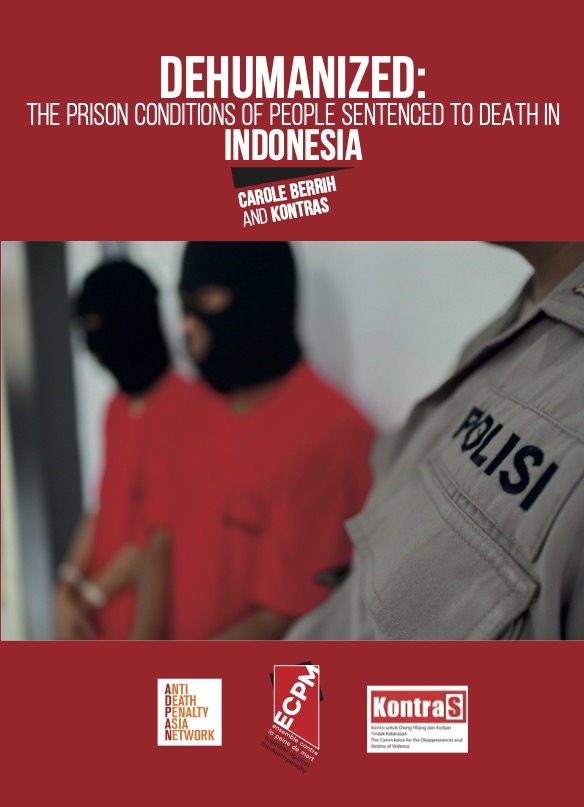
Dehumanized: The prison conditions of people sentenced to death in Indonesia
Carole Berrih and KontraS, 2019
Launched on 10 October 2019 – World Day Against Death Penalty, this report is derived from a fact-finding mission carried out in Indonesia from December 2018 to May 2019 by KontraS and ECPM (Together Against the Death Penalty). It was led by three KontraS members who conducted semi- directive individual interviews with death row prisoners, prison directors and wardens, and lawyers in Indonesia. Given that the investigation team could not be deployed in all the prisons that house people sentenced to death, they selected eight prisons which represent different types of prison. Other interviews were conducted by the author of the report, Carole Berrih, Director of Synergies Coopération, with relatives of people sentenced to death and lawyers. Carole Berrih accurately uses all the accounts collected and puts them into context within the country’s criminal and penitentiary systems.
This report is part of the “Fact-Finding mission on death row” collection which aims to make an assessment of the living conditions on death row in various countries across the world. The goal is both to report on the reality of death row and to engage public opinion.
Produced by KontraS, with ECPM and ADPAN (IEDHR Project)
Dehumanized: The prison conditions of people sentenced to death in Indonesia
