Singapore: Review the Death Penalty Halt Executions

Singapore: Review the Death Penalty Halt Executions

February 25, 2022, Statements

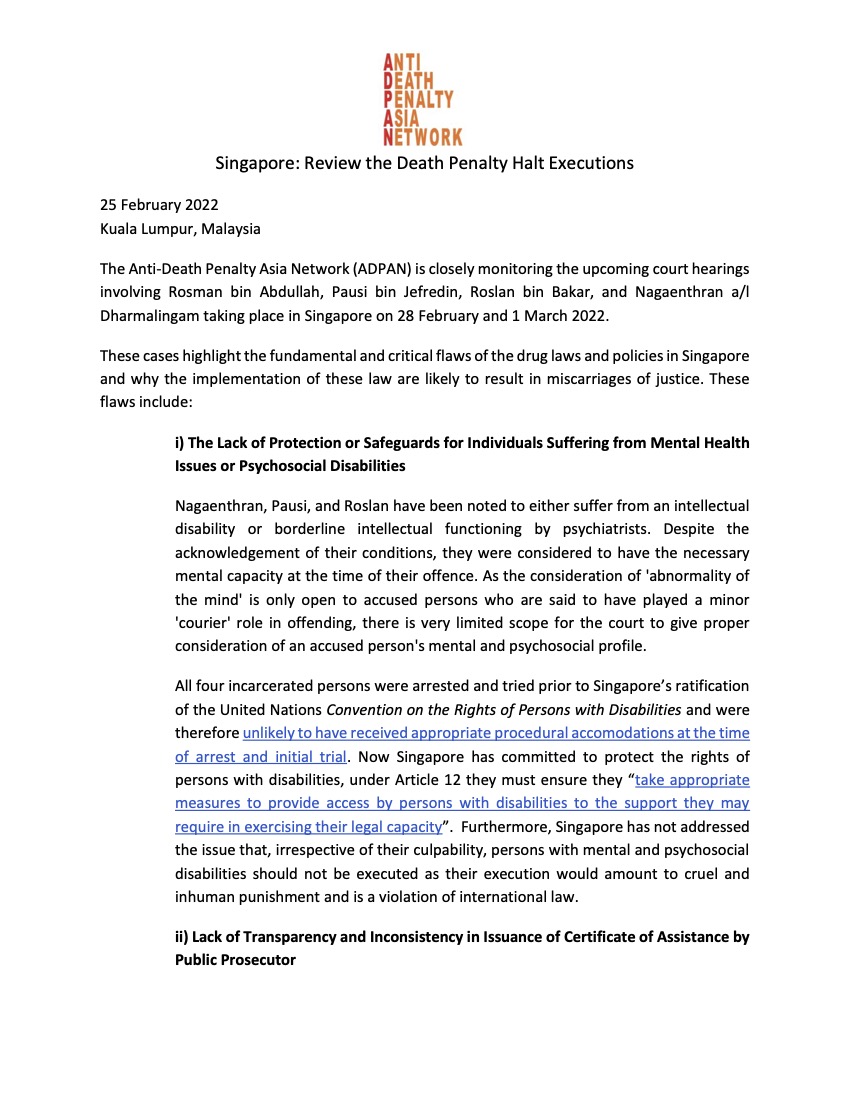
The Anti-Death Penalty Asia Network (ADPAN) is closely monitoring the upcoming court hearings  involving Rosman bin Abdullah, Pausi bin Jefredin, Roslan bin Bakar, and Nagaenthran a/l  Dharmalingam taking place in Singapore on 28 February and 1 March 2022. 

These cases highlight the fundamental and critical flaws of the drug laws and policies in Singapore  and why the implementation of these law are likely to result in miscarriages of justice. These  flaws include: 

i) The Lack of Protection or Safeguards for Individuals Suffering from Mental Health  Issues or Psychosocial Disabilities 

Nagaenthran, Pausi, and Roslan have been noted to either suffer from an intellectual  disability or borderline intellectual functioning by psychiatrists. Despite the  acknowledgement of their conditions, they were considered to have the necessary  mental capacity at the time of their offence. As the consideration of ‘abnormality of  the mind’ is only open to accused persons who are said to have played a minor  ‘courier’ role in offending, there is very limited scope for the court to give proper  consideration of an accused person’s mental and psychosocial profile. 

All four incarcerated persons were arrested and tried prior to Singapore’s ratification  of the United Nations Convention on the Rights of Persons with Disabilities and were  therefore unlikely to have received appropriate procedural accomodations at the time  of arrest and initial trial. Now Singapore has committed to protect the rights of  persons with disabilities, under Article 12 they must ensure they “take appropriate  measures to provide access by persons with disabilities to the support they may  require in exercising their legal capacity”. Furthermore, Singapore has not addressed  the issue that, irrespective of their culpability, persons with mental and psychosocial  disabilities should not be executed as their execution would amount to cruel and  inhuman punishment and is a violation of international law.  

ii) Lack of Transparency and Inconsistency in Issuance of Certificate of Assistance by  Public Prosecutor

Earlier court decisions on the issue of Certificate of Assistance suggests that  substantive assistance that is required cannot be based on the defence’s subjective  beliefs but on the will of the Public Prosecutor.  

The lack of an objective, transparent and consistent methodology in the issuance of  the Certificate of Assistance gives rise to a sense of injustice or perception of bias or  abuse.  

For these reasons, ADPAN maintains its view that given the courts are the ultimate  adjudicators in criminal trials, the decision whether or not an accused person’s level  of cooperation amounts to ‘substantive assistance’ should lie with the judiciary.  Judicial determination of ‘substantive assistance’ would allow objective measures to  be set and create a mechanism for a proper review of such decisions.  

iii) Hasty and Onerous Judicial Processes that Undermines the Right to Fair Trial 

The haste in the recent cases raises additional concerns regarding the potential  violation of important fair trial guarentees. Despite the gravity of the death sentence,  the hearings and subsequent appeals were concluded within hours. The speed in  which the matters were ‘resolved’ effectively denies the defence an adequate  opportunity to prepare and argue complex appelant casework and casts doubt as to  whether the arguments were given due consideration by the court. Legal counsel,  appearing on a pro-bono basis, are put in an excruciatingly difficult position where  they are required to brief their clients on the case whilst drafting an appeal that needs  to be filed within the hour. 

Furthermore, in the case of Roslan and Pausi, the court required a security of cost  order of 20,000SGD be lodged to the court on behalf of the Applicants within an hour  of the decision by the High Court. The exorbitant sum denies and deters legitimate  judicial challenges from being heard as many would unlikely be able to pay such an  amount within limited time. Incarcerated persons on death row and their families are  disproportionately indigent and largely reliant on pro-bono legal assistance,  particularly at the final appeal stage of their cases. The requirement to lodge funds  before accessing the right to appeal in a death penalty case sets a prohibitive and  discriminatory financial barrier to accessing justice.  

The presence of any one of these issues ought to have been enough of a concern for the death  penalty to be set aside for the incarerated persons on death row concerned. Unfortunately, this  has not been the case in Singapore despite the presence of multiple or all these factors in a single  case. The irreversible nature of the death penalty means that courts must uphold the strictest 

observance of fair trial guarentees. Furthermore, international norms dictate that for the  minority of States that still apply the death penalty, it can only be applied to ‘the most serious  crimes’. This is a threshold that drug offences does not meet and has been consistently excluded  from the category of ‘the most serious crimes’. 

ADPAN calls on the Government of Singapore: 

  • To impose a moratorium on executions and join the clear global trend that is moving  towards abolotion of the death penalty;
  • To review Singapore’s continued reliance on the death penalty based on the false perception that the death penalty is an effective deterrence to crime;
  • To facilitate independent psychiatric and medical assessments of all death row prisoners at the time an execution is listed, to ensure that Singapore is adhering to its obligations under the UN Convention of Persons with Disability; 
  • To commute the sentences of individuals suffering from mental illness, mental and psychosocial disabilities;
  • and to ensure that no persons with mental illness or disability are executed.
Singapore – Imminent Execution of Rosman Abdullah

Singapore – Imminent Execution of Rosman Abdullah

November 20, 2022, Statements

The Anti-Death Penalty Asia Network (ADPAN) is concerned with yet another execution scheduled in  Singapore. Rosman bin Abdullah has been scheduled for execution on 23 February 2022 for the  offence of drug trafficking. 

The number of executions scheduled by Singapore in recent months is highly concerning as prior cases  were all identified to be problematic in nature. Nagaenthran a/l Dharmalingam, Roslan bin Bakar and  Pausi bin Jefredin were all identified to be of low IQ, and yet Singapore has consistently refused to  acknowledge the implication of their conditions in relation to the crime they are convicted of. 

A medical assessment of Rosman noted that he was likely to suffer from Attention Deficit Hyperactivity  Disorder (ADHD) and had prior drug dependence on amphetamines. The assessment notes that while  Rosman was of sound mind during the time of his offence, his underlying conditions likely contributed  to the commission of the offence. Unfortunately, Singapore’s present legal framework does not  provide automatic consideration for individuals who suffer from mental and psychosocial disabilities,  and it does not recognise the impact of such disabilities on a person’s actions leading to the  commission of an offence. The defence of ‘abnormality of the mind’ is only open to accused persons  who are said to have played a minor ‘courier’ role in offending; proper consideration of an accused  person’s mental and psychosocial profile should not be limited based on the role in an offence they  are alleged to have undertaken. This position is discordant with Singapore’s obligations to uphold  Article 12 of the Conventions on the Rights of Persons with Disabilities1

Furthermore, the Rosman case also reveals the inconsistency and subjectivity behind the issuances of  the certificate of assistance by the public prosecutor. In his statement, Rosman revealed the nature of  his role in the commission of the offence and information relating to the buyer, the seller and the  process of procurement for the drugs in question. Despite his testimony, the relevant authorities have  chosen not to issue the certificate. 

The court in his case ruled that while Rosman may subjectively believe that he rendered substantive  assistance, this would not be adequate if the public prosecutor deemed that there was no substantive  assistance rendered. This is a highly problematic process of certification that relies solely on the  subjective will of the public prosecutor with no need for any form of transparency nor recognisable  and objective standards. The lack of objective standards places excessive power in the hands of the  public prosecution as they would be, in effect, accountable to no one in the issuance of the certificate. 

Given the courts are the ultimate adjudicators in criminal trials, the decision whether or not an  accused person’s level of cooperation amounts to ‘substantive assistance’ should lie with the judiciary  in order for transparency, accountability and consistency to apply.  

During the parliamentary debate on the matter, the Minister of Law suggested that the latitude  afforded to the public prosecutor was to encourage the provision of useful assistance that falls out of  the statutory definition of assistance. However, the present state of how the certificate of assistance  is issued, especially in other cases similar to Rosman when the convicted person has provided  

1 Equal recognition before the law – 

https://www.ohchr.org/EN/HRBodies/CRPD/Pages/ConventionRightsPersonsWithDisabilities.aspx#12

substantial information to the relevant authorities but fail to obtain the certificate, would undermine  the raison d’etre of the certificate of assistance. 

The current method of implementation, and lack of transparency, supports the perception that the  certificate of assistance is unreachable for most convicted, despite their best efforts to assist. In the  long run, this would gradually discourage assistance and cooperation by accused and convicted  persons as they would find it pointless and irrelevant for them to give any form of cooperation when  their final destination would be the gallows despite their willingness to repent and cooperate with  authorities. 

Recognising the existing flaws in the foundation and implementation of the Misuse of Drug Act and  the international norm where drug offences do not constitute the ‘most serious crimes’ which the  capital punishment can be meted out suggests that Singapore ought to suspend further executions  and review its law and policy on the death penalty. 

To this end, ADPAN calls on the Government of Singapore to call off the scheduled execution and  implement a moratorium on further executions.

Singapore: Respite Order for Roslan bin Bakar and Pausi bin Jefridin

Singapore: Respite Order for Roslan bin Bakar and Pausi bin Jefridin

February 18, 2022, Statements

The Anti-Death Penalty Asia Network (ADPAN) welcomes the President’s decision to grant  respite to Roslan bin Bakar and Pausi bin Jefridin and calls on the Government of Singapore  to commute their sentences considering their vulnerabilities as persons with borderline  intellectual functioning and intellectual disability.  

ADPAN strongly encourages the Government of Singapore to impose a moratorium on  execution and to review the use of the death penalty in Singapore. 

International law and norms limit the use of the death penalty only for the most serious  crimes involving intentional crimes with lethal consequences. Drug trafficking does not meet  this threshold and it is disproportionate for persons convicted of drug offences to be punished  with the death penalty. Furthermore, the death penalty has not been proven to be an  effective means of deterrence and this should not be the foundation on which the death  penalty is applied.

Statement on Singapore Executions

Statement on Singapore Executions

February 16, 2022, Statements

Ensemble contre la peine de mort (ECPM), Responsible Business Initiative for Justice, Eleos Justice, Capital Punishment Justice Project (CPJP) and Anti-Death Penalty Asia Network (ADPAN) are dismayed that Singapore has scheduled two executions for Wednesday, 16th February. 

Executions have been on hold for the past two years in Singapore due to litigation, some of which arose on account of the impact of Covid-19 related restrictions. In November 2021, Singapore scheduled the execution of an intellectually disabled and mentally ill man, Nagaenthran a/l Dharmalingam, only to face legal challenges and international condemnation. Nagaenthran’s execution has been halted while he mounts a further legal challenge before the Supreme Court, which has been scheduled for 1 March 2022. 

As with Nagaenthran’s case, the cases of Roslan bin Bakar and Pausi bin Jefridin offer a window into the deep and systemic injustices that plague the death penalty in Singapore. 

Intellectual disability and the death penalty 

Our organisations oppose the death penalty in all circumstances for all people, and note that there is a global trend towards ending the practice for the intellectually disabled and mentally ill.1 

Singapore has ratified the UN Convention on the Rights of Persons with Disabilities, which states at Article 10: 

Every human being has the inherent right to life and shall take all necessary measures to ensure its effective enjoyment by persons with disabilities on an equal basis with others.” 

The UN General Assembly in Resolutions 71/187 of 2 February 2017; 73/185 of 17 December 2018; 75/183 of 16 December 2020 has “call[ed] upon States not to impose capital punishment on persons with mental or intellectual disabilities.” 

In 2017, the High Court of Singapore acknowledged that both Roslan and Pausi had IQ levels of lower than 70 at the time of the alleged commission of the offence. This indicates a significant impairment in the intellectual functioning of both individuals.2 

Neither Roslan nor Pausi have had an independent psychiatric or medical assessment in recent years, and it is not possible to know how severe their intellectual disabilities are at this point, or whether they have become mentally ill while on death row. However, it is well accepted that without appropriate psychosocial support, intellectual disability may worsen over time. 

At minimum, Singapore must facilitate access to independent psychiatrists and medical practitioners in order to assess the psychiatric and physiological conditions of those on its death row and to provide them with an appropriate standard of care. Surely if Singapore’s Court of Appeal is unwilling to execute a person afflicted with Covid-19 then that same ‘sense of logic, common sense and humanity’ that Justice Andrew Phang spoke of in November in Nagaenthran’s hearing ought to apply to those with intellectual disabilities or severe mental illness.

A Joint Statement by Capital Punishment Justice Project, Eleos Justice And Anti-Death Penalty Asia Network Upon the Occasion of the Repeal of The Death Penalty by the Parliament of Papua New Guinea

A Joint Statement by Capital Punishment Justice Project, Eleos Justice And Anti-Death Penalty Asia Network Upon the Occasion of the Repeal of The Death Penalty by the Parliament of Papua New Guinea

January 24, 2022, Statements

Capital Punishment Justice Project (CPJP), Eleos Justice and Anti-Death Penalty  Asia Network (ADPAN) commend the decision on 21 January 2022 by the  Parliament of Papua New Guinea (PNG) to repeal the death penalty. This is a  moment of historical importance for the global anti-death penalty movement,  and it is also a significant victory for human rights in the Asia Pacific region.  

The repeal of the death penalty ends months of uncertainty and concern that  executions may resume in PNG, following the 30 July 2021 judgment of the  Supreme Court of Papua New Guinea, which paved the way for the possibility  that the near 70-year moratorium on executions would end.  

Despite the Supreme Court having quashed the National Court’s temporary  stay of executions for all people sentenced to death, and despite the  reintroduction of the death penalty in 1991, PNG’s government has decided  that there is a different and better way to forge ahead and that the death  penalty is both inhumane and is not effective as a deterrent for serious  crime. We endorse Prime Minister James Marape’s statement, that made  reference to ‘other global trends and studies’, noting that the death penalty ‘is  not an effective deterrent to serious crime and offences’. We also endorse the  statement of PNG’s Justice Minister Bryan Kramer who noted that it was not  possible for PNG to carry out the death penalty in a humane way. 

CPJP, Eleos Justice and ADPAN now call on PNG to ratify the Second Optional  Protocol to the International Covenant on Civil and Political Rights (ICCPR) in  order to make a firm commitment that abolition will hold, noting that this is  not the first time that PNG has abolished the death penalty, but that we have  confidence it will be the last. We also call on PNG to ensure that the 40  prisoners that reportedly on death row at present are given the opportunity to  have a resentencing hearing, noting that there may be new evidence or compelling arguments that may make it appropriate that their sentences not  be automatically converted to life sentences. We note that the PNG  Department of Justice and Attorney General have established a new quasi judicial Advisory Committee on the Power of Mercy (ACPM) which appears to  be an appropriate mechanism to conduct such reviews. 

We also encourage the last remaining vestige of the death penalty in the  Pacific – the nation of Tonga – to follow the example of PNG and to repeal the  death penalty, thereby bringing it into line with the other Pacific nations which  are at the forefront of the abolitionist movement. While every nation grapples  with different criminal justice issues against the backdrop of the pandemic,  there continues to be overwhelming evidence that the death penalty is cruel,  inhumane and degrading, that it disproportionately affects the disadvantaged  and marginalised, and that its existence does not deter the commission of  death eligible offences. We are pleased to see abolitionist states such as  Australia taking steps to implement their policy commitment to advocate for  abolition globally, through their bilateral discussions with retentionist states.


Joint Statement on Sentencing of Sri Lankan Prison Superintendent to the Death Penalty

Joint Statement on Sentencing of Sri Lankan Prison Superintendent to the Death Penalty

January 12, 2022, Statements

The undersigned organizations are alarmed by the recent publication by the Chinese authorities of new judicial guidelines  providing directives to prosecute and harshly punish, including by the death penalty, those advocating and acting for  Taiwan’s independence. The guidance effectively encourages China’s courts and law enforcement agencies to violate  several rights established under international human rights law and standards, including the rights to life, to the freedoms of expression, peaceful assembly and association, and to a fair trial. We call on the Chinese authorities to immediately withdraw the guidelines and swiftly introduce legislative changes to repeal vague and overly broad national security-related offences and the death penalty, as critical first steps. 

On 21 June 2024, the Supreme People’s Court of China jointly issued with the Supreme People’s Procuratorate, the  Ministry of Public Security, the Ministry of State Security and Ministry of Justice the “Opinions on Punishing ‘Taiwan  Independence’ Diehards for Conducting or Inciting Separatism in Accordance with Law” (henceforth, guidelines).1 The  guidelines are based on existing provisions under China’s Anti-Secession Law, Criminal Law and Criminal Procedure Law; and encourage lower courts and various government and law enforcement agencies to prosecute and punish as national  security offences various acts, including peaceful ones, aimed at the pursuit of the independence of Taiwan from China.  The guidelines came into effect upon publication.  

Our organizations are gravely concerned by the violations of human rights that are encouraged and would be carried out  through the implementation of these guidelines. By explicitly criminalizing and demanding harsh punishments for peaceful acts that aim at advocating for Taiwan’s independence, the Chinese authorities are cracking down under the  pretext of national security on the rights to freedom of expression, freedom of peaceful assembly and other human rights.  

According to internationally recognized human rights standards, “national security” cannot be invoked to justify  restrictions on rights and freedoms unless genuinely and demonstrably intended to protect a state’s existence or territorial  integrity against specific threats of the use of force;2 nor can this national security framework legitimately be applied by governments to entrench a particular ideology or deny people the right to express different political views and to exercise  their other human rights as protected by international legal standards.3 Expression can only be punished as a threat to  national security when the authorities can demonstrate that the speaker has the intent to incite violence, there is a  likelihood that the expression will incite such violence and a direct and immediate connection between the expression and  the likelihood or occurrence of such violence.4 Speech such as advocating for a change in government or government  policy, as well as criticism or even insult of a state’s institutions or its symbols, or exposure of human rights violations, is  protected under international human rights law and must not be restricted or penalized on national security grounds.5 Likewise, demanding territorial changes in the form of autonomy or even secession in speeches and demonstrations does  


not automatically amount to a threat to the country’s territorial integrity and national security.6 The UN Human Rights  Committee, the UN body tasked with monitoring the implementation of the International Covenant on Civil and Political  Rights (ICCPR) – which China signed in 1998 – has frequently rejected attempts to justify far-reaching restrictions with  vague references to “national security”.7 

Of additional concern is the broad definition of aggravating circumstances that would warrant the harshest penalties,  including the death penalty, under sections 6 and 7 of the guidelines.8International human rights law and standards set  out that the imposition of the death penalty must not be based on “vaguely defined criminal provisions, whose application  to the convicted individual depend on subjective or discretionary considerations, the application of which is not  reasonably foreseeable.”9 These are necessary requirements prescribed by the principle of legality, a core general  principle of law, enshrined, among other places, in Article 15 of the ICCPR and Article 11 of the Universal Declaration of  Human Rights. Without an explicit and effective requirement to comply with international human rights law, vague terms  leave the law open to abuse by authorities who use it to crack down on a wide range of human rights.10 Vaguely drafted  laws can lead to a chilling effect and ultimately self-censorship in public debate, including online. 

We oppose the death penalty absolutely and are already greatly concerned at the overall lack of transparency that  surrounds the use of the death penalty in China. We are further alarmed that the guidelines recommend the imposition of  this cruel punishment in violation of the principle of legality; and as a result of trials where the defendant is not present (in  absentia), including on people in other countries. Death sentences imposed in unfair proceedings are arbitrary in nature  and amount to a violation of the right to life.11 Furthermore, pending full abolition of the death penalty, international law  and standards restrict its use to the “most serious crimes”, most recently interpreted as referring to “crimes of extreme  gravity involving intentional killing”.12 The majority of acts criminalized in the guidelines do not meet this minimum  threshold.13 

We call on the Chinese government and all authorities to review and amend all laws and regulations, and end all related  policies and measures, that violate human rights, in particular the rights to life, freedom of expression, peaceful assembly  and association, and ensure that any legal provisions aimed at protecting national security are clearly and narrowly  defined and conform to international human rights law and standards. We urge the authorities to establish an immediate  moratorium on all executions, as well as initiate legislative amendments to fully abolish the death penalty and commute all  death sentences.  

This statement is co-signed by:  

  1. Amnesty International 
  2. Anti-Death Penalty Asia Network 
  3. Capital Punishment Justice Project 
  4. The Rights Practice 
  5. World Coalition Against the Death Penalty 

***

  1. English translation available at https://en.spp.gov.cn/2024-06/21/c_998795.htm 
  2. Siracusa Principles on the Limitation and Derogation of Provisions in the International Covenant on Civil and Political Rights, UN Doc. E/CN.4/1985/4,  paras. 29-30. 
  3. Johannesburg Principles on National Security, Freedom of Expression and Access to Information, adopted on 1 October 1995 by a group of experts in  international law, national security, and human rights convened by Article 19, the International Centre Against Censorship, in collaboration with the  Centre for Applied Legal Studies of the University of the Witwatersrand in Johannesburg, http://www.article19.org/data/files/pdfs/standards/joburgprinciples.pdf 4 Johannesburg Principle 6. 
  4. Johannesburg Principle 7.
  5. European Court of Human Rights, Stankov and the United Macedonian Organisation Ilinden v. Bulgaria, application numbers (29225/95 and  29221/95), 2001, para. 97. 
  6. UN Human Rights Committee, “General Comment 34: Freedom of opinion and expression (Art. 19)”, UN Doc. CCPR/C/GC/34, 12 September 2011,  paras. 21-26. 
  7. For example, the death penalty may be imposed for those “who cause particularly serious harm to the state and the people” and when the  circumstances of the crime are “particularly heinous”. 
  8. Human Rights Committee, General comment No. 36 (2018) on article 6 of the International Covenant on Civil and Political Rights, on the right to life,  UN Doc. CCPR/C/GC/36, para.38. 
  9. Working Group on Arbitrary Detention, Report, 15 December 2003, UN Doc. E/CN.4/2004/3, paras 64-65. 
  10. UN Human Rights Committee, General comment No. 36 (2018) on article 6 of the International Covenant on Civil and Political Rights, on the right to  life, UN Doc. CCPR/C/GC/36, para.41. 
  11. UN Human Rights Committee, General comment No. 36 (2018) on article 6 of the International Covenant on Civil and Political Rights, on the right to  life, UN Doc. CCPR/C/GC/36, para.35. 
  12. Conduct considered as “serious crime” include directly participating in the implementation of major separatist activities of an organization advocating  for Taiwan’s independence; or carrying out activities advocating for Taiwan’s independence with serious consequences and adverse impacts; and  playing a significant role in separatist activities.

Joint statement on the killing of Priyantha Kumara

Joint statement on the killing of Priyantha Kumara

April 20, 2022, Statements

We, the undersigned, condemn the brutal murder of Priyantha Kumara on 3  December 2021 in Sialkot, Pakistan. Kumara, a Sri Lankan national, was  lynched and his body set alight by a mob after allegations of blasphemy were reportedly levelled against him.  

Kumara’s murder is not an isolated incident, but the latest episode of an  ongoing and increasing pandemic of violence perpetrated in the name of  religion. According to the Centre for Social Justice (Pakistan), at least 81 

people accused of blasphemy have been extralegally killed in Pakistan since  1994.  

The spike in such violence coincides with blasphemy becoming a capital  offence under Pakistani law. Blasphemy has been criminalised in Pakistan  since Partition; however, the introduction of the discretionary death penalty for  blasphemy in 1986 (which became mandatory in 1991) appears to have  inflamed religious tensions in the country. Since then, the number of  blasphemy accusations has soared, with the Centre for Social Justice  (Pakistan) documenting a record 200 cases in 2020 alone. It has been  suggested that the State’s strict anti-death penalty stance—of which the  hundreds of death sentences meted out are illustrative—and paradoxical  reluctance to carry out executions on this basis have encouraged civilians to  take matters into their own hands, inspiring vigilante justice

Pakistani authorities have been widely criticised for failing to address, and in  some cases even endorsing, such violence. Amnesty International has stated that ‘the lack of a consistent, robust and timely response by the authorities to  situations of developing mob violence… and the failure to prosecute rigorously  

and promptly those responsible, leads to a climate of impunity which can  provide fertile ground for further such attacks’. 

We call on Pakistan to take urgent steps to realise justice for Kumara and his  family, and to address the deep-seated legal and sociocultural issues of which  this crime is a symptom. Failure to act would render the authorities as having  acquiesced to, or being complicit in, killings of this nature. In the short term,  we welcome Prime Minister Imran Khan’s decision to oversee a  comprehensive and impartial investigation of Kumara’s murder and hold his  assailants accountable by full and fair operation of criminal justice processes.

Looking forward, we call on the government of Pakistan to: 

  1. Take steps to reform its blasphemy framework, including the abolition of  the death penalty for blasphemy, in a manner that is both compliant with  international human rights law and accommodating of societal  sensitivities. 
  2. 2. Recognise that in addition to legal reform, administrative and  educational measures must be taken to end the climate of fear and the  impunity with which blasphemy-related violence is committed. 

BANGLADESH: Immediate Moratorium on Executions Must be Imposed

BANGLADESH: Immediate Moratorium on Executions Must be Imposed

November 30, 2021, Statements

We the undersigned civil society organizations condemn attempts1 by Bangladeshi authorities to proceed  with the execution of Shukur Ali, in violation of his right to a fair trial and in total disregard of due process. 

On 7 November 2021, it was reported that the prisons authorities sought to proceed with the execution of Mr. Shukur Ali who was convicted in 2004 for the abduction, rape and murder of a 13-year-old girl,  despite the fact that the release of his appeal-verdict by the in August 2021 was still pending. On 7  November, the Supreme Court ordered to halt Mr. Shukur Ali’s execution until it releases the full text of  the judgement after the schedule execution was circulated publicly through the media. 

This incident would not be the first of its kind in Bangladesh as recently published reports2suggest that  two convicts – namely Abdul Mokim and Golam Rasul Jharu – were executed in Jessore Central Jail on 16  November 2017 while their appeals were pending before the Supreme Court of Bangladesh. Such cases  are a violation of a person’s right to life and the right to a fair trial and due process. These planned executions are also in violation of Article 35 (3) of the Constitution of Bangladesh as the due process of  law was denied to the convicts prior to the execution of the capital punishment. 

In addition, Article 14 of the International Covenant on Civil and Political Rights (ICCPR) guarantees that  everyone convicted of a crime shall have the right to his conviction and sentence being reviewed by a  higher tribunal according to law. Failure to fulfil and uphold these rights in such cases renders the  execution unlawful and an act of extrajudicial killing by state authorities. 

We call on Bangladesh to investigate the violation of the right to fair trial against Mr. Shukur Ali and ensure  that similar violations do not take place against other individual. Failure to safeguard the right to a fair  trial will undoubtedly contribute to the violation of their right to life. We also call on the Bangladeshi  government to immediately impose a moratorium on executions and review the use of the death penalty  in Bangladesh in line with international trends towards abolition.

Arbitrary Arrest and Detention of Khurram Parvez

Arbitrary Arrest and Detention of Khurram Parvez

November 24, 2021, Statements

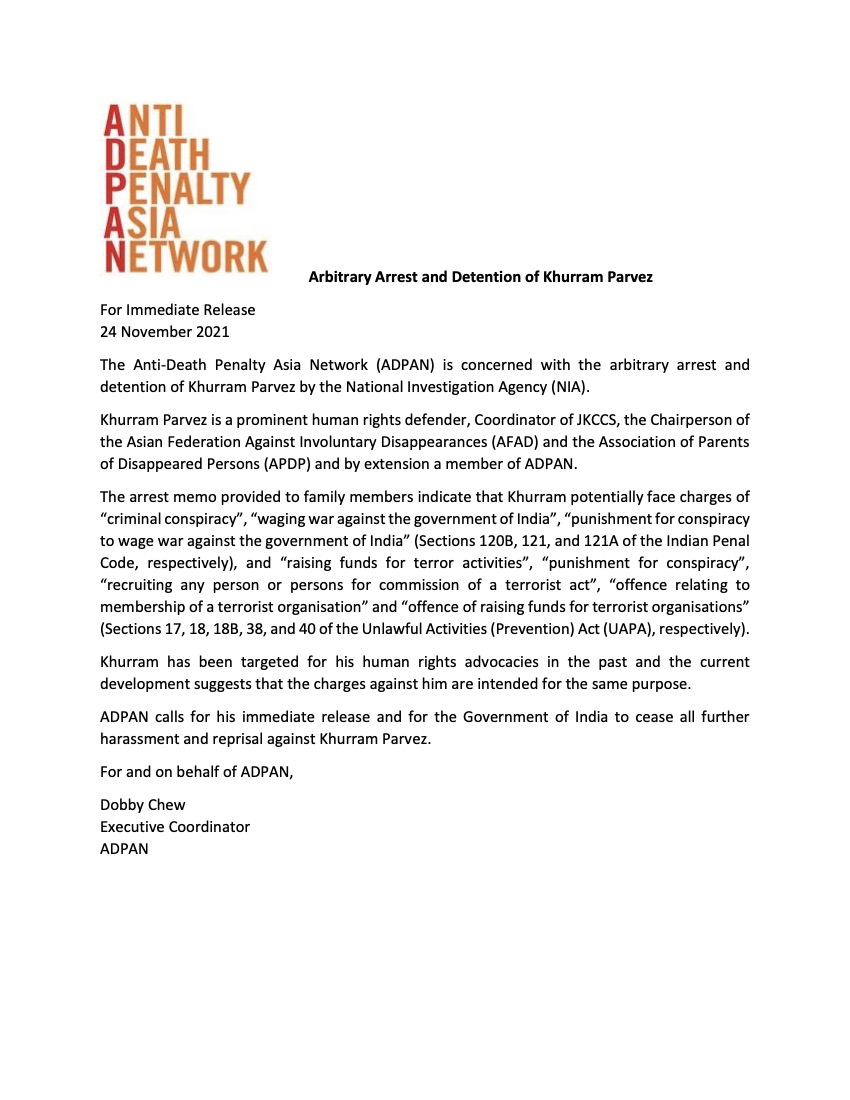
The Anti-Death Penalty Asia Network (ADPAN) is concerned with the arbitrary arrest and  detention of Khurram Parvez by the National Investigation Agency (NIA). 

Khurram Parvez is a prominent human rights defender, Coordinator of JKCCS, the Chairperson of  the Asian Federation Against Involuntary Disappearances (AFAD) and the Association of Parents  of Disappeared Persons (APDP) and by extension a member of ADPAN. 

The arrest memo provided to family members indicate that Khurram potentially face charges of  “criminal conspiracy”, “waging war against the government of India”, “punishment for conspiracy  to wage war against the government of India” (Sections 120B, 121, and 121A of the Indian Penal  Code, respectively), and “raising funds for terror activities”, “punishment for conspiracy”,  “recruiting any person or persons for commission of a terrorist act”, “offence relating to  membership of a terrorist organisation” and “offence of raising funds for terrorist organisations”  (Sections 17, 18, 18B, 38, and 40 of the Unlawful Activities (Prevention) Act (UAPA), respectively). 

Khurram has been targeted for his human rights advocacies in the past and the current  development suggests that the charges against him are intended for the same purpose. 

ADPAN calls for his immediate release and for the Government of India to cease all further  harassment and reprisal against Khurram Parvez. 

Singapore: Execution of Person with Intellectual Disabilities a Violation of International Law

Singapore: Execution of Person with Intellectual Disabilities a Violation of International Law

October 29, 2021, Statements

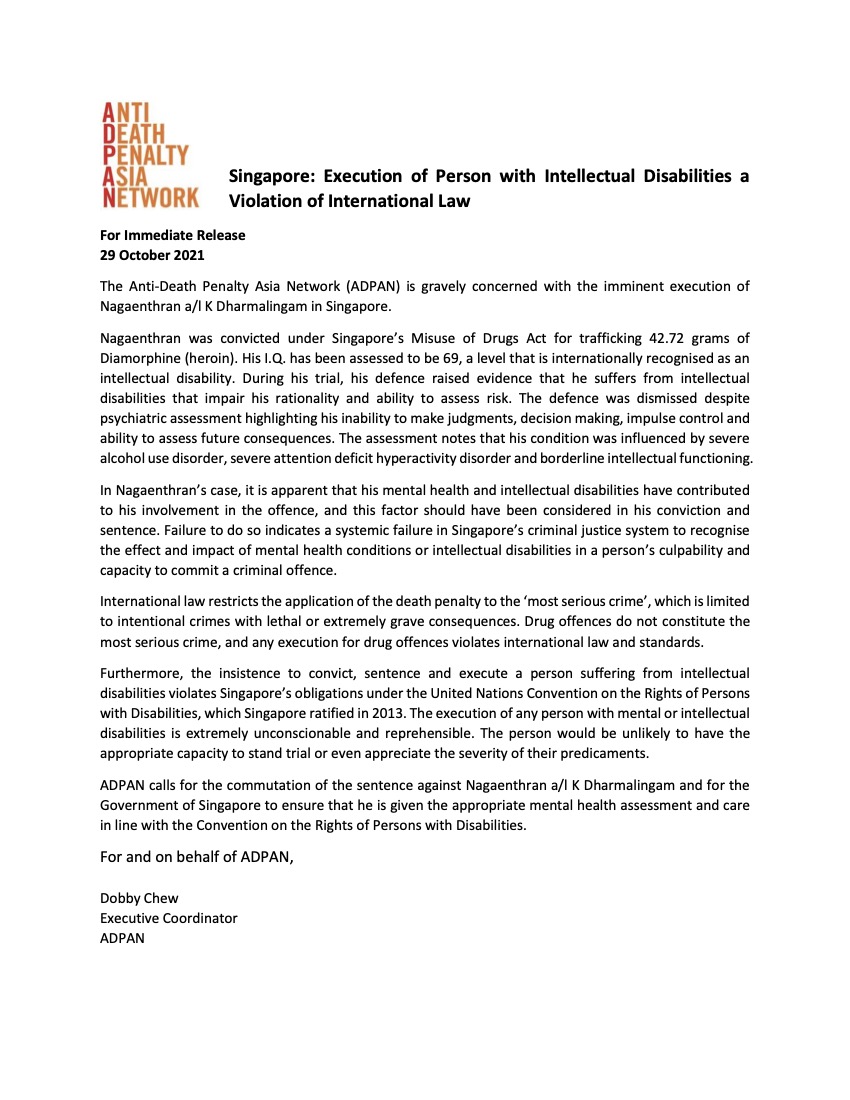
The Anti-Death Penalty Asia Network (ADPAN) is gravely concerned with the imminent execution of  Nagaenthran a/l K Dharmalingam in Singapore. 

Nagaenthran was convicted under Singapore’s Misuse of Drugs Act for trafficking 42.72 grams of  Diamorphine (heroin). His I.Q. has been assessed to be 69, a level that is internationally recognised as an  intellectual disability. During his trial, his defence raised evidence that he suffers from intellectual  disabilities that impair his rationality and ability to assess risk. The defence was dismissed despite  psychiatric assessment highlighting his inability to make judgments, decision making, impulse control and  ability to assess future consequences. The assessment notes that his condition was influenced by severe  alcohol use disorder, severe attention deficit hyperactivity disorder and borderline intellectual functioning. 

In Nagaenthran’s case, it is apparent that his mental health and intellectual disabilities have contributed  to his involvement in the offence, and this factor should have been considered in his conviction and  sentence. Failure to do so indicates a systemic failure in Singapore’s criminal justice system to recognise  the effect and impact of mental health conditions or intellectual disabilities in a person’s culpability and  capacity to commit a criminal offence. 

International law restricts the application of the death penalty to the ‘most serious crime’, which is limited  to intentional crimes with lethal or extremely grave consequences. Drug offences do not constitute the  most serious crime, and any execution for drug offences violates international law and standards.  

Furthermore, the insistence to convict, sentence and execute a person suffering from intellectual  disabilities violates Singapore’s obligations under the United Nations Convention on the Rights of Persons  with Disabilities, which Singapore ratified in 2013. The execution of any person with mental or intellectual  disabilities is extremely unconscionable and reprehensible. The person would be unlikely to have the  appropriate capacity to stand trial or even appreciate the severity of their predicaments.  

ADPAN calls for the commutation of the sentence against Nagaenthran a/l K Dharmalingam and for the  Government of Singapore to ensure that he is given the appropriate mental health assessment and care  in line with the Convention on the Rights of Persons with Disabilities.