Myanmar: Death Penalty by Military Tribunal Contravenes International Law

Myanmar: Death Penalty by Military Tribunal Contravenes International Law

July 26, 2021, Statements

The Anti-Death Penalty Asia Network (ADPAN) strongly condemns the imposition of the death penalty  by the military tribunal in Myanmar. 

Civilians should not be made to stand trial by a military tribunal. A trial by a military tribunal at this  juncture reeks of political interference by the military junta which usurped the democratic  government of Myanmar earlier in the year. The imposition of the death penalty by a military tribunal  can only be interpreted as further attempts to intimidate and cowl political opponents to the junta. 

There are grave concerns that the military tribunal does not observe internationally recognized fair  trial processes. Apart from trials shrouded in secrecy, there are no avenues for those sentenced to  appeal the decision to an appropriate judicial body. The only avenue for appeal is through Senior  General, Min Aung Hlaing via the prison with no avenue for legal intervention by lawyers. The onerous  conditions and limited avenues for appeal cast further doubt on the legitimacy of the legal process  adopted by the military junta.  

Under international law, the death penalty can only be imposed for the most serious crime and the  right to a fair trial must be observed. In this instance, the 65 individuals sentenced have been denied  the right to a fair trial and there are substantial doubts on the legitimacy of the charges levelled against  them. If any crime was committed by any of the individuals, they should be trialled by a civilian court  not a military tribunal. 

ADPAN condemns these sentences and demands immediate retrial for those sentenced by a  competent and legitimate civilian court hearing, conducted in accordance with international fair trial  standards. In addition, ADPAN also calls for the allegations of extrajudicial killing involving State  security apparatuses by an independent and impartial tribunal. State sanctioned killing and the  imposition of the death penalty by the military junta in Myanmar must be halted immediately.

Global Moratorium on the Death Penalty

Global Moratorium on the Death Penalty

December 18, 2020, Statements

Anti-Death Penalty Asia Network (ADPAN) welcomes the latest United Nations General  Assembly vote for the global moratorium on the death penalty. With this vote, the world  moves ever closer to a consensus that rejects the death penalty with more member states in  favour of a global moratorium. 

ADPAN applauds the continued commitment for a global moratorium by states and  acknowledges the vote of support for the first time by South Korea, Djibouti, and Lebanon. It  is regrettable that countries in the Asia region continue to be the most resistant to the  adoption of the global trend towards total abolition of the death penalty. 

The death penalty has no place in any modern criminal justice system as it has consistently  failed to deliver justice, and proven time and time again to be flawed, discriminatory and  ineffective both as punitive and deterrent measures. ADPAN calls for countries that continue  to implement the death penalty to take proactive action to review the practice in their  respective jurisdictions and join the clear global trend towards abolition of the death penalty.

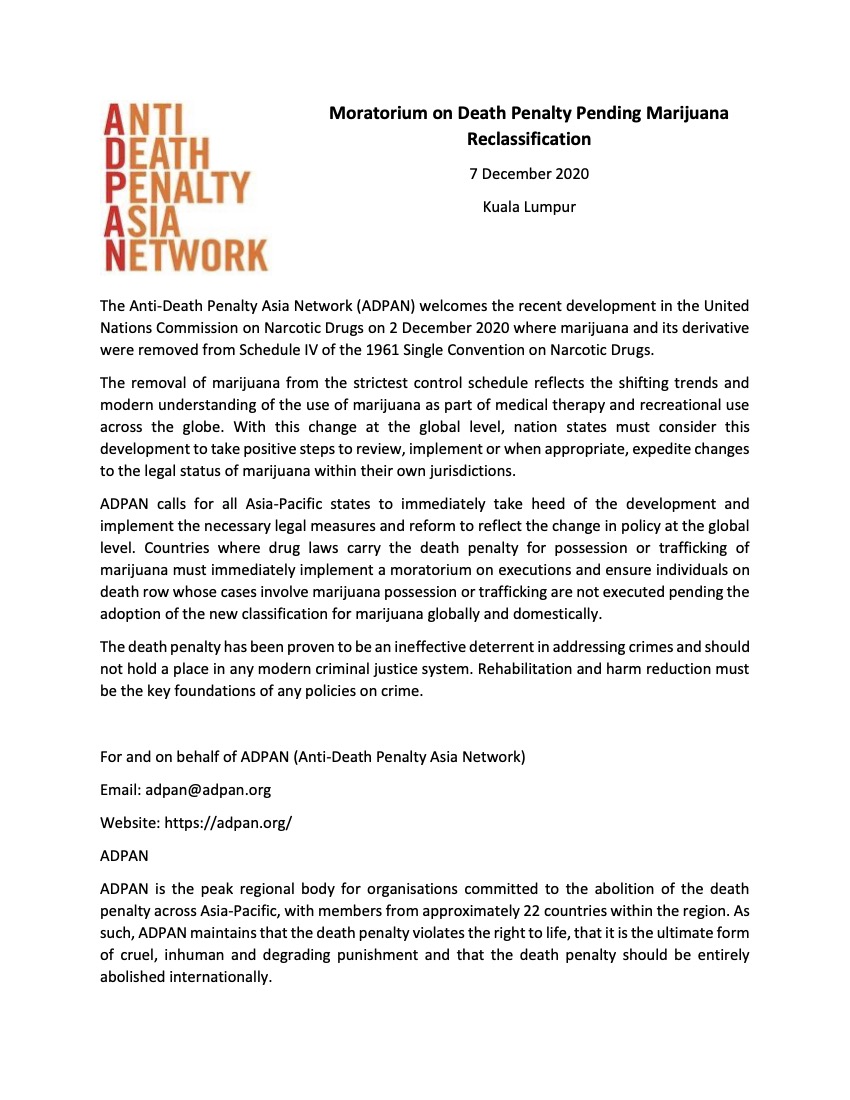
Moratorium on Death Penalty Pending Marijuana Reclassification

Moratorium on Death Penalty Pending Marijuana Reclassification

December 7,2020, Statements

The Anti-Death Penalty Asia Network (ADPAN) welcomes the recent development in the United  Nations Commission on Narcotic Drugs on 2 December 2020 where marijuana and its derivative  were removed from Schedule IV of the 1961 Single Convention on Narcotic Drugs. 

The removal of marijuana from the strictest control schedule reflects the shifting trends and  modern understanding of the use of marijuana as part of medical therapy and recreational use  across the globe. With this change at the global level, nation states must consider this  development to take positive steps to review, implement or when appropriate, expedite changes  to the legal status of marijuana within their own jurisdictions. 

ADPAN calls for all Asia-Pacific states to immediately take heed of the development and  implement the necessary legal measures and reform to reflect the change in policy at the global  level. Countries where drug laws carry the death penalty for possession or trafficking of  marijuana must immediately implement a moratorium on executions and ensure individuals on  death row whose cases involve marijuana possession or trafficking are not executed pending the  adoption of the new classification for marijuana globally and domestically.  

The death penalty has been proven to be an ineffective deterrent in addressing crimes and should  not hold a place in any modern criminal justice system. Rehabilitation and harm reduction must  be the key foundations of any policies on crime. 

Pakistan: Accountability and Conviction of Perpetrators to Achieve Justice for Victim Survivors, Not The Death Penalty

Pakistan: Accountability and Conviction of Perpetrators to Achieve Justice for Victim Survivors, Not The Death Penalty

November 27, 2020, Statements

Anti-Death Penalty Asia Network (ADPAN) expresses its deepest concern over the recent  announcement of the government of Pakistan to introduce the death penalty as a mean to  address the rising incidents of rape and child sexual abuse in the country.  

The debate around the use of public execution and castration of offenders in the wake of violence  against women and children suggests the willful ignorance of the state of its international  obligations under various human rights treaties that it has ratified. The narrative adopted by the  state can be seen as an attempt to deflect public scrutiny of the state’s failure in protecting  victim-survivor of sexual offences and the criminal justice system that is unable to achieve justice  against perpetrators 

ADPAN believes that the death penalty is cruel, inhuman and against all norms of civility. The  punishment has also failed to show any effectiveness in deterring future crimes. Pakistan’s  continued and unabated use of death penalty in the past echoes the global trend where it is not  the severity but the certainty of punishment that reduces crime in society. 

Pakistan penal code is already replete with more than 27 offences that carry the death penalty  and prescribing the death penalty for yet another offence will not deter and prevent future  crimes. Introduction of the death penalty to sexual offences will only violate international human  rights and it will not bring justice to the victim-survivors. 

ADPAN calls upon Pakistan to learn and adopt the studies conducted globally on the application  of the death penalty and its futility. ADPAN reiterate the global call for Pakistan to impose an  immediate moratorium on the use of the death penalty for all offences in the country.  

ADPAN also urge Pakistan to introduce widespread educational reform and improvement to the criminal justice system as part of its policy agenda to protect and respect the rights of women  and children in the country.

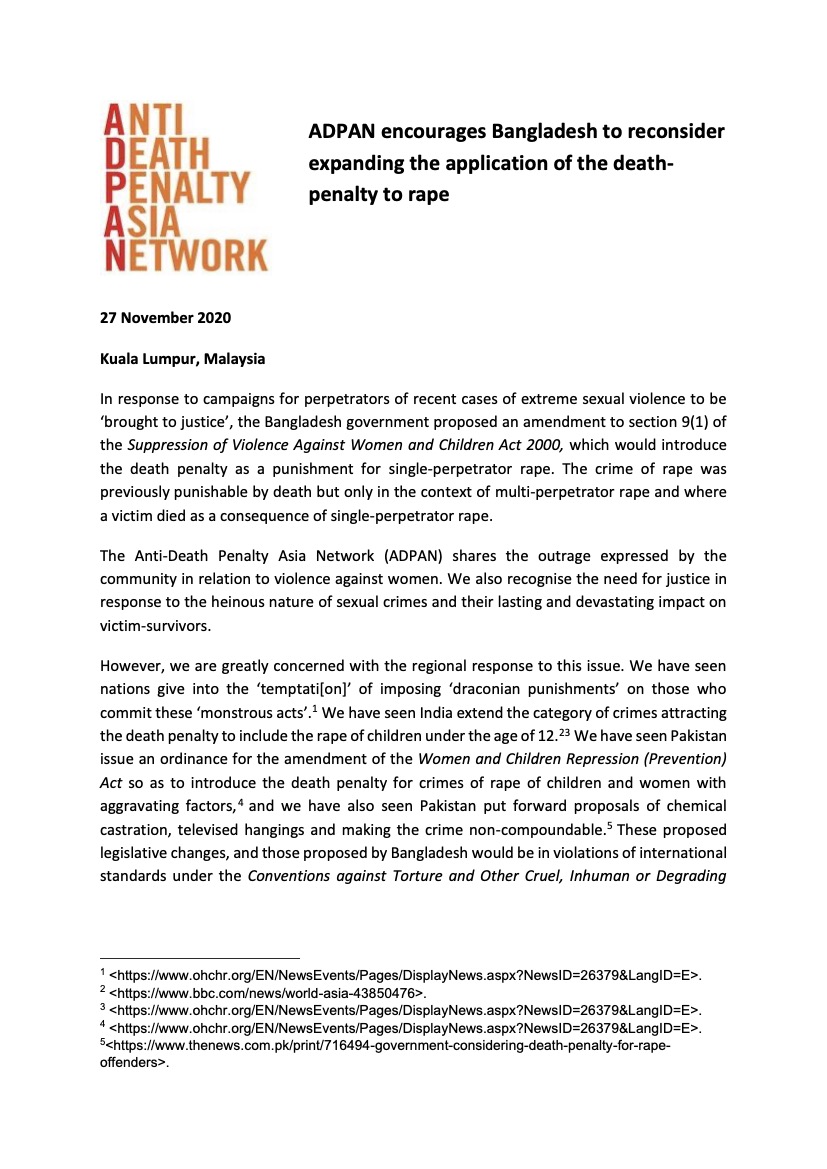
ADPAN Encourages Bangladesh to Reconsider Expanding the Application of the Death Penalty to Rape

ADPAN Encourages Bangladesh to Reconsider Expanding the Application of the Death Penalty to Rape

November 20, 2020, Statements

In response to campaigns for perpetrators of recent cases of extreme sexual violence to be  ‘brought to justice’, the Bangladesh government proposed an amendment to section 9(1) of  the Suppression of Violence Against Women and Children Act 2000, which would introduce  the death penalty as a punishment for single-perpetrator rape. The crime of rape was  previously punishable by death but only in the context of multi-perpetrator rape and where  a victim died as a consequence of single-perpetrator rape.  

The Anti-Death Penalty Asia Network (ADPAN) shares the outrage expressed by the  community in relation to violence against women. We also recognise the need for justice in  response to the heinous nature of sexual crimes and their lasting and devastating impact on  victim-survivors.  

However, we are greatly concerned with the regional response to this issue. We have seen  nations give into the ‘temptati[on]’ of imposing ‘draconian punishments’ on those who  commit these ‘monstrous acts’.1 We have seen India extend the category of crimes attracting  the death penalty to include the rape of children under the age of 12.23 We have seen Pakistan  issue an ordinance for the amendment of the Women and Children Repression (Prevention)  Act so as to introduce the death penalty for crimes of rape of children and women with  aggravating factors,4 and we have also seen Pakistan put forward proposals of chemical  castration, televised hangings and making the crime non-compoundable.5 These proposed  legislative changes, and those proposed by Bangladesh would be in violations of international  standards under the Conventions against Torture and Other Cruel, Inhuman or Degrading  Treatment or Punishment, and breach the rights afforded by the International Covenant on  Civil and Political Rights.  

The imposition of the death penalty will only contribute to further violations of human rights  without addressing—the underlying failures and weaknesses of the criminal justice system for sexual offences. We urge the Bangladesh government to consider an approach which is  both survivor-centred and responsive to underlying structural and societal concerns.  

There is no evidence to support the claim that the death penalty will be an effective deterrent  to rape in Bangladesh and the broader region. The likelihood of conviction and punishment  has been proven to be a greater deterrent than the severity of the penalty itself. Available  data suggests that there is only a 3% conviction rate for cases of violence against women and  children in Bangladesh.6In contrary, statistics from countries that have abolished the death  penalty show that conviction rates for crimes punishable by death actually rose after the  death penalty was abolished7. The discrepancy indicates that there are more impactful means  of addressing sexual offences beyond the death penalty. 

Imposing the death penalty for perpetrators of rape will not address the main impediments  to victim-survivors achieving justice. The introduction of the death penalty will likely further  deter victim-survivors from disclosing incidents. Victim-survivors who come forward are  already subject to a high degree of shame and scrutiny from their communities, throughout  and following the investigation and court process. This is further compounded by the nature  of the sexual offences involving associates or in some cases, close associates of the victim survivors, creating additional barriers against reporting of the rape. In other countries, such  factors have resulted in a reduced number of successful cases where there is a conviction  against the perpetrator. 

Introducing the death penalty will only exacerbate this issue, as death penalty cases involve  more victim scrutiny through extensive Court processes and attract more media attention.  Furthermore, the prospect of being blamed for the offender’s death, especially when it  involves an individual known to the victim-survivor would likely act as anadditional barrier  for victim-survivors in disclosing incidents.  

ADPAN acknowledge the Government of Bangladesh’s commitment to delivering justice to  rape victim-survivors but strongly urge the government to address the underlying flaws of  existing criminal justice system and not introduce mechanisms that have no impact in  deterring future crimes Reforms should revolve around empowering victim-survivors and  encouraging the pursuit of criminal prosecution against perpetrators by removing stigma and   providing specific legal and medical services for victim-survivors throughout the criminal  justice process. 

We also urge the government of Bangladesh to consider including all victims, male or female,  as well as marital partners, in the definition of rape, prohibiting character evidence and  training courts and police to interact with rape victim-survivors more appropriately. ADPAN  urges the Government of Bangladesh to take this opportunity to lead the Asia region on this  matter and implement meaningful policy changes that will make Bangladesh a safer place for  victims-survivors of sexual violence. 

Death penalty for rape will not deliver justice. Justice can only be achieved when victim survivors are provided the necessary support and perpetrators are convicted for their crimes. 

  1. https://www.ohchr.org/EN/NewsEvents/Pages/DisplayNews.aspx?NewsID=26379&LangID=E 
  2. https://www.bbc.com/news/world-asia-43850476
  3. https://www.ohchr.org/EN/NewsEvents/Pages/DisplayNews.aspx?NewsID=26379&LangID=E. 
  4. https://www.ohchr.org/EN/NewsEvents/Pages/DisplayNews.aspx?NewsID=26379&LangID=E
  5. https://www.thenews.com.pk/print/716494-government-considering-death-penalty-for-rape offenders
  6. https://www.dhakatribune.com/bangladesh/dhaka/2019/11/26/only-3-convicted-for-rape-in-bangladesh

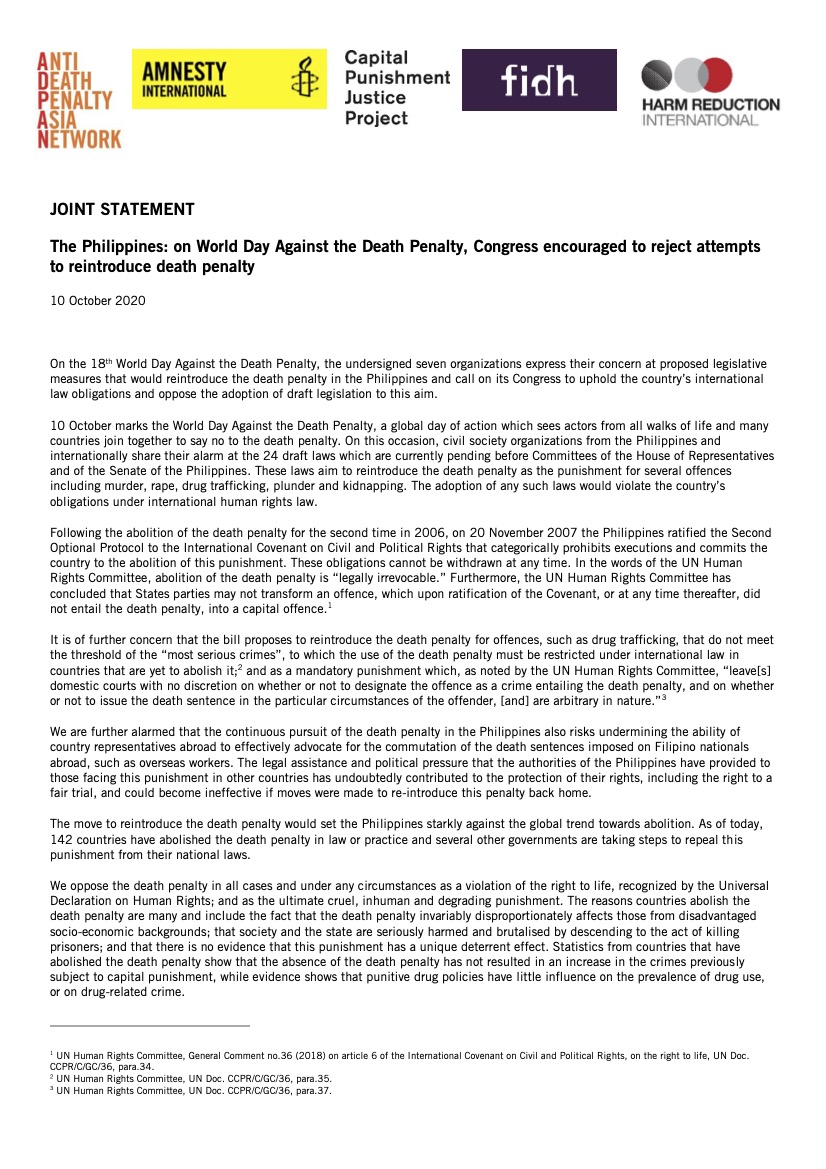
The Philippines: On World Day Against the Death Penalty, Congress Encouraged to Reject Attempts to Reintroduce Death Penalty

The Philippines: On World Day Against the Death Penalty, Congress Encouraged to Reject Attempts to Reintroduce Death Penalty

October 10, 2020, Statements

On the 18th World Day Against the Death Penalty, the undersigned seven organizations express their concern at proposed legislative  measures that would reintroduce the death penalty in the Philippines and call on its Congress to uphold the country’s international  law obligations and oppose the adoption of draft legislation to this aim. 

10 October marks the World Day Against the Death Penalty, a global day of action which sees actors from all walks of life and many  countries join together to say no to the death penalty. On this occasion, civil society organizations from the Philippines and  internationally share their alarm at the 24 draft laws which are currently pending before Committees of the House of Representatives  and of the Senate of the Philippines. These laws aim to reintroduce the death penalty as the punishment for several offences  including murder, rape, drug trafficking, plunder and kidnapping. The adoption of any such laws would violate the country’s  obligations under international human rights law. 

Following the abolition of the death penalty for the second time in 2006, on 20 November 2007 the Philippines ratified the Second  Optional Protocol to the International Covenant on Civil and Political Rights that categorically prohibits executions and commits the  country to the abolition of this punishment. These obligations cannot be withdrawn at any time. In the words of the UN Human  Rights Committee, abolition of the death penalty is “legally irrevocable.” Furthermore, the UN Human Rights Committee has  concluded that States parties may not transform an offence, which upon ratification of the Covenant, or at any time thereafter, did  not entail the death penalty, into a capital offence.1 

It is of further concern that the bill proposes to reintroduce the death penalty for offences, such as drug trafficking, that do not meet  the threshold of the “most serious crimes”, to which the use of the death penalty must be restricted under international law in  countries that are yet to abolish it;2 and as a mandatory punishment which, as noted by the UN Human Rights Committee, “leave[s] domestic courts with no discretion on whether or not to designate the offence as a crime entailing the death penalty, and on whether  or not to issue the death sentence in the particular circumstances of the offender, [and] are arbitrary in nature.”3 

We are further alarmed that the continuous pursuit of the death penalty in the Philippines also risks undermining the ability of  country representatives abroad to effectively advocate for the commutation of the death sentences imposed on Filipino nationals  abroad, such as overseas workers. The legal assistance and political pressure that the authorities of the Philippines have provided to  those facing this punishment in other countries has undoubtedly contributed to the protection of their rights, including the right to a  fair trial, and could become ineffective if moves were made to re-introduce this penalty back home. 

The move to reintroduce the death penalty would set the Philippines starkly against the global trend towards abolition. As of today,  142 countries have abolished the death penalty in law or practice and several other governments are taking steps to repeal this  punishment from their national laws. 

We oppose the death penalty in all cases and under any circumstances as a violation of the right to life, recognized by the Universal  Declaration on Human Rights; and as the ultimate cruel, inhuman and degrading punishment. The reasons countries abolish the  death penalty are many and include the fact that the death penalty invariably disproportionately affects those from disadvantaged socio-economic backgrounds; that society and the state are seriously harmed and brutalised by descending to the act of killing  prisoners; and that there is no evidence that this punishment has a unique deterrent effect. Statistics from countries that have  abolished the death penalty show that the absence of the death penalty has not resulted in an increase in the crimes previously  subject to capital punishment, while evidence shows that punitive drug policies have little influence on the prevalence of drug use,  or on drug-related crime. 

Today, as abolitionist advocates from around the world join forces to raise awareness against the death penalty, we renew our call on  the members of the Congress of the Philippines to ensure its international commitments are respected and to reject legislative  measures to reintroduce the ultimate cruel, inhuman and degrading punishment. 

This statement is co-signed by: 

  • ADPAN – Anti-Death Penalty Asia Network 
  • Amnesty International 
  • CAAPR – Colegio de Abogados y Abogadas de Puerto Rico 
  • Capital Punishment Justice Project 
  • FIDH – International Federation for Human Rights 
  • Harm Reduction International 
  • MADPET – Malaysians Against Death Penalty & Torture
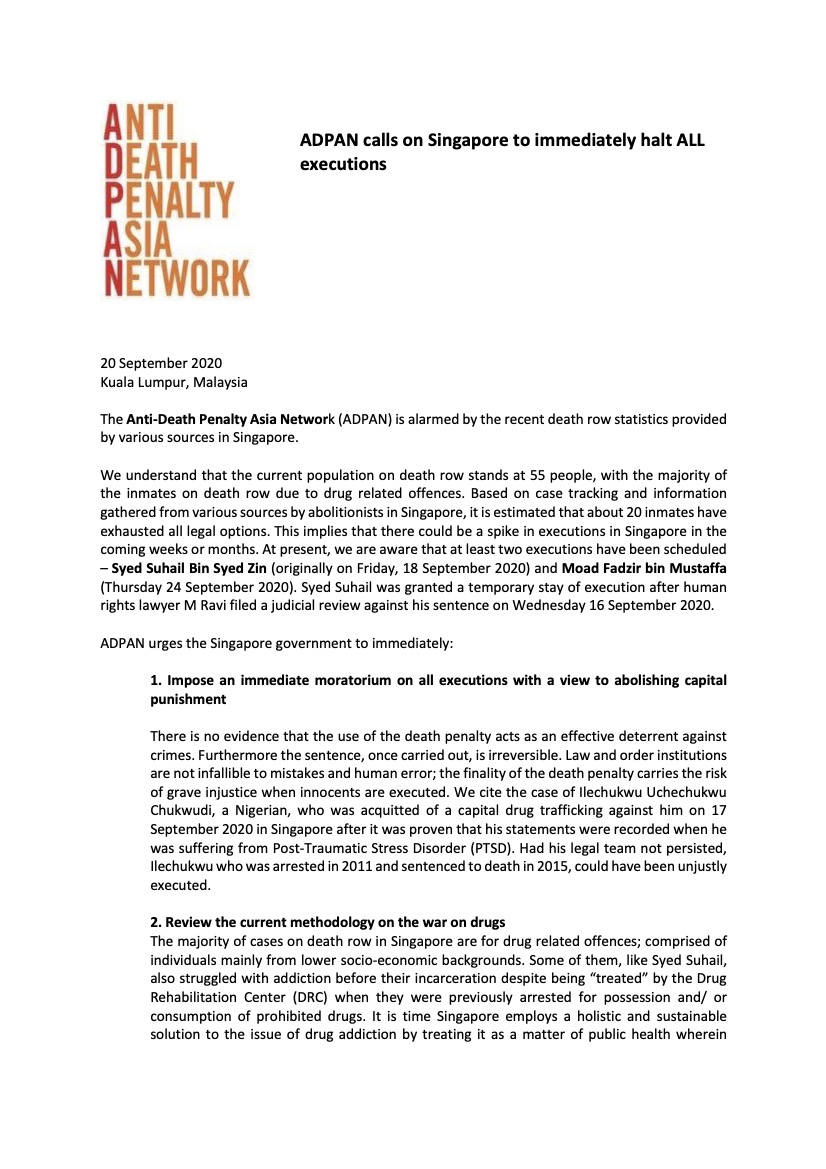
ADPAN Calls on Singapore to Immediately Halt ALL Executions

ADPAN Calls on Singapore to Immediately Halt ALL Executions

September 20, 2020, Statements

The Anti-Death Penalty Asia Network (ADPAN) is alarmed by the recent death row statistics provided  by various sources in Singapore.  

We understand that the current population on death row stands at 55 people, with the majority of  the inmates on death row due to drug related offences. Based on case tracking and information  gathered from various sources by abolitionists in Singapore, it is estimated that about 20 inmates have  exhausted all legal options. This implies that there could be a spike in executions in Singapore in the  coming weeks or months. At present, we are aware that at least two executions have been scheduled  – Syed Suhail Bin Syed Zin (originally on Friday, 18 September 2020) and Moad Fadzir bin Mustaffa 

(Thursday 24 September 2020). Syed Suhail was granted a temporary stay of execution after human  rights lawyer M Ravi filed a judicial review against his sentence on Wednesday 16 September 2020.  

ADPAN urges the Singapore government to immediately: 

  1. Impose an immediate moratorium on all executions with a view to abolishing capital  punishment

    There is no evidence that the use of the death penalty acts as an effective deterrent against  crimes. Furthermore the sentence, once carried out, is irreversible. Law and order institutions  are not infallible to mistakes and human error; the finality of the death penalty carries the risk  of grave injustice when innocents are executed. We cite the case of Ilechukwu Uchechukwu  Chukwudi, a Nigerian, who was acquitted of a capital drug trafficking against him on 17  September 2020 in Singapore after it was proven that his statements were recorded when he  was suffering from Post-Traumatic Stress Disorder (PTSD). Had his legal team not persisted,  Ilechukwu who was arrested in 2011 and sentenced to death in 2015, could have been unjustly  executed.  
  1. Review the current methodology on the war on drugs

    The majority of cases on death row in Singapore are for drug related offences; comprised of  individuals mainly from lower socio-economic backgrounds. Some of them, like Syed Suhail,  also struggled with addiction before their incarceration despite being “treated” by the Drug  Rehabilitation Center (DRC) when they were previously arrested for possession and/ or  consumption of prohibited drugs. It is time Singapore employs a holistic and sustainable solution to the issue of drug addiction by treating it as a matter of public health wherein  anyone struggling with drug addiction will be treated and supported instead of being  incarcerated and then stigmatized.  
  1. Grant public access to information of cases and real time statistics beyond legal  documents on Courts’ websites and annual prison statistics 

    Due to the lack of transparency and the existence of the Officials Secrets Act which  criminalises the dissemination of information from prison workers, abolitionist groups  campaigning against the death penalty in Singapore can only rely on information provided by  family members of inmates, lawyers, and documents of legal proceedings on the Court’s  website, as well as whatever little news reports that shed light on capital cases. Together with  our abolitionist colleagues in Singapore, we call upon the government to make good their  commitment during the 2011 Universal Periodic Review process to make information about  the use of the death penalty publicly and easily available, i.e., lift the secrecy on executions,  grant public access to information of cases, as well as provide real time statistics on the death  row in Singapore.  

Lastly, we recognize that campaigning in a country with tough laws against freedom of expression and  assembly as well as very little resources and public support is an uphill task, and we would like to  express our strongest solidarity with our fellow abolitionists in Singapore. 

ADPAN Calls on Singapore to Immediately Halt the Imminent Execution of Syed Suhail Bin Syed Zin

ADPAN Calls on Singapore to Immediately Halt the Imminent Execution of Syed Suhail Bin Syed Zin

September 20, 2020, Statements

The Anti-Death Penalty Asia Network (ADPAN) urgently calls upon the Government of Singapore to  stop the execution of Syed Suhail Bin Syed Zin who is scheduled to be hanged at Changi Prison on  Friday 18 September having being convicted of drug offences. 

Singapore is a sovereign nation which rightly recognises the fundamental liberties of the person and  the right to life and liberty in Part IV of its Constitution. To engage in state-sanctioned killing of  prisoners, regardless of the nature of their offending, is an affront to the universal right to life and  accordingly undermines the inherent dignity of all people. Singapore is in a position to adopt the  recommendations of UN member states and ratify the International Covenant on Civil and Political  Rights (ICCPR) and the Second Optional Protocol to the ICCPR. By doing so, Singapore could promote  the fundamental liberties which it protects in its Constitution and acknowledge that the persistence  of the death penalty is an inherent contradiction to the ‘enhancement of human dignity and  progressive development of human rights’. ADPAN calls for the Government of Singapore to exercise  its sovereign powers and immediately stay the execution of Syed Suhail. 

The death penalty will not ensure the protection and safety of the Singaporean people from drugs.  There is no evidence that executions are a more effective deterrent. The international drug trade  continues to thrive despite thousands of executions being carried out in the last decade for drug related offences worldwide. Syed Suhail has suffered from drug addiction problems and is himself a  victim of the drug trade. ADPAN urges Singapore to take an approach that would address the  underlying causes of addiction and offending rather than continuing to carry out executions.  

During the COVID-19 pandemic, Singapore’s focus should be on preventing the spread of COVID-19  instead of creating more pain and death by carrying out executions. Syed’s sisters and aunt and uncle live in Malaysia. Syed’s father died in 2006. Syed’s execution should be stayed to prevent his family  from being subjected to any more loss. 

It should not be assumed that the death penalty is a necessary feature of the administration of justice  within Singapore. Rather, Singapore has the opportunity to introduce a moratorium on executions and  be a human-rights leader in the Asian-Pacific region, following the unmistakable international trend  towards abolition of the death penalty. ADPAN maintains that the death penalty is cruel and unusual  in all circumstances and advocates for the abolition of the death penalty worldwide.  

Proceeding with the execution of Syed Suhail Bin Syed Zin would only illustrate the inherent futility of  the death penalty. ADPAN calls on the Government of Singapore takes action immediately, consistent  with the exercise of its sovereign powers, to prevent Syed’s unnecessary death. 

ADPAN’s statement in support of the victims of Enforced Disappearances

ADPAN’s statement in support of the victims of Enforced Disappearances

August 30,  2020, Statements

Each year on 30 August, the International Day of the Victims of Enforced Disappearances  commemorates those who are missing as a consequence of enforced disappearance. The effects of  enforced disappearance do not only affect close relatives of the disappeared, but also the  disappeared person’s community, nation and society as a whole. Today, we recognise and  remember the hundreds of thousands of people who have vanished in at least 85 countries, and the  millions who have been impacted by disappearances.  

ADPAN has joined 12 human rights groups shining the spotlight on Bangladesh, where it is estimated  at least 572 people have been reported forcibly disappeared by security forces and law-enforcement  agencies in Bangladesh since 2009. 

Full statement:  https://www.hrw.org/news/2020/08/28/bangladesh-end-enforced-disappearances 

ADPAN stands in solidarity with the victims of enforced disappearances and celebrates the  achievements of activists and organisations who work to bring these issues to light. 

ADPAN Opposes President Rodrigo Duterte’s Call to Reinstate the Death Penalty in the Philippines

ADPAN Opposes President Rodrigo Duterte’s Call to Reinstate the Death Penalty in the Philippines

July 31, 2020, Statements

The Anti-Death Penalty Asia Network (ADPAN), who advocates the abolition of the death  penalty, is appalled by the anti-human rights position taken by the Philippines President who  is trying to reimpose the death penalty. In his State of the National Address (SONA) on 27 July  2020, President Duterte’s called for the reimposition of the death penalty in the Philippines  for drug-related offences. In his address, President Duterte expressed support for “the swift  passage of a law reviving the death penalty by lethal injection for crimes specified under the  Comprehensive Dangerous[Drugs] Act of 2002.” He added that this change will “not only help  us deter criminality but also save our children from the dangers posed by illegal and  dangerous drugs”.  

Since the beginning of his administration in 2016, President Duterte has waged a damaging  campaign against drugs, which resulted in extra-judicial killings and a denial of the  fundamental right to a fair trial. An estimated 5,600 people have died in this ‘drug war’;  however, some organisations estimate that the number of deaths could exceed 27,000.  Despite widespread condemnation from both local groups and the international community,  the comments made during the SONA reflect President Duterte’s relentless attempts to  undermine fundamental human rights.  

Reinstating the death penalty in the Philippines counters a clear global trend towards  abolition of the death penalty; to date 142 countries – more than two thirds of the worlds’  countries – have abolished the death penalty in law or practice. Further, the statements  expressed are in contravention to the Second Optional Protocol to the International Covenant  on Civil and Political Rights, to which the Philippines is a signatory. The re-emergence of  support for reinstating the death penalty symbolises a concerning disregard for the  Philippine’s international legal obligations. 

During the reintroduction of the death penalty in the Philippines in the 1990s, the Republic  Act 8177 was passed, prescribing the use of lethal injection as the method of implementing  capital punishment. In 1999, the first Filipino to be meted by this reinstatement was Leo  Echegaray. Echegaray maintained his innocence and was denied an appeal for his conviction.  His final words were reported to be “Sambayanang Pilipino, patawarin ako sa kasalanang  ipinaratang ninyo sa akin. Pilipino, pinatay ng kapwa Pilipino” (People of the Philippines,  forgive me of the sin which you have accused me. A Filipino, killed by fellow Filipinos). In 2006,  then Chief Justice Artemio Panganiban disclosed that the case against Echegaray had a fatally  defective rape charge sheet and indicated that Echegaray’s execution was a mistake; that  same year, the Philippines abolished the death penalty. A return to the death penalty in the  

Philippines may repeat such miscarriages of justice where an innocent person may be wrongly  executed by the State. 

ADPAN calls on both President Duterte and the Philippines parliament to restrain from the promotion and re-introduction of the death penalty which would be a subversion of  international human rights law. The notion that the death penalty is an effective deterrent to  committing drug offending has not been supported by empirical evidence. Rather, ADPAN  encourages President Duterte and the Philippines parliament to support humane, voluntary  and evidence-based policies around crime and drug policy, consistent with the exercise of its  sovereign powers and human rights standards.