Appeal to the Minister of Justice to Stop the Execution of Chiou Ho-Shun

China: Judicial Guidelines to Curtail Activism for Taiwan a Further Blow for Human Rights Protections

July 11, 2024, Statements

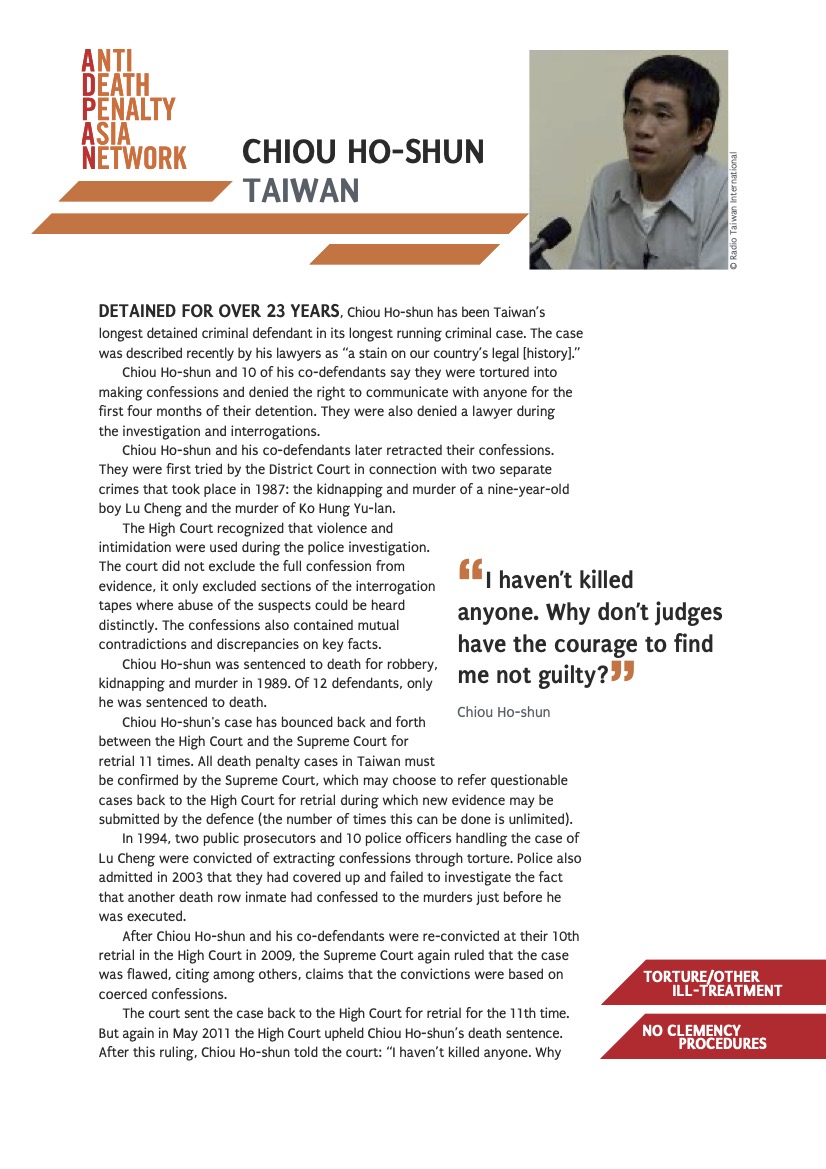
Detained for over 23 years, Chiou Ho-shun has been Taiwan’s longest detained criminal defendant in its longest running criminal case. The case was described recently by his lawyers as “a stain on our country’s legal [history].” Chiou Ho-shun and 10 of his co-defendants say they were tortured into making confessions and denied the right to communicate with anyone for the first four months of their detention. They were also denied a lawyer during the investigation and interrogations.

 
Chiou Ho-shun and his co-defendants later retracted their confessions. They were first tried by the District Court in connection with two separate crimes that took place in 1987: the kidnapping and murder of a nine-year-old boy Lu Cheng and the murder of Ko Hung Yu-lan.
The High Court recognized that violence and intimidation were used during the police investigation. The court did not exclude the full confession from evidence, it only excluded sections of the interrogation tapes where abuse of the suspects could be heard distinctly. The confessions also contained mutual contradictions and discrepancies on key facts.

Chiou Ho-shun was sentenced to death for robbery, kidnapping and murder in 1989. Of 12 defendants, only he was sentenced to death.  Chiou Ho-shun’s case has bounced back and forth between the High Court and the Supreme Court for retrial 11 times. All death penalty cases in Taiwan must be confirmed by the Supreme Court, which may choose to refer questionable cases back to the High Court for retrial during which new evidence may be submitted by the defence (the number of times this can be done is unlimited).

In 1994, two public prosecutors and 10 police officers handling the case of Lu Cheng were convicted of extracting confessions through torture. Police also admitted in 2003 that they had covered up and failed to investigate the fact that another death row inmate had confessed to the murders just before he was executed.

 After Chiou Ho-shun and his co-defendants were re-convicted at their 10th retrial in the High Court in 2009, the Supreme Court again ruled that the case was flawed, citing among others, claims that the convictions were based on coerced confessions.

The court sent the case back to the High Court for retrial for the 11th time. But again in May 2011 the High Court upheld Chiou Ho-shun’s death sentence. After this ruling, Chiou Ho-shun told the court: “I haven’t killed anyone. Why don’t judges have the courage to find me not guilty?” On 28 July 2011, Chiou Ho-shun lost his final appeal to the Supreme Court and on 25 August 2011 the Prosecutor General rejected a request to seek an extraordinary appeal for a retrial. Chiou Ho-shun could be executed at any time.

Appeal to the minister of Justice to:

  • Stop the execution of Chiou Ho-shun by whatever judicial or other means available.
  • Investigate the reports of torture and other ill-treatment and ensure that all statements resulting from such coercion are completely excluded from any re-trial.
  • Ensure Chiou Ho-shun is re-tried in proceedings which comply with international fair trial standards.
  • Suspend all executions and the imposition of death sentences as a step towards the total abolition of the death penalty. 
  • Revise laws and change policies and practices to ensure fair trials in line with international standards. 
  • Ensure that those sentenced to death have an effective opportunity to exercise their right to seek a pardon or commutation of their sentence in line with international standards.

COVID-19: Calling for a Worldwide Moratorium on the Death Penalty During the Pandemic

COVID-19: Calling for a Worldwide Moratorium on the Death Penalty During the Pandemic

June 8, 2020, Statements

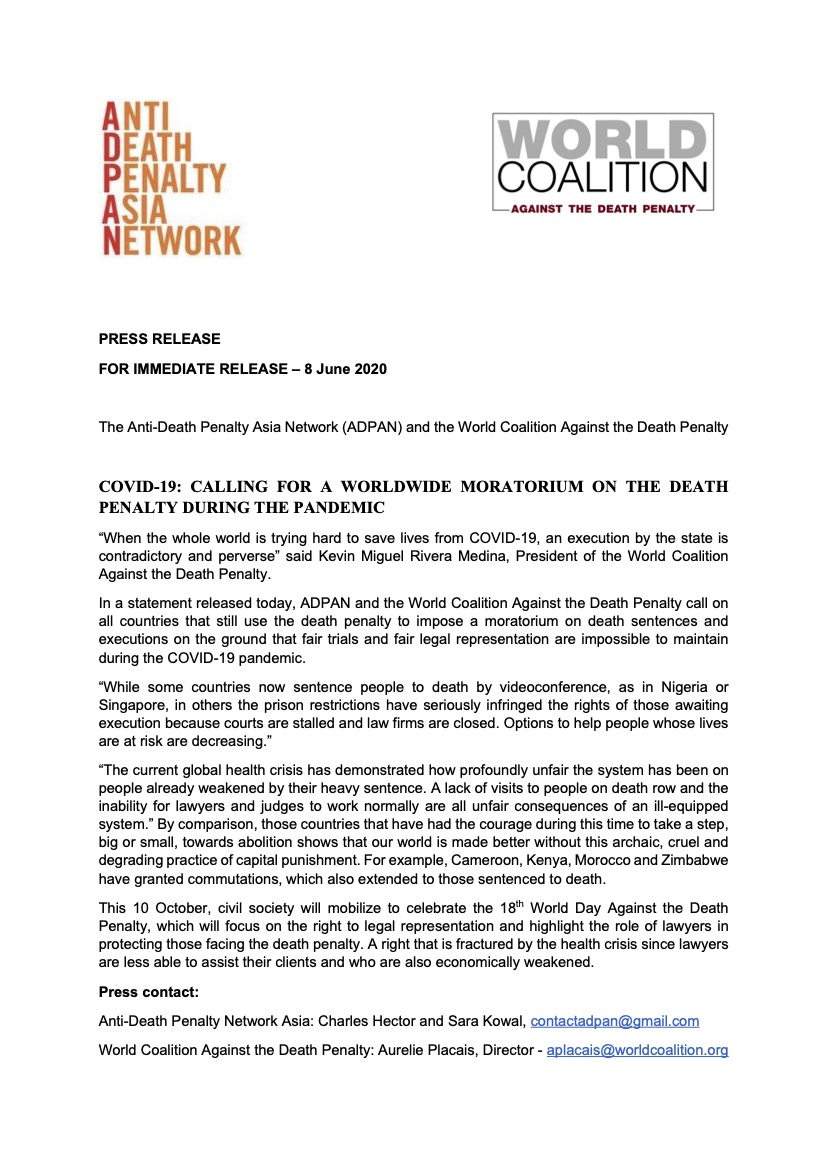
“When the whole world is trying hard to save lives from COVID-19, an execution by the state is  contradictory and perverse” said Kevin Miguel Rivera Medina, President of the World Coalition  Against the Death Penalty. 

In a statement released today, ADPAN and the World Coalition Against the Death Penalty call on  all countries that still use the death penalty to impose a moratorium on death sentences and  executions on the ground that fair trials and fair legal representation are impossible to maintain  during the COVID-19 pandemic. 

“While some countries now sentence people to death by videoconference, as in Nigeria or  Singapore, in others the prison restrictions have seriously infringed the rights of those awaiting  execution because courts are stalled and law firms are closed. Options to help people whose lives  are at risk are decreasing.” 

“The current global health crisis has demonstrated how profoundly unfair the system has been on  people already weakened by their heavy sentence. A lack of visits to people on death row and the  inability for lawyers and judges to work normally are all unfair consequences of an ill-equipped  system.” By comparison, those countries that have had the courage during this time to take a step,  big or small, towards abolition shows that our world is made better without this archaic, cruel and  degrading practice of capital punishment. For example, Cameroon, Kenya, Morocco and Zimbabwe  have granted commutations, which also extended to those sentenced to death.  

This 10 October, civil society will mobilize to celebrate the 18th World Day Against the Death  Penalty, which will focus on the right to legal representation and highlight the role of lawyers in  protecting those facing the death penalty. A right that is fractured by the health crisis since lawyers  are less able to assist their clients and who are also economically weakened.  

Statement in Relation to the Imposition of the Death Penalty by Remote Court Hearings

Statement in Relation to the Imposition of the Death Penalty by Remote Court Hearings

June 8, 2020, Statements

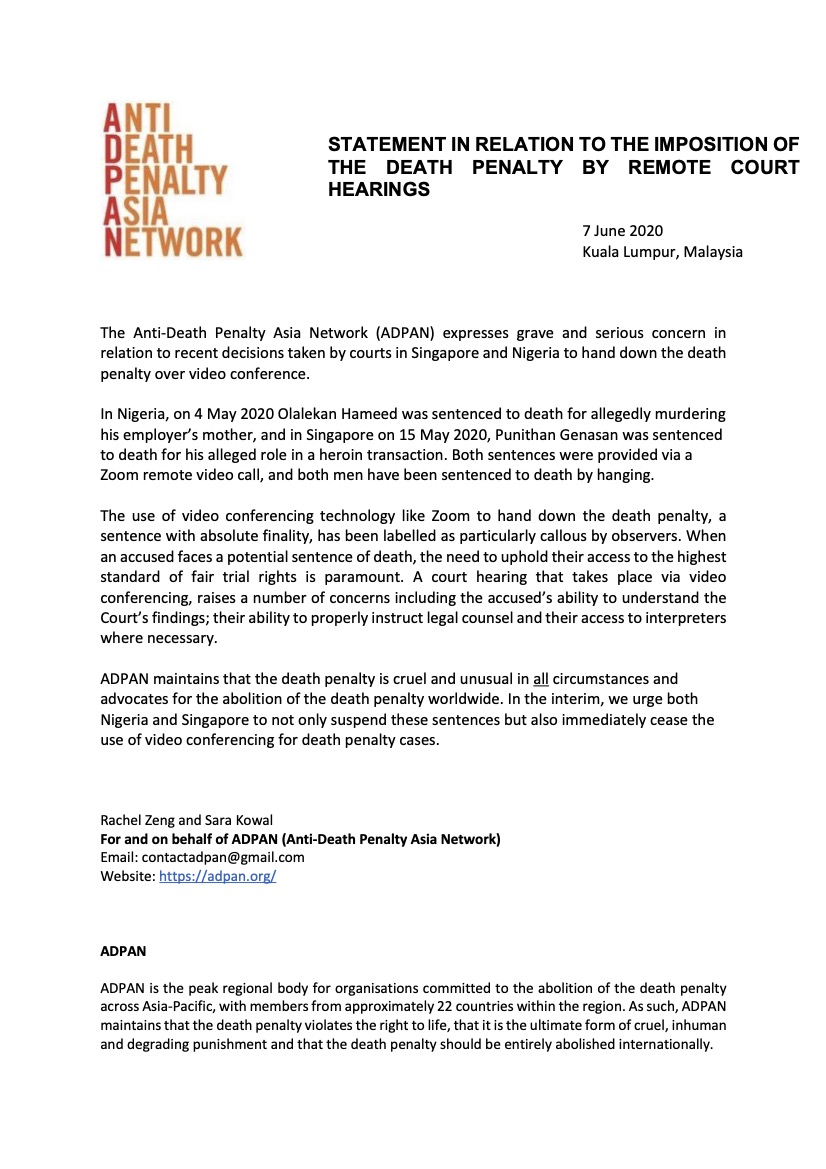
The Anti-Death Penalty Asia Network (ADPAN) expresses grave and serious concern in  relation to recent decisions taken by courts in Singapore and Nigeria to hand down the death  penalty over video conference. 

In Nigeria, on 4 May 2020 Olalekan Hameed was sentenced to death for allegedly murdering  his employer’s mother, and in Singapore on 15 May 2020, Punithan Genasan was sentenced  to death for his alleged role in a heroin transaction. Both sentences were provided via a  Zoom remote video call, and both men have been sentenced to death by hanging. 

The use of video conferencing technology like Zoom to hand down the death penalty, a  sentence with absolute finality, has been labelled as particularly callous by observers. When  an accused faces a potential sentence of death, the need to uphold their access to the highest  standard of fair trial rights is paramount. A court hearing that takes place via video  conferencing, raises a number of concerns including the accused’s ability to understand the  Court’s findings; their ability to properly instruct legal counsel and their access to interpreters  where necessary.  

ADPAN maintains that the death penalty is cruel and unusual in all circumstances and  advocates for the abolition of the death penalty worldwide. In the interim, we urge both  Nigeria and Singapore to not only suspend these sentences but also immediately cease the  use of video conferencing for death penalty cases. 

Statement on the Health and Safety of Prisoners During the COVID-19 Pandemic

Statement on the Health and Safety of Prisoners During the COVID-19 Pandemic

April 9, 2020, Statements

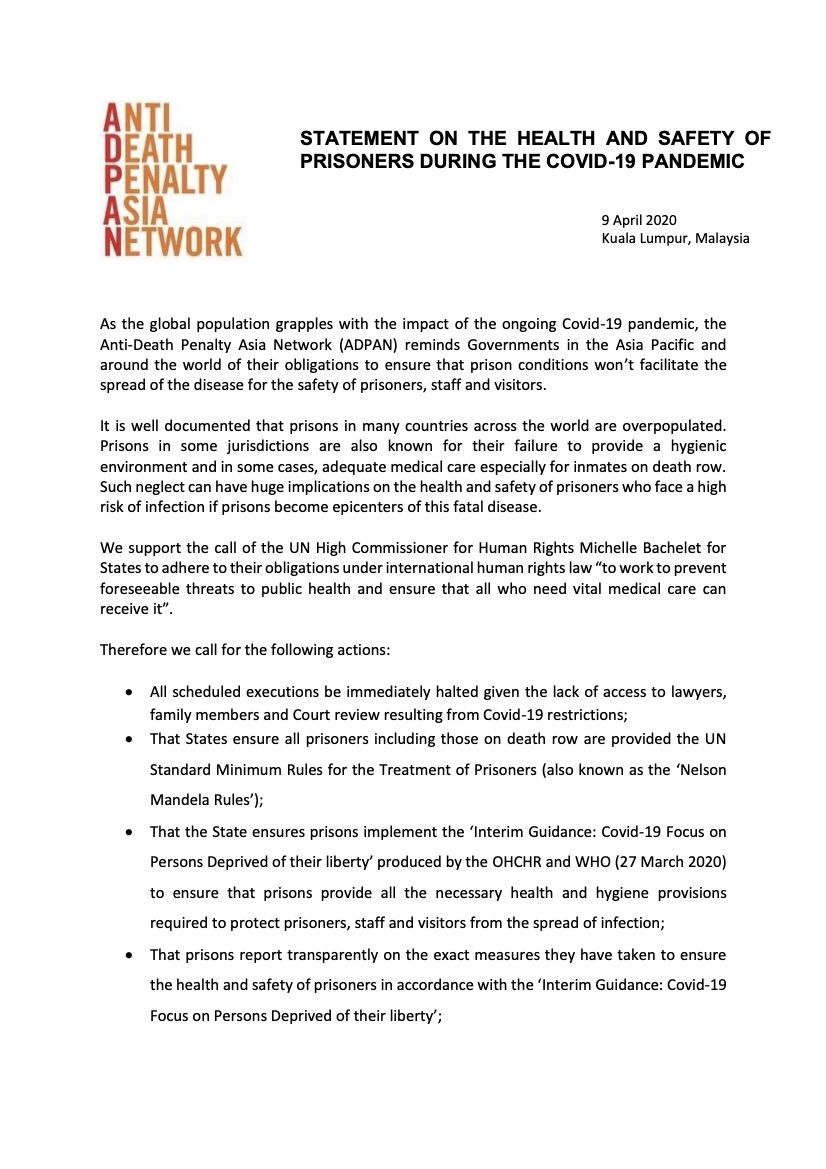
As the global population grapples with the impact of the ongoing Covid-19 pandemic, the  Anti-Death Penalty Asia Network (ADPAN) reminds Governments in the Asia Pacific and  around the world of their obligations to ensure that prison conditions won’t facilitate the  spread of the disease for the safety of prisoners, staff and visitors.  

It is well documented that prisons in many countries across the world are overpopulated.  Prisons in some jurisdictions are also known for their failure to provide a hygienic  environment and in some cases, adequate medical care especially for inmates on death row.  Such neglect can have huge implications on the health and safety of prisoners who face a high  risk of infection if prisons become epicenters of this fatal disease.  

We support the call of the UN High Commissioner for Human Rights Michelle Bachelet for  States to adhere to their obligations under international human rights law “to work to prevent  foreseeable threats to public health and ensure that all who need vital medical care can  receive it”.  

Therefore we call for the following actions: 

  • All scheduled executions be immediately halted given the lack of access to lawyers,  family members and Court review resulting from Covid-19 restrictions; 
  • That States ensure all prisoners including those on death row are provided the UN  Standard Minimum Rules for the Treatment of Prisoners (also known as the ‘Nelson  Mandela Rules’); 
  • That the State ensures prisons implement the ‘Interim Guidance: Covid-19 Focus on  Persons Deprived of their liberty’ produced by the OHCHR and WHO (27 March 2020)  to ensure that prisons provide all the necessary health and hygiene provisions  required to protect prisoners, staff and visitors from the spread of infection; 
  • That prisons report transparently on the exact measures they have taken to ensure  the health and safety of prisoners in accordance with the ‘Interim Guidance: Covid-19  Focus on Persons Deprived of their liberty’; 
  • That appropriate measures are taken to provide immediate treatment and complete  isolation to those diagnosed positive with Covid-19 or displaying symptoms consistent  with Covid-19, and immediate isolation for those in any way in contact with the  affected prisoners;  
  • Consideration be given to early release of elderly prisoners and prisoners with  underlying health conditions and the granting of bail to prisoners awaiting trial to  reduce the overcrowding in jails given the need for physical distancing to control the  spread of Covid-19; and 
  •  That any restrictions on visits to prisons be imposed with full transparency and  balanced with increased access to phone calls and letters with family member.

Adpan Condemns Singapore’s Use of Police Harassment in Curbing Public Scrutiny of the Judiciary and Discussions of Court Cases

Adpan Condemns Singapore’s Use of Police Harassment in Curbing Public Scrutiny of the Judiciary and Discussions of Court Cases

March 15, 2020, Statements

The Anti-Death Penalty Asia Network (ADPAN) stands in solidarity with Singapore’s human  rights lawyer Mr M Ravi, the Chief Editor of The Online Citizen (TOC) Mr Terry Xu, TOC writer  Ms Danisha Hakeem and Mr Mohan Rajangam, all of who are currently under investigation  for possible contempt of Court under Section 3(1)(b) of the state’s Administration of Justice  (Protection) Act.  

It was reported in media articles that police, acting under the authorisation of the Attorney General, raided the office of Mr Ravi and the home of Mr Xu, seizing their mobile devices and  computers. Mr Xu was held at Cantonment Police Station for questioning by the Criminal  Investigation Division (CID) for about 7 hours on Friday 13 March 2020.  

It appears that the investigation commenced after some articles were published by The Online  Citizen questioning the role of the Singapore State Court in Mr Mohan’s extradition to  Malaysia. It has been reported that Mr Mohan was arrested on 21 March 2015 and extradited  to Malaysia following the endorsement of a Malaysian arrest warrant by a magistrate in  Singapore, for an offence that he maintains he did not commit. He reportedly spent four  months in custody before being released by Malaysian authorities without charge. 

ADPAN holds strong to the view that public institutions must be transparent in order to be  accountable, including being open to scrutiny and review. Public questioning or discussion  regarding court cases ought not automatically be considered ‘prejudicing or interfering’ with  court proceedings. Judicial officers have a duty to act independently from pressure from the  public, media or the Executive. 

The use of police powers that have the effect of unduly harassing individuals who publicly  express their opinions or discusses such matters, including the seizure of mobile devices and  computers and extended police questioning send the wrong message to the public in the  exercise of legitimate dissent on government policies and actions. Rather, we strongly  recommend the use of public platforms for the Government or institutions to clarify matters  that impact on society including outcomes arising from the country’s justice system. 

For more information: 

ADPAN Calls on India to Immediately Halt the Imminent Executions of Akshay Thakur, Mukesh Singh, Vinay Sharma and Pawan Gupta.

Adpan Calls on India to Immediately Halt the Imminent Executions of Akshay Thakur, Mukesh Singh, Vinay Sharma and Pawan Gupta.

January 21, 2024, Statements

The undersigned organizations are alarmed by the recent publication by the Chinese authorities of new judicial guidelines  providing directives to prosecute and harshly punish, including by the death penalty, those advocating and acting for  Taiwan’s independence. The guidance effectively encourages China’s courts and law enforcement agencies to violate  several rights established under international human rights law and standards, including the rights to life, to the freedoms of expression, peaceful assembly and association, and to a fair trial. We call on the Chinese authorities to immediately withdraw the guidelines and swiftly introduce legislative changes to repeal vague and overly broad national security-related offences and the death penalty, as critical first steps. 

On 21 June 2024, the Supreme People’s Court of China jointly issued with the Supreme People’s Procuratorate, the  Ministry of Public Security, the Ministry of State Security and Ministry of Justice the “Opinions on Punishing ‘Taiwan  Independence’ Diehards for Conducting or Inciting Separatism in Accordance with Law” (henceforth, guidelines).1 The  guidelines are based on existing provisions under China’s Anti-Secession Law, Criminal Law and Criminal Procedure Law; and encourage lower courts and various government and law enforcement agencies to prosecute and punish as national  security offences various acts, including peaceful ones, aimed at the pursuit of the independence of Taiwan from China.  The guidelines came into effect upon publication.  

Our organizations are gravely concerned by the violations of human rights that are encouraged and would be carried out  through the implementation of these guidelines. By explicitly criminalizing and demanding harsh punishments for peaceful acts that aim at advocating for Taiwan’s independence, the Chinese authorities are cracking down under the  pretext of national security on the rights to freedom of expression, freedom of peaceful assembly and other human rights.  

According to internationally recognized human rights standards, “national security” cannot be invoked to justify  restrictions on rights and freedoms unless genuinely and demonstrably intended to protect a state’s existence or territorial  integrity against specific threats of the use of force;2 nor can this national security framework legitimately be applied by governments to entrench a particular ideology or deny people the right to express different political views and to exercise  their other human rights as protected by international legal standards.3 Expression can only be punished as a threat to  national security when the authorities can demonstrate that the speaker has the intent to incite violence, there is a  likelihood that the expression will incite such violence and a direct and immediate connection between the expression and  the likelihood or occurrence of such violence.4 Speech such as advocating for a change in government or government  policy, as well as criticism or even insult of a state’s institutions or its symbols, or exposure of human rights violations, is  protected under international human rights law and must not be restricted or penalized on national security grounds.5 Likewise, demanding territorial changes in the form of autonomy or even secession in speeches and demonstrations does  


not automatically amount to a threat to the country’s territorial integrity and national security.6 The UN Human Rights  Committee, the UN body tasked with monitoring the implementation of the International Covenant on Civil and Political  Rights (ICCPR) – which China signed in 1998 – has frequently rejected attempts to justify far-reaching restrictions with  vague references to “national security”.7 

Of additional concern is the broad definition of aggravating circumstances that would warrant the harshest penalties,  including the death penalty, under sections 6 and 7 of the guidelines.8International human rights law and standards set  out that the imposition of the death penalty must not be based on “vaguely defined criminal provisions, whose application  to the convicted individual depend on subjective or discretionary considerations, the application of which is not  reasonably foreseeable.”9 These are necessary requirements prescribed by the principle of legality, a core general  principle of law, enshrined, among other places, in Article 15 of the ICCPR and Article 11 of the Universal Declaration of  Human Rights. Without an explicit and effective requirement to comply with international human rights law, vague terms  leave the law open to abuse by authorities who use it to crack down on a wide range of human rights.10 Vaguely drafted  laws can lead to a chilling effect and ultimately self-censorship in public debate, including online. 

We oppose the death penalty absolutely and are already greatly concerned at the overall lack of transparency that  surrounds the use of the death penalty in China. We are further alarmed that the guidelines recommend the imposition of  this cruel punishment in violation of the principle of legality; and as a result of trials where the defendant is not present (in  absentia), including on people in other countries. Death sentences imposed in unfair proceedings are arbitrary in nature  and amount to a violation of the right to life.11 Furthermore, pending full abolition of the death penalty, international law  and standards restrict its use to the “most serious crimes”, most recently interpreted as referring to “crimes of extreme  gravity involving intentional killing”.12 The majority of acts criminalized in the guidelines do not meet this minimum  threshold.13 

We call on the Chinese government and all authorities to review and amend all laws and regulations, and end all related  policies and measures, that violate human rights, in particular the rights to life, freedom of expression, peaceful assembly  and association, and ensure that any legal provisions aimed at protecting national security are clearly and narrowly  defined and conform to international human rights law and standards. We urge the authorities to establish an immediate  moratorium on all executions, as well as initiate legislative amendments to fully abolish the death penalty and commute all  death sentences.  

This statement is co-signed by:  

  1. Amnesty International 
  2. Anti-Death Penalty Asia Network 
  3. Capital Punishment Justice Project 
  4. The Rights Practice 
  5. World Coalition Against the Death Penalty 

***

  1. English translation available at https://en.spp.gov.cn/2024-06/21/c_998795.htm 
  2. Siracusa Principles on the Limitation and Derogation of Provisions in the International Covenant on Civil and Political Rights, UN Doc. E/CN.4/1985/4,  paras. 29-30. 
  3. Johannesburg Principles on National Security, Freedom of Expression and Access to Information, adopted on 1 October 1995 by a group of experts in  international law, national security, and human rights convened by Article 19, the International Centre Against Censorship, in collaboration with the  Centre for Applied Legal Studies of the University of the Witwatersrand in Johannesburg, http://www.article19.org/data/files/pdfs/standards/joburgprinciples.pdf 4 Johannesburg Principle 6. 
  4. Johannesburg Principle 7.
  5. European Court of Human Rights, Stankov and the United Macedonian Organisation Ilinden v. Bulgaria, application numbers (29225/95 and  29221/95), 2001, para. 97. 
  6. UN Human Rights Committee, “General Comment 34: Freedom of opinion and expression (Art. 19)”, UN Doc. CCPR/C/GC/34, 12 September 2011,  paras. 21-26. 
  7. For example, the death penalty may be imposed for those “who cause particularly serious harm to the state and the people” and when the  circumstances of the crime are “particularly heinous”. 
  8. Human Rights Committee, General comment No. 36 (2018) on article 6 of the International Covenant on Civil and Political Rights, on the right to life,  UN Doc. CCPR/C/GC/36, para.38. 
  9. Working Group on Arbitrary Detention, Report, 15 December 2003, UN Doc. E/CN.4/2004/3, paras 64-65. 
  10. UN Human Rights Committee, General comment No. 36 (2018) on article 6 of the International Covenant on Civil and Political Rights, on the right to  life, UN Doc. CCPR/C/GC/36, para.41. 
  11. UN Human Rights Committee, General comment No. 36 (2018) on article 6 of the International Covenant on Civil and Political Rights, on the right to  life, UN Doc. CCPR/C/GC/36, para.35. 
  12. Conduct considered as “serious crime” include directly participating in the implementation of major separatist activities of an organization advocating  for Taiwan’s independence; or carrying out activities advocating for Taiwan’s independence with serious consequences and adverse impacts; and  playing a significant role in separatist activities.