ADPAN Forum Brings Together Cross-Border Defenders for Persons on Death Row in the Asia Pacific

ADPAN Forum Brings Together Cross-Border Defenders for Persons on Death Row in the Asia Pacific

ADPAN Forum Brings Together Cross-Border Defenders for Persons on Death Row in the Asia Pacific

The Anti-Death Penalty Asia Network (ADPAN) hosted a timely forum titled ‘Cross-Border Defense for Persons on Death Row in the Asia Pacific’, held in the wake of renewed executions in Singapore and other countries in Asia. Moderated by ADPAN’s Chow Ying Ngeow, the discussion featured distinguished speakers: Justice Lex Lasry AM KC (Australia), Attorney Edre U. Olalia (Philippines), Edward Fitzgerald CBE KC (United Kingdom), and Zaid Malek (Malaysia). Drawing on decades of collective experience in capital defense, the panel reflected on landmark cases such as those of Van Tuong Nguyen, Flor Contemplacion, Mary Jane Veloso, and Malaysians executed in Singapore. The speakers underscored the urgent need for regional cooperation, access to competent legal representation, and cross-border solidarity in defending the rights of those facing the death penalty.

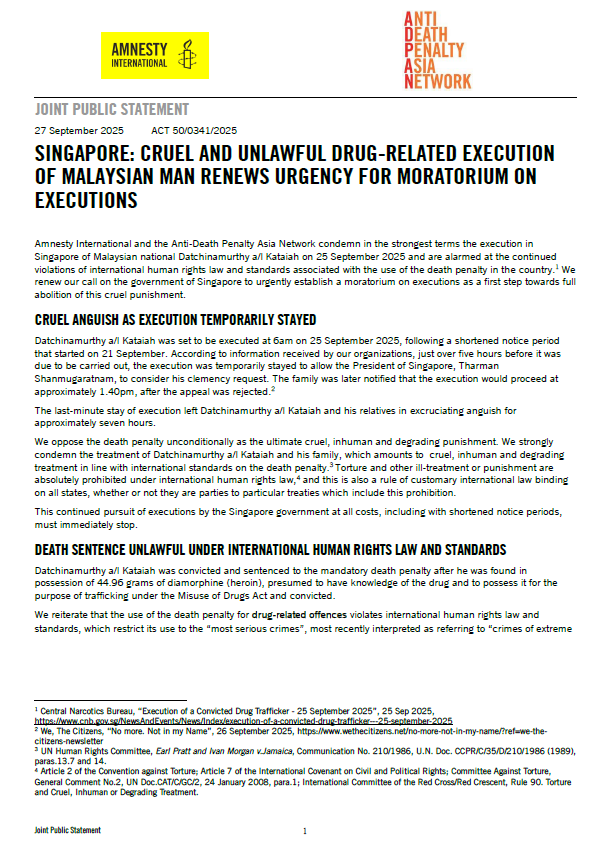
Singapore: Cruel And Unlawful Drug-Related Execution Of Malaysian Man Renews Urgency For Moratorium On Executions

Singapore: Cruel And Unlawful Drug-Related Execution Of Malaysian Man Renews Urgency For Moratorium On Executions

27 Sept 2025, Statements

Amnesty International and the Anti-Death Penalty Asia Network condemn in the strongest terms the execution in Singapore of Malaysian national Datchinamurthy a/l Kataiah on 25 September 2025 and are alarmed at the continued violations of international human rights law and standards associated with the use of the death penalty in the country.[1] We renew our call on the government of Singapore to urgently establish a moratorium on executions as a first step towards full abolition of this cruel punishment.

CRUEL ANGUISH AS EXECUTION TEMPORARILY STAYED
Datchinamurthy a/l Kataiah was set to be executed at 6am on 25 September 2025, following a shortened notice period that started on 21 September. According to information received by our organizations, just over five hours before it was due to be carried out, the execution was temporarily stayed to allow the President of Singapore, Tharman Shanmugaratnam, to consider his clemency request. The family was later notified that the execution would proceed at approximately 1.40pm, after the appeal was rejected.[2]

The last-minute stay of execution left Datchinamurthy a/l Kataiah and his relatives in excruciating anguish for approximately seven hours.

We oppose the death penalty unconditionally as the ultimate cruel, inhuman and degrading punishment. We strongly condemn the treatment of Datchinamurthy a/l Kataiah and his family, which amounts to  cruel, inhuman and degrading treatment in line with international standards on the death penalty.[3] Torture and other ill-treatment or punishment are absolutely prohibited under international human rights law,[4] and this is also a rule of customary international law binding on all states, whether or not they are parties to particular treaties which include this prohibition.

This continued pursuit of executions by the Singapore government at all costs, including with shortened notice periods, must immediately stop.  

death sentence unlawful under international human rights law and standards

Datchinamurthy a/l Kataiah was convicted and sentenced to the mandatory death penalty after he was found in possession of 44.96 grams of diamorphine (heroin), presumed to have knowledge of the drug and to possess it for the purpose of trafficking under the Misuse of Drugs Act and convicted.

We reiterate that the use of the death penalty for drug-related offences violates international human rights law and standards, which restrict its use to the “most serious crimes”, most recently interpreted as referring to “crimes of extreme

gravity involving intentional killing”.[1] Several UN bodies, including the International Narcotics Control Board, have repeatedly clarified that drug-related offences do not meet this threshold.[2]

We also remain alarmed by the continued resort to the mandatory death penalty, which removes judges’ power to consider the particular circumstances of the offence and the background of the convicted person, also in violation of international law and standards;[3] and the reliance on the legal presumption of trafficking under the Misuse of Drugs Act, based on the amount of drugs a person is found with. When these legal presumptions are invoked, the burden of proof is shifted onto the defendant to be rebutted to the reversed –and therefore higher – legal standard of “on balance of probabilities”. Legal presumptions of guilt violate the right to be presumed innocent – a peremptory norm of customary international law – and other fair trial guarantees under international human rights law that mandate that the burden of proving all charges rests on the prosecution.[4] In addition, presumptions of guilt have also had the effect of lowering the threshold of evidence needed to secure a conviction in capital cases.

urgent need for moratorium on executions as critical first step

So far in 2025, Singapore has executed 11 men, including nine for drug-related offences. In recent years, only two countries in the Association of Southeast Asian Nations (ASEAN) were known to have carried out executions – Singapore and Viet Nam. With the recent abolition of the death penalty for transporting drugs in Viet Nam on 25 June 2025, Singapore is due to be the last ASEAN country to carry out executions for this offence.[5]

Several others remain at imminent risk of execution in Singapore, including Malaysian nationals Pannir Selvam Pranthaman, Saminathan Selvaraju, Lingkesvaran Rajendaren and Singapore national Jumaat bin Mohamed Sayed. We renew our call on the Government of Singapore to immediately establish a moratorium on all executions; commute all death sentences; and review national legislation to bring it in line with international human rights law and standards, pending full abolition of the death penalty.

[1] Central Narcotics Bureau, “Execution of a Convicted Drug Trafficker – 25 September 2025”, 25 Sep 2025, https://www.cnb.gov.sg/NewsAndEvents/News/Index/execution-of-a-convicted-drug-trafficker—25-september-2025

[2] We, The Citizens, “No more. Not in my Name”, 26 September 2025, https://www.wethecitizens.net/no-more-not-in-my-name/?ref=we-the-citizens-newsletter

[3] UN Human Rights Committee, Earl Pratt and Ivan Morgan v.Jamaica, Communication No. 210/1986, U.N. Doc. CCPR/C/35/D/210/1986 (1989), paras.13.7 and 14.

[4] Article 2 of the Convention against Torture; Article 7 of the International Covenant on Civil and Political Rights; Committee Against Torture, General Comment No.2, UN Doc.CAT/C/GC/2, 24 January 2008, para.1; International Committee of the Red Cross/Red Crescent, Rule 90. Torture and Cruel, Inhuman or Degrading Treatment.

[5] Article 6(2) of the International Covenant on Civil and Political Rights; Safeguard No.1 of the UN Safeguards guaranteeing protection of the rights of those facing the death penalty, adopted through UN Economic and Social Council resolution 1984/50.

[6] UN Human Rights Committee, General comment No. 36 (2018) on article 6 of the International Covenant on Civil and Political Rights, on the right to life, UN Doc. CCPR/C/GC/36, 30 October 2018, para.35; Report of the Special Rapporteur on extrajudicial, summary or arbitrary executions (2012), UN Doc. A/67/275, para.122; UN Chief Executives Board, “What we have learned over the last ten years: A summary of knowledge acquired and produced by the UN system on drug-related matters”, UN Doc. E/CN.7/2019/CRP.10; UN Chief Executives Board, “What we have learned over the last ten years: A summary of knowledge acquired and produced by the UN system on drug-related matters”, UN Doc. E/CN.7/2019/CRP.10; Report of the International Narcotics Control Board for 2021, UN DOC. E/INCB/2021/1, para. 90.

[7] UN Human Rights Committee, General comment No. 36 (2018) on article 6 of the International Covenant on Civil and Political Rights, on the right to life, CCPR/C/GC/36, 30 October 2018, para.37.

[8] UN Human Rights Committee, General Comment No. 24: Issues relating to reservations made upon ratification or accession to the Covenant or the Optional Protocols thereto, or in relation to declarations under article 41 of the Covenant (Art. 41), para.8.

[9] UN Office of the High Commissioner for Human Rights, “Viet Nam: Parliament votes to abolish death penalty for some offences”, 27 June 2025, https://www.ohchr.org/en/press-releases/2025/06/viet-nam-parliament-votes-abolish-death-penalty-some-offences

Malaysia dan Singapura di persimpangan: Hentikan hukuman mati, tegakkan hak asasi manusiaKenyataan media bersama

Malaysia dan Singapura di persimpangan: Hentikan hukuman mati, tegakkan hak asasi manusia - Kenyataan media bersama

22 Sept 2025, Statements

Memandangkan lima banduan lelaki kini dipercayai berisiko di Singapura, kami, pertubuhan masyarakat sivil yang bertandatangan di bawah, menyeru pihak berkuasa Singapura untuk menghentikan serta-merta semua hukuman mati. Kami juga menggesa kerajaan Malaysia untuk mengambil semua langkah yang mungkin untuk melindungi hak rakyatnya yang berhadapan dengan hukuman mati di Singapura dan mendesak supaya hukuman mati dihentikan sepenuhnya, di Malaysia dan di peringkat antarabangsa.

Antara mereka yang berisiko pelaksanaan hukuman mati ialah Datchinamurthy a/l Kataiah, Pannir Selvam Pranthaman, Saminathan a/l Selvaraju, Lingkesvaran Rajendaren dan Jumaat bin Mohamed Sayed. Kesemua mereka dijatuhi hukuman mati kerana didakwa mengedar dadah, dan masing-masing telah menjalani kehidupan selama tujuh hingga sepuluh tahun sebagai banduan akhir. Sementara Jumaat adalah warga Singapura, empat lagi adalah warga Malaysia. Rayuan terkini kelima-lima mereka telah ditolak, selepas bertahun-tahun mereka berjuang mengatasi segala kemungkinan untuk mendapatkan keadilan.

Singapura telah pun melaksanakan hukuman mati ke atas sepuluh lelaki, termasuk dua rakyat Malaysia, setakat tahun ini. Pada Ogos 2025, Kabinet Singapura menasihatkan Presiden untuk memberikan pengampunan kepada seorang yang dihukum mati—kali pertama ini dilakukan dalam hampir tiga dekad. Walaupun kami mengalu-alukan keputusan yang jarang berlaku ini, ia hanya menekankan kesewenang-wenangan dan kekejaman hukuman mati untuk semua yang lain yang masih berisiko.

Individu yang dihukum mati di Singapura dan keluarga mereka hanya diberi notis empat hingga tujuh hari sebelum hukuman mati dilaksanakan. Sebagaimana kami menggesa pihak berkuasa kedua-dua negara untuk melindungi hak asasi manusia dan menamatkan hukuman mati, kami juga menggalakkan rakyat Malaysia dan Singapura untuk bertindak sekarang untuk membantu menghentikan hukuman mati yang akan dilaksanakan terhadap individu-individu ini; kami tidak mampu untuk menunggu, sementara kami tahu mana-mana individu ini mungkin mendapat notis pelaksanaan dalam beberapa hari akan datang.

Pada persimpangan kritikal ini, kerajaan Malaysia mesti bertindak tegas untuk melindungi nyawa rakyatnya dan semua yang menghadapi hukuman mati, serta mendesak pemansuhan hukuman mati di rantau ini. Ramai anak muda Malaysia, sering daripada latar belakang sosio-ekonomi yang kurang bernasib baik, telah terdedah untuk direkrut ke dalam perdagangan dadah, dan kerajaan Malaysia mempunyai kewajipan moral untuk membela mereka, bukan membiarkan mereka mati di penjara asing. Setelah memansuhkan hukuman mati mandatori pada 2023, dan meneruskan usaha ke arah pemansuhan sepenuhnya, Malaysia kini perlu melangkah lebih jauh dengan memperluaskan advokasinya untuk melindungi warganegaranya di luar negara yang kekal berisiko di bawah rejim hukuman mati mandatori yang keras dan kejam di Singapura.

Sementara itu, rakyat Singapura yang gerun dengan hukuman mati ini mesti bersuara menentang hukuman yang tidak berperikemanusiaan ini. Singapura semakin bersendirian di rantau ini dalam melaksanakan hukuman mati mandatori dan melaksanakan hukuman mati bagi pengedaran dadah.

Kes Pannir Selvam Pranthaman

Salah seorang warga Malaysia yang berisiko tinggi ialah Pannir Selvam Pranthaman. Kes beliau dipenuhi dengan pelanggaran undang-undang dan piawaian hak asasi manusia antarabangsa, dan menunjukkan kelemahan asas dalam rejim hukuman mati yang kejam di Singapura.

Pada 2017, Pannir disabitkan kesalahan mengimport 51.84g diamorphine (heroin) ke Singapura dan dijatuhkan hukuman mati mandatori. Walaupun terdapat bukti bahawa beliau hanyalah “kurier” dan telah memberikan maklumat substantif kepada pihak berkuasa, Jabatan Peguam Negara Singapura enggan mengeluarkan Sijil Bantuan Substantif kepada Pannir. Tanpa sijil sedemikian, mahkamah tidak mempunyai pilihan selain menjatuhkan hukuman mati kepada beliau. Pannir, melalui keluarganya, telah berkongsi maklumat dengan Polis Diraja Malaysia berhubung operasi sindiket di sepanjang pantai Malaysia. Kesnya juga telah terjejas oleh kekurangan perwakilan undang-undang semasa soal siasat polis, undang-undang yang menyekat rayuan selepas sabitan kesalahan, penafian bantuan guaman pada peringkat selepas rayuan, dan pelanggaran komunikasi istimewa antara mereka yang menghadapi hukuman mati dengan peguam.

Pada 5 September 2025, Mahkamah Rayuan Singapura menolak permohonan terbaru Pannir untuk penangguhan pelaksanaan, walaupun aduan tatatertib beliau terhadap bekas peguam beliau masih belum diselesaikan. Mahkamah berkata dalam penghakimannya bahawa Persatuan Undang-undang Singapura mungkin perlu bertindak segera untuk “memelihara” keterangan Pannir sebelum pelaksanaan hukuman mati ke atas beliau─satu pengakuan yang mengejutkan dan mengerikan tentang kekejaman besar hukuman mati yang semakin hampir.

Penggunaan Anggapan (Bersalah) Undang-undang dalam Kes-kes Jenayah: Pertarungan Berani oleh Datchinamurthy, Saminathan, Lingkesvaran dan Jumaat

Pada Ogos 2022, Datchinamurthy, Saminathan, Lingkesvaran dan Jumaat memfailkan cabaran terhadap perlembagaan anggapan (bersalah) undang-undang berhubung dengan pengedaran, pemilikan dan pengetahuan di bawah Akta Penyalahgunaan Dadah Singapura. Mereka masing-masing telah disabitkan berdasarkan kepada dua anggapan sedemikian yang terkandung dalam Seksyen 18(1) dan 18(2) Akta itu.

Akta Penyalahgunaan Dadah membenarkan anggapan (bersalah) undang-undang digunakan oleh pihak pendakwaan, di mana beban pembuktian dialihkan kepada defendan untuk disangkal oleh mereka kepada piawaian undang-undang “pada keseimbangan kebarangkalian”. Walaupun bidang kuasa lain seperti Kanada, Hong Kong dan United Kingdom telah menolak penggunaan anggapan undang-undang untuk disangkal atas imbangan kebarangkalian—atas dasar membenarkan seseorang tertuduh disabitkan walaupun keraguan munasabah masih wujud—Singapura terus menggunakan anggapan (bersalah) undang-undang tersebut dalam kes pengedaran, pemilikan dan pengetahuan dalam kes dadah. Anggapan bersalah secara berkesan melemahkan jaminan perbicaraan yang adil di bawah undang-undang hak asasi manusia antarabangsa dan melanggar hak untuk dianggap tidak bersalah, norma lazim undang-undang antarabangsa. Selanjutnya, anggapan pemilikan dan pengetahuan boleh digunakan bersama-sama di Singapura—penggunaannya telah diterangkan di mahkamah lain sebagai suatu penghinaan kepada anggapan tidak bersalah.

Empat lelaki banduan akhir ini telah mengharungi suatu cabaran perjalanan yang panjang dan sukar. Skim bantuan guaman di Singapura tidak meliputi pemfailan rayuan luar biasa. Memandangkan mereka tidak mempunyai cara untuk menghubungi peguam secara persendirian, mereka berempat tidak diwakili untuk masa yang lama, memaksa mereka hadir ke mahkamah tanpa peguam untuk menghujahkan bantahan mereka sendiri. Apabila peguam kanan asing menawarkan untuk mewakili mereka secara pro bono, mahkamah memutuskan bahawa mereka sendiri perlu menghujahkan permintaan untuk menerima peguam asing ini untuk mewakili mereka di Singapura — mewujudkan keadaan yang keterlaluan di mana orang yang dihukum mati terpaksa mengemukakan hujah undang-undang yang sangat teknikal manakala peguam kanan asing hanya boleh melihat ini berlaku. Akhirnya, Mahkamah Singapura menolak permohonan mereka supaya peguam ini mewakili mereka.

Hanya kira-kira dua tahun selepas cabaran perlembagaan mereka difailkan, beberapa peguam tempatan bersetuju untuk mengambil kes mereka, yang ditolak bulan lalu. Dengan berakhirnya kes ini, tiada lagi prosiding undang-undang tertangguh untuk menghalang pihak berkuasa Singapura daripada menjadualkan pelaksanaan hukuman mati mereka.

Kebimbangan Besar Terhadap Lain-lain Pelanggaran Undang-undang dan Piawaian Hak Asasi Manusia Antarabangsa

Kami mengingatkan pihak berkuasa Singapura bahawa perlindungan antarabangsa mengenai penggunaan hukuman mati melarang pelaksanaan hukuman mati sementara rayuan atau prosedur lain yang dilakukan masih belum selesai. Sudah tentu boleh diakui bahawa penglibatan Pannir—untuk mengarahkan peguam, memberi keterangan dan menjawab sebarang bukti yang dibangkitkan oleh bekas peguam beliau—adalah satu-satunya cara untuk memastikan keputusan yang adil dalam aduan beliau yang dikemukakan kepada Persatuan Undang-undang Singapura. Ini amat kritikal memandangkan aduan itu termasuk perbualan langsung yang melibatkan Pannir dan bekas peguam beliau; dan beberapa orang lain yang dihukum mati yang juga telah memfailkan aduan terhadap peguam yang sama ini telah pun dilaksanakan hukuman mereka sebelum keterangan mereka didengar.

Seperti Pannir, surat-menyurat peribadi kedua-dua Datchinamurthy dan Saminathan juga telah disalin dan diserahkan oleh Perkhidmatan Penjara Singapura, tanpa kebenaran, kepada Jabatan Peguam Negara—suatu tindakan yang telah diputuskan oleh Mahkamah Rayuan Singapura sebagai menyalahi undang-undang.

Individu yang dijatuhkan hukuman mati di Singapura telah menimbulkan kebimbangan serius tentang halangan yang sangat terlarang yang mereka hadapi dalam memfailkan permohonan undang-undang selepas rayuan jenayah mereka selesai. Mereka juga berulang kali membangkitkan betapa sukarnya untuk mereka melibatkan peguam di Singapura, memandangkan risiko denda yang membebankan, teguran dan kos yang perlu ditanggung oleh peguam untuk mengambil kes jenayah di peringkat akhir. Keadaan hukuman mati di Singapura semakin memburuk saban tahun, dengan banduan mengalami pengasingan dalam sel bersendirian, komunikasi yang sangat terhad antara mereka dan orang tersayang mereka, dan pihak berkuasa penjara menjadikannya hampir mustahil bagi banduan yang terlibat dalam cabaran undang-undang yang sama untuk berbincang antara satu sama lain.

Hukuman mati bagi kesalahan dadah melanggar undang-undang dan piawaian hak asasi manusia antarabangsa, yang mengehadkan penggunaan hukuman mati hanya kepada “jenayah paling serius”, yang difahami sebagai pembunuhan dengan sengaja. Pengedaran dadah tidak memenuhi ambang ini. Kedua-dua Jawatankuasa Hak Asasi Manusia Pertubuhan Bangsa-Bangsa Bersatu dan Pelapor Khas Pertubuhan Bangsa-Bangsa Bersatu telah secara konsisten mengesahkan pendirian ini. Namun sebahagian besar hukuman mati yang berlaku di Singapura dijalankan sebagai sebahagian daripada kempen nasional “perang melawan dadah”—yang mana menunjukkan betapa jauhnya pendirian Singapura berbanding masyarakat antarabangsa dalam soal hak asasi manusia dan keadilan.

Perdana Menteri Baharu, Lawrence Wong

Sebagai perdana menteri baharu Singapura, Lawrence Wong berpeluang mengambil langkah penting untuk menghentikan penggunaan hukuman mati yang kejam dan tidak berperikemanusiaan di Singapura yang telah meragut ratusan nyawa sejak merdeka. Mengenakan moratorium serta-merta ke atas hukuman mati dan memansuhkan hukuman mati mandatori akan menjadi langkah penting yang mendesak yang boleh beliau lakukan, dengan tujuan ke arah pemansuhan sepenuhnya. Ini bukan sahaja akan menyelamatkan nyawa ramai banduan akhir, tetapi juga memastikan Singapura tidak ketinggalan oleh trend antarabangsa yang menolak penggunaan hukuman mati.

Perdana Menteri Wong setakat ini tidak membuat sebarang kenyataan umum mengenai penggunaan hukuman mati oleh Singapura. Bagaimanapun, pengampunan pertama yang diberikan kepada banduan hukuman mati dalam tempoh 27 tahun—yang tidak mungkin berlaku tanpa Kabinet Wong menasihati Presiden Tharman Shanmugaratnam untuk berbuat demikian—menunjukkan bahawa perubahan boleh dilakukan. Perdana Menteri Wong tidak seharusnya berdiam diri dalam isu ini, dan harus menunjukkan kepimpinan dalam menamatkan penggunaan hukuman mati oleh Singapura.

Peranan Malaysia sebagai Pengerusi ASEAN: Peluang Menerajui Pemansuhan

Pemansuhan hukuman mati mandatori Malaysia berkuat kuasa pada Julai 2023, sebelum proses pendakwaan semula menyeluruh di mahkamah untuk semua individu yang dijatuhkan hukuman mati mandatori sebelum pindaan, termasuk mereka yang disabitkan kesalahan mengedar dadah. Akibatnya, kebanyakan hukuman mati telah diketepikan dan digantikan dengan 30 hingga 40 tahun penjara dan, jika berkenaan, sebat.

Kami diberi suntikan semangat dengan pengumuman baru-baru ini bahawa moratorium pelaksanaan hukuman mati terus dipatuhi di Malaysia dan kajian baharu sedang ditugaskan untuk mempertimbangkan kemungkinan pemansuhan hukuman mati sepenuhnya. Sebagai Pengerusi Persatuan Negara-Negara Asia Tenggara (ASEAN), Malaysia mempunyai kedudukan unik untuk memperjuangkan hak asasi manusia di rantau ini. Campur tangan Malaysia dalam kes ini bukan sahaja menunjukkan komitmennya untuk menyokong rakyatnya yang menghadapi hukuman mati di luar negara, tetapi juga kepimpinannya dalam memajukan agenda hak asasi manusia dalam ASEAN.

Kami menyeru pihak berkuasa kedua-dua negara untuk:

1) Melibatkan diri dalam campur tangan yang pantas dan berkesan: Gunakan semua saluran yang ada, termasuk rayuan diplomatik langsung untuk menggesa Kerajaan Singapura supaya tidak melaksanakan hukuman mati ke atas Datchinamurthy, Pannir, Saminathan, dan Lingkesvaran, dan untuk menghalang hukuman mati selanjutnya daripada berlaku di Singapura, termasuk yang akan menyalahi undang-undang di bawah undang-undang dan piawaian antarabangsa;

2) Memanfaatkan mekanisme ASEAN dan memimpin melalui contoh: Gunakan kedudukan Malaysia sebagai Pengerusi ASEAN untuk menyokong kerjasama serantau untuk menghapuskan hukuman mati, sambil bergerak ke arah pemansuhan sepenuhnya di negara sendiri untuk menunjukkan contoh yang kukuh bagi rantau ini.

3) Berkomitmen ke arah pemansuhan hukuman mati sepenuhnya: Melaksanakan atau mengekalkan moratorium ke atas pelaksanaan hukuman mati, dan menjalankan kajian bebas, berasaskan bukti dan telus untuk menjauhi hukuman mati.

Ini bukan semata-mata untuk menyelamatkan nyawa beberapa orang lelaki banduan akhir terpilih yang mendekam di Penjara Changi Singapura. Ia adalah mengenai menamatkan kekejaman hukuman mati, memastikan kedua-dua Singapura dan Malaysia menegakkan maruah dan hak semua, dan menunjukkan kepimpinan yang diperlukan untuk menggerakkan negara mereka dan serantau ke arah pemansuhan.

Kami menyeru Kerajaan Malaysia untuk bertindak tanpa berlengah-lengah, dan kepada pihak berkuasa Singapura untuk melaksanakan moratorium serta-merta ke atas hukuman mati, dan mengelak daripada mengeluarkan sebarang notis pelaksanaan.

*Pada 21 September 2025, keluarga Datchinamurthy Kataiah menerima berita bahawa hukuman mati ke atas beliau akan dilaksanakan pada 25 September 2025 di Penjara Changi.

Penandatangan:

  1. Anti-Death Penalty Asia Network (ADPAN)
  2. Amnesty International
  3. Capital Punishment Justice Project
  4. Transformative Justice Collective (Singapore)
  5. Student Actions for Transformative Justice (SATU, Singapore)
  6. Alliance Against the Death Penalty (AADP, Singapore)
  7. Function 8 (Singapore)
  8. Center for Orang Asli Concerns
  9. Advancing Knowledge in Democracy and Law initiative
  10. Freedom Film Network
  11. Sebaran Kasih Malaysia
  12. ECPM (Together Against the Death Penalty)
  13. MADPET-Malaysians Against Death Penalty and Torture
  14. Center for Alliance of Labor and Human Rights
  15. Redemption Pakistan
  16. Workers Hub For Change (WH4C)
  17. North South Initiative
  18. Julian Wagner Memorial Fund Inc.
  19. Australians Against Capital Punishment
  20. The National Human Rights Society (HAKAM)
  21. Centre for Independent Journalism
  22. HAKAM
  23. Banglar Manabadhikar Suraksha Mancha (MASUM)
  24. Coalition for Clean & Fair Election (BERSIH)
  25. Saya Anak Bangsa Malaysia [SABM]
  26. SIS Forum (Malaysia)
  27. TENAGANITA
  28. Maldivian Democracy Network
  29. Bersih
  30. KLSCAH Youth
  31. Puerto Rico Bar
  32. ALIRAN
  33. International Federation of Journalists


MALAYSIA AND SINGAPORE AT A CROSSROADS: STOP EXECUTIONS, UPHOLD HUMAN RIGHTS

Malaysia and Singapore at a Crossroads: Stop Executions, Uphold Human Rights - Joint Press Statement

22 Sept 2025, Statements

As five men are now believed to be at imminent risk in Singapore, we, the undersigned civil society organisations, call on the Singaporean authorities to immediately halt all executions. We also urge the Malaysian government to take all possible steps to protect the rights of its nationals facing execution in Singapore and to press for a complete end to the death penalty, at home and internationally.

Among those who are at imminent risk of execution are Datchinamurthy a/l Kataiah, Pannir Selvam Pranthaman, Saminathan a/l Selvaraju, Lingkesvaran Rajendaren and Jumaat bin Mohamed Sayed. All of them were sentenced to death for drug trafficking, and have each spent seven to ten years on death row. While Jumaat is a Singaporean, the other four are Malaysians. The five of them had their most recent appeals dismissed, after many years of struggle for justice against all odds.

Singapore has already executed ten men, including two Malaysians, so far this year. In August 2025, Singapore’s Cabinet advised the President to grant clemency to one person on death row—the first time this has been done in almost three decades. While we welcome this rare decision, it only underscores the arbitrariness and cruelty of the death penalty for all others still at risk.

Individuals on death row in Singapore and their families are only given four to seven days’ notice of their execution. As we urge the authorities of both countries to protect human rights and end the death penalty, we also encourage Malaysians and Singaporeans to act now to help stop the imminent executions of these individuals; we cannot afford to wait, knowing that any of these individuals may get an execution notice in the coming days.

At this critical juncture, the Malaysian government must act decisively to protect the lives of its nationals and all those facing execution, as well as push for the abolition of the death penalty in the region. Many young Malaysians, often from disadvantaged socio-economic backgrounds, have been vulnerable to being recruited into the drug trade, and the Malaysian government has a moral duty to advocate for them, not leave them to die in foreign prisons. Having abolished the mandatory death penalty in 2023, as it continues its journey towards full abolition Malaysia must now go further by extending its advocacy to protect its nationals abroad who remain at risk under Singapore’s harsh and cruel mandatory death penalty regime.

Meanwhile, Singaporeans who are horrified by these executions must speak out against this inhumane punishment. Singapore is increasingly alone in the region in implementing the mandatory death penalty and carrying out executions for drug trafficking.

The Case of Pannir Selvam Pranthaman

One of the Malaysian nationals at grave risk is Pannir Selvam Pranthaman. His case is riddled with violations of international human rights law and standards, and demonstrates fundamental flaws in Singapore’s cruel capital punishment regime.

In 2017, Pannir was convicted of importing into Singapore 51.84g of diamorphine (heroin) and was sentenced to the mandatory death penalty. Despite evidence that he was a mere “courier” and had provided substantive information to the authorities, Singapore’s Attorney-General’s Chambers refused to issue Pannir a Certificate of Substantive Assistance. Without such a certificate, the court had no choice but to sentence him to death. Pannir, through his family, has shared information with the Royal Malaysia Police regarding syndicate operations along Malaysia’s shores. His case has also been affected by the lack of legal representation during police interrogation, restrictive laws that curtailed post-conviction appeals, the denial of legal aid at the post-appeal stage, and breaches of privileged communication between those facing the death penalty and lawyers.

On 5 September 2025, the Singapore Court of Appeal dismissed Pannir’s latest application for a stay of execution, even as his disciplinary complaint against his former lawyer remains unresolved. The court said in its judgment that the Law Society of Singapore may need to act urgently to “preserve” Pannir’s testimony before his execution—a shocking and macabre acknowledgment of the grave cruelty of his looming execution.

The Use of Legal Presumptions of Guilt in Capital Cases: A Valiant Fight by Datchinamurthy, Saminathan, Lingkesvaran and Jumaat

In August 2022, Datchinamurthy, Saminathan, Lingkesvaran and Jumaat filed a challenge against the constitutionality of the legal presumptions of guilt in relation to trafficking, possession and knowledge under Singapore’s Misuse of Drugs Act. They each had been convicted with reliance on two such presumptions contained in Section 18(1) and 18(2) of that Act.

The Misuse of Drugs Act allows legal presumptions to be used by the prosecution, whereby the burden of proof is shifted onto the defendant to be rebutted by them to the legal standard of “on a balance of probabilities”. While other jurisdictions such as Canada, Hong Kong and the United Kingdom have rejected the use of legal presumptions to be rebutted on the balance of probabilities—on the basis that it allows for an accused person to be convicted despite reasonable doubt still existing—Singapore continues to apply such legal presumptions in cases of trafficking, possession and knowledge in capital drug cases. Presumptions of guilt effectively undermine fair trial guarantees under international human rights law and violate the right to be presumed innocent, a peremptory norm of customary international law. Further, the presumption of possession and knowledge can be applied together in Singapore—the use of which has been described in other courts as a severe derogation from the presumption of innocence.

It was a long, arduous journey for the four men to see this challenge through. Legal aid schemes in Singapore do not cover the filing of extra-ordinary appeals. As they had no means to engage a lawyer privately, the four men were unrepresented for a long time, forcing them to appear in court without lawyers to argue their challenge by themselves. When foreign senior counsel offered to represent them pro bono, the court ruled that they would have to argue by themselves the request to admit these foreign counsels to represent them in Singapore —creating an outrageous situation in which persons on death row had to present highly technical legal arguments while the foreign senior lawyers could only watch. In the end, the Singapore Courts rejected their application to have these lawyers represent them.

It was only about two years after their constitutional challenge was filed that some local lawyers agreed to take on the case, which was dismissed last month. With the conclusion of this case, there is no longer any pending legal proceeding to prevent the Singaporean authorities from scheduling their executions.

Grave Concerns Over Other Violations of International Human Rights Law and Standards

We remind the Singaporean authorities that international safeguards on the use of the death penalty prohibit carrying out executions while appeals or other recourse procedures are pending. Surely it can be recognised that Pannir’s involvement—to instruct counsel, give testimony and respond to any evidence raised by his former lawyer—is the only way to ensure a fair outcome in his complaint lodged with the Law Society of Singapore. This is especially critical given that the complaint includes a direct conversation involving Pannir and his former lawyer; and that several other persons on death row who had also filed complaints against this same lawyer have already been executed before their testimonies could be heard.

Like Pannir, both Datchinamurthy and Saminathan also had their private correspondence copied and forwarded by the Singapore Prison Service, without authorisation, to the Attorney-General’s Chambers—an act that Singapore’s Court of Appeal has ruled to be unlawful.

Individuals on death row in Singapore have raised serious concerns about the extremely prohibitive barriers that they face in filing legal applications after their criminal appeal has concluded. They have also repeatedly brought up how difficult it is for them to engage lawyers in Singapore, given the risk of onerous fines, reprimands and costs that lawyers have to bear for taking up capital cases at later stages. Conditions on death row in Singapore have worsened over the years, with prisoners enduring isolation in solitary cells, severely restricted communications between them and their loved ones, and the prison authorities making it close to impossible for persons involved in the same legal challenge to confer with one another.

The death penalty for drug offences violates international human rights law and standards, which limit the use of capital punishment only to the “most serious crimes”, understood as intentional killing. Drug trafficking does not meet this threshold. Both the United Nations Human Rights Committee and the United Nations Special Rapporteurs have consistently affirmed this position. Yet the vast majority of executions that take place in Singapore are carried out as part of the country’s extremely punitive “war on drugs”—demonstrating how far out of step Singapore is with the international community when it comes to human rights and justice.

Lawrence Wong’s New Premiership

As Singapore’s new prime minister, Lawrence Wong has an opportunity to take the momentous step of leading Singapore away from the cruel and inhumane use of the death penalty that has taken hundreds of lives since independence. Imposing an immediate moratorium on executions and repealing the mandatory death penalty would be critical urgent steps that he could lead on, with a view towards full abolition. This will not only spare the many people currently on death row, but also ensure that Singapore is not left behind by the international trend away from the use of capital punishment.

Prime Minister Wong has so far not made any public statements on Singapore’s use of the death penalty. However, the first clemency granted to a death row prisoner in 27 years—which would not have been possible without Wong’s Cabinet advising President Tharman Shanmugaratnam to do so—shows that change is possible. Prime Minister Wong should not remain silent on this issue, and should demonstrate leadership in ending Singapore’s use of the death penalty.

Malaysia’s Role as ASEAN Chair: A Chance to Lead on Abolition

Malaysia’s abolition of the mandatory death penalty came into effect in July 2023, preceding a comprehensive resentencing process in court for all individuals sentenced to the mandatory death penalty prior to the amendments, including those convicted of drug trafficking. As a result, most death sentences have been set aside and replaced with 30 to 40 years imprisonment and, when applicable, whipping.

We are encouraged by the recent announcement that the moratorium on executions continues to be observed in Malaysia and that a new study is being commissioned to consider the potential abolition of the death penalty. As the current Chair of the Association of Southeast Asian Nations (ASEAN), Malaysia is uniquely positioned to champion human rights in the region. Malaysia’s intervention in these cases would not only demonstrate its commitment to support its nationals facing execution abroad, but also its leadership in advancing a human rights agenda within ASEAN.

We call on the authorities of the two countries to:

  • Engage in swift and effective intervention: Utilise all available channels, including direct diplomatic appeals to urge the Government of Singapore to halt the executions of Datchinamurthy, Pannir, Saminathan, and Lingkesvaran, and to prevent further executions from taking place in Singapore, including those that would be unlawful under international law and standards;
  • Leverage ASEAN mechanisms and lead by example: Utilise Malaysia’s position as ASEAN Chair to advocate for regional cooperation to abolish the death penalty, while moving towards full abolition at home to set a strong example for the region.
  • Commit to steps toward full abolition of the death penalty: Implement or maintain a moratorium on executions, and commission independent, evidence-based and transparent studies on moving away from capital punishment.

This is not merely about saving the lives of a select few men languishing on death row in Singapore’s Changi Prison. It is about ending the cruelty of the death penalty, ensuring that both Singapore and Malaysia uphold the dignity and rights of all, and demonstrating the leadership needed to move their countries and the region towards abolition.

We call on the Malaysian Government to act without delay, and on the Singaporean authorities to implement an immediate moratorium on the death penalty, and refrain from issuing any execution notices.

*On 21 September 2025, Datchinamurthy Kataiah’s family received news that his execution will be carried out on 25 September, 2025 at Changi Prison.

Signatories:

  1. Anti-Death Penalty Asia Network (ADPAN)
  2. Amnesty International
  3. Capital Punishment Justice Project
  4. Transformative Justice Collective (Singapore)
  5. Student Actions for Transformative Justice (SATU, Singapore)
  6. Alliance Against the Death Penalty (AADP, Singapore)
  7. Function 8 (Singapore)
  8. Center for Orang Asli Concerns
  9. Advancing Knowledge in Democracy and Law initiative
  10. Freedom Film Network
  11. Sebaran Kasih Malaysia
  12. ECPM (Together Against the Death Penalty)
  13. MADPET-Malaysians Against Death Penalty and Torture
  14. Center for Alliance of Labor and Human Rights
  15. Redemption Pakistan
  16. Workers Hub For Change (WH4C)
  17. North South Initiative
  18. Julian Wagner Memorial Fund Inc.
  19. Australians Against Capital Punishment
  20. The National Human Rights Society (HAKAM)
  21. Centre for Independent Journalism
  22. HAKAM
  23. Banglar Manabadhikar Suraksha Mancha (MASUM)
  24. Coalition for Clean & Fair Election (BERSIH)
  25. Saya Anak Bangsa Malaysia [SABM]
  26. SIS Forum (Malaysia)
  27. TENAGANITA
  28. Maldivian Democracy Network
  29. Bersih
  30. KLSCAH Youth
  31. Puerto Rico Bar
  32. ALIRAN
  33. International Federation of Journalists

2025 World Drug Day: UNODC and CND Must Take Urgent Action to End Unlawful Use of the Death Penalty for Drug-Related Offences

2025 World Drug Day: UNODC and CND Must Take Urgent Action to End Unlawful Use of the Death Penalty for Drug-Related Offences

25 June 2025, Statements

On the occasion of the 2025 International Day against Drug Abuse and Illicit Trafficking, also known as World Drug Day, on 26 June – which also marks the Support. Don’t Punish Global Day of Action – we, the undersigned 70 organizations, call on the UN Office on Drugs and Crime (UNODC) and the Commission on Narcotic Drugs (CND) to unequivocally condemn the use of the death penalty for drug-related offences and take concrete steps to ensure that international human rights safeguards restricting the imposition of this cruel punishment are fully implemented, with a view to its full abolition. The continued failure to take a stand against the death penalty by these UN bodies mandated to oversee the development and implementation of international drug policies contributes to a lack of transparency and accountability for these human rights violations, and risks being interpreted as tolerance or even complicity at a critical moment when drug-related executions are in an unprecedented rise.


THE DEATH PENALTY FOR DRUG-RELATED OFFENCES: EXECUTIONS ON THE RISE IN A HANDFUL OF COUNTRIES


The death penalty is retained for drug-related offences in at least 34 countries. Although official information on the use of the death penalty is not publicly available for many countries, research carried out independently and separately by our organizations indicates that this punishment is mostly imposed for offences related to the cultivation, manufacturing, trafficking or importing/exporting of controlled substances.


Drug-related executions have been increasing in recent years. In 2024, Amnesty International and Harm Reduction International recorded over 600 drug-related executions, which constituted around 40% of total executions globally (1,518) and a 25% increase on the known total executions for these offences in 2023 (508 out of 1,153), making 2024 the deadliest year on record since 2015.1 These figures show that punitive drug policies have become a significant driver of the use of capital punishment both globally and in many countries individually.


Drug-related executions were known to have been carried out in four countries in 2024: Iran, Singapore, Saudi Arabia and China. In China, official sources confirmed drug-related executions, but state censorship and lack of transparency did not make it possible to establish a credible figure. The authorities of Iran carried out approximately 500 executions for drug-related offences in 2024, the majority of executions confirmed nationally, according to figures by the Abdorrahman Boroumand Centre, Iran Human Rights and others.2 These constituted 79% of the known global totals for drug-related executions. In Saudi Arabia, the number of drug-related executions (122) constituted 35% of the national total and an alarming rise from the only two recorded in 2023.3 In Singapore, eight out of 9 executions carried over the year were drug-related.4 Civil society monitoring also suggests that drug-related executions were carried out in the Democratic People’s Republic of Korea (North Korea) and Viet Nam, but could not confirm it due to restrictive state practices.
Amnesty International and Harm Reduction International recorded at least 337 new death sentences known to have been imposed for drug-related offences in at least 13 countries in 2024: Bangladesh, China, Indonesia, Iran, Iraq, Kuwait, Laos, Malaysia, Pakistan, Singapore, Sri Lanka, Viet Nam, and Yemen. In addition to these, Harm Reduction International recorded death sentences for drug-related offences in Egypt, North Korea, Saudi Arabia and Thailand. It is estimated that at least 2,300 people were on death row for drug offences in 19 countries at the end of 2024; though actual figures are likely to be significantly higher.


Attempts to discuss or introduce the death penalty as punishment for drug-related offences were also recorded in some countries in 2024, including Fiji, the Maldives, Nigeria and Tonga.


However, recent developments in several Asian countries suggest that, in the long term and with sufficient political will, a significant decrease in the global resort to the death penalty for drug-related offences is possible. Among other examples, in July 2023, Pakistan repealed the death penalty for drug-related offences; the first country to do so in over a decade; 5 and in April 2025, the Ministry of Public Security of Viet Nam proposed repealing the death penalty in the Penal Code for eight crimes, including drug trafficking.6 The 2023 repeal of the mandatory death penalty Malaysia resulted in the commutation of more than 1,000 death sentences, with none of the more than 40 sentences confirmed by the Federal Court relating to drug trafficking.


A CLEAR VIOLATION OF INTERNATIONAL HUMAN RIGHTS LAW AND STANDARDS


International human rights law and standards restrict the use of the death penalty to the “most serious crimes”, which do not include drug-related offences. Article 6(2) of the International Covenant on Civil and Political Rights and Safeguard No.1 of the UN Safeguards guaranteeing protection of the rights of those facing the death penalty, adopted through UN Economic and Social Council resolution 1984/50, provide that the imposition of the death penalty must be restricted to the “most serious crimes”. The UN Human Rights Committee has stated that “The term ‘the most serious crimes’ must be read restrictively and appertain only to crimes of extreme gravity, involving intentional killing. Crimes not resulting directly and intentionally in death, such as […] drug and sexual offences, although serious in nature, can never serve as the basis, within the framework of article 6, for the imposition of the death penalty. […].”8 In a 2023 report to the UN Human Rights Council, the Office of the High Commissioner on Human Rights highlighted that “[d]rug-related offences can never serve as the basis for the imposition of the death penalty”.9


The three UN Drug Conventions do not make any reference to the death penalty, while several UN human rights and drug control bodies have reiterated the total opposition to the death penalty, including for drug related offences. The UN Common Position on Drugs has reiterated in unequivocal terms that the application of the death penalty for drug-related offences does not respect the spirit of the UN Drug Conventions and has the potential to become an obstacle to effective cross-border and international cooperation against drug trafficking.10 The International Narcotics Control Board (INCB) has also noted that the use of the death penalty for drug-related offences is in breach of the UN Drug Conventions and a violation of international human rights law, and has called on States that still retain this punishment for drug-related offences to consider abolishing it for such offences and commuting death sentences that have already been imposed.11 More broadly, the INCB has stressed that respect for human rights is a prerequisite for the implementation of the UN Drug Conventions, and that measures adopted with the purported aim of furthering drug policy that are inconsistent with universally recognized human rights norms are a violation of the Conventions.


WORLD DRUG DAY AND THE DEATH PENALTY


World Drug Day is an initiative designed to encourage international cooperation to address the risks and harms of drugs. However, this day has unfortunately been used by various governments to promote highly punitive approaches as the authorities display “zero tolerance” and “iron-fist on drug crime” stances. In some retentionist countries, World Drug Day has been used to support an increased resort to the death penalty or even to ramp up drug-related executions. For example, World Drug Day has been a regular hook for Chinese courts, including the Supreme People’s Court, to issue judicial guidelines on how to apply the death penalty for drug-related offences.12 The authorities of Iran have also reaffirmed on World Drug Day their strong resolve to act as “the flag bearer of the global fight against narco-traffickers and death dealers”.13


Meanwhile, the publication of the World Drug Report, launched by UNODC every year on 26 June, presents a unique opportunity for UNODC to publicly condemn the application of the death penalty for drug-related offences and recommend concrete measures that states that still retain this cruel punishment can implement to align their domestic policies with international human rights law and standards.


Our organizations reiterate our call on all international drug control mechanisms, including the CND and UNODC, to consistently incorporate death penalty abolition (and human rights more generally) into their work, including in connection with the World Drug Day.14 In particular, we urge the CND to establish a standing item in its agenda to address the human rights impacts of drug policies; and for UNODC to ensure that human rights are part of its constant monitoring work, including through the inclusion of a specific chapter on human rights in its yearly World Drug Report.


The continued and unequivocal public condemnation by UNODC and the CND of the use of the death penalty for drug-related offences would be critical, in the long term, to change the perception of this issue and foster a context for discussions that puts the protection of human rights at the core of international and national drug control policies.
This statement is co-signed by:
ACAT Germany (Action by Christians for the Abolition of Torture)
ACEID (Costa Rica)
Africa Network of People Who Use Drugs [AfricaNPUD]
AIVL-Australian Injecting & Illicit Drug Users League
ALQST for Human Rights
Amnesty International
Añadir REPECAP – Academicsforabolition. Spain
Anti-Death Penalty Asia Network
Association for Humane Drug Policy, Norway
Capital Punishment Justice Project
Center of Legal and Social Studies (CELS)
Colegio de Abogados y Abogadas de Puerto Rico
Corporación Acción Técnica Social – Colombia
Corporación Viso Mutop- Colombia
Corporación Viviendo
DITSHWANELO – The Botswana Centre for Human Rights
Drug Policy Alliance
DRUGZ (https://drugz.fr/ ; France)
drustvo AREAL (Slovenia)
ECPM (Together against the death penalty)
Elementa – Colombia and Mexico
European Network of People who Use Drugs (EuroNPUD)
European Saudi Organization for Human Rights
Groupement Romand d’Études des Addictions (GREA), Switzerland
German Coalition to Abolish the Death Penalty (GCADP)
HUMANITY DIASPO
Human Rights Dallas
Hands off Cain
Harm Reduction International
Harm Reduction Malta
Harm Reduction Nurses Association (HRNA)
HAYAT
Health and Opportunity Network (HON)
HIV Legal Network, Canada
IDUCARE, Philippines
Indonesian Drug Policy Reform Network (Jaringan Reformasi Kebijakan Narkotika)
Institute for the Rule of Law of the International Association of Lawyers (UIA-IROL)
Instituto RIA, AC (México)
Intercambios Puerto Rico
International Center for Ethnobotanical Education, Research and Service (ICEERS), Spain
International Commission of Jurists
International Drug Policy Consortium (IDPC)
International Network of People who Use Drugs (INPUD)
International Federation for Human Rights (FIDH)
Iran Human Rights (IHRNGO)
Kenya Human Rights Commission (KHRC)
The Kenyan Section of the International Commission of Jurists (ICJ Kenya)
Lembaga Bantuan Hukum Masyarakat
lifepark (Switzerland) – movement against the death penalty
MADPET (Malaysians Against Death Penalty and Torture)
Mainline (Netherlands)
Maldivian Democracy Network (MDN)
Menahra
MANAS (Portugal)
Mantes la Galette (France)
My Brain My Choice Initiative (Germany)
Organisation for the Prevention of Intense Suffering (OPIS)
Parliamentarians for Global Action (PGA)
Release (UK)
Reprieve
Responsible Business Initiative for Justice
Skoun, Lebanese Addictions Center
Southern Methodist University Human Rights Program
StoptheDrugWar.org (US)
Taiwan Alliance to End the Death Penalty
Transnational Institute (TNI)
WHRIN
Witness to Innocence
Women Beyond Walls
World Coalition Against the Death Penalty


1 Amnesty International, “Death sentences and executions in 2024” (ACT 50/8976/2025), April 2025, https://www.amnesty.org/en/documents/act50/8976/2025/en/; Harm Reduction International, “The Death Penalty for Drug Offences: Global Overview 2024” March 2024. https://hri.global/flagship-research/death-penalty/the-death-penalty-for-drug-offences-global-overview-2024/
2 According to monitoring and research by Amnesty International Abdorrahman Boroumand Centre; Harm Reduction International and Iran Human rights.
3 European Saudi Organization for Human Rights, “Blood Era: A Historic Record of Executions in Saudi Arabia 2024”, January 2025, https://www.esohr.org/wp-content/uploads/2025/01/Blood_Era_A_Historic_Record_of_Executions_in_Saudi_Arabia_2024.pdf
4 Singapore Prison Service, “SPS Annual Statistics Release for 2024”, 11 February 2025, https://www.sps.gov.sg/resource/media-releases/sps-annual-statistics-release-for-2024/

5 Pakistan today, “Pakistan ends capital punishment for drug trafficking convicts”, 26 July 2023, https://www.pakistantoday.com.pk/2023/07/26/pakistan-ends-capital-punishment-for-drug-trafficking-convicts/
6 Viet Nam News, Proposal to remove death penalty for eight crimes in the Penal Code, 8 April 2025, https://vietnamnews.vn/society/1695403/proposal-to-remove-death-penalty-for-eight-crimes-in-the-penal-code.html the draft amendments are expected to be considered by the National Assembly in October.
7 Amnesty International, “Death sentences and executions in 2024” (ACT 50/8976/2025), p.25.
8 Human Rights Committee, General comment No. 36 (2018) on article 6 of the International Covenant on Civil and Political Rights, on the right to life, UN Doc. CCPR/C/ GC/36, 30 October 2018, para.35.
9 UN Human Rights Council, Human rights challenges in addressing and countering all aspects of the world drug problem- Report of the Office of the United Nations High Commissioner for Human Rights, UN Doc.A/HRC/54/53, 15 August 2023, para.30.
10 UN Chief Executives Board, “What we have learned over the last ten years: A summary of knowledge acquired and produced by the UN system on drug-related matters”, UN Doc. E/CN.7/2019/CRP.10.
11 Report of the International Narcotics Control Board for 2021, UN DOC. E/ INCB/2021/1, para. 90.

12 Amnesty International, China: Annual execution spree looms on UN anti-drugs day, 25 June 2004, https://www.amnesty.org/es/wp-content/uploads/2021/09/asa170262004en.pdf; Supreme People’s Court of the People’s Republic of China, Courts remain committed to handing down heavy punishment for drug-related crimes, 27 June 2023, https://english.court.gov.cn/2023-06/27/c_897735.htm; Legal Information, The Supreme Court has released 10 typical cases (最高法发布10件毒品犯罪典型案例), 26 June 2024, http://legalinfo.moj.gov.cn/zhfxfzzx/fzzxyw/202406/t20240626_501176.html
13 Ministry of Foreign Affairs of the Islamic Republic of Iran, Foreign Ministry spokesman: Iran flag-bearer of fighting narco-traffickers, 26 June 2024, https://en.mfa.ir/portal/newsview/748605/Foreign-Ministry-spokesman-Iran-flag-bearer-of-fighting-narco-traffickers
14 Among other examples, Amnesty International, “World Drugs Day: UNODC must integrate ending drug related executions in its work”, (ACT 50/4347/2021), 26 June 2021, https://www.amnesty.org/en/wp-content/uploads/2023/08/ACT5043472021ENGLISH.pdf


Singapore: Call for Death Penalty Moratorium Renewed After First Clemency Since 1998 and Third Execution in Three Weeks

Singapore: Call for Death Penalty Moratorium Renewed After First Clemency Since 1998 and Third Execution in Three Weeks

22 August 2025, Statements

In a welcome move, on 14 August 2025 the President of Singapore, Tharman Shanmugaratnam, granted the first clemency in a death penalty case in the country since 1998. However, it is gravely concerning that this positive outcome came closely after the announcement of the third execution being carried out by the Singapore authorities within a period of three weeks – all for drug-related offences.[1] The use of the death penalty for drug-related offences violates international human rights law and standards.[2] The undersigned organizations urge the Government of Singapore to immediately establish a moratorium on all executions, and commute all existing death sentences as the first critical steps towards fully abolishing the death penalty.

first clemency in close to three decades exposes need to repeal requirement for certificates of substantial assistance

On 14 August, the President of Singapore, Tharman Shanmugaratnam, acting on advice from the Cabinet commuted the death sentence of a 33-year-old man from Singapore, reducing it to life imprisonment.[3] This was the first clemency granted in a death penalty case in close to 30 years, a decision that is as welcome as long-overdue.

The power of granting clemency is a discretionary prerogative of the executive, but the lack of a positive outcome in a clemency petition for such a long interval had given rise to the question of whether UN safeguards guaranteeing the protection of the rights of those facing the death penalty, which provide the right to apply for clemency and for such applications to be granted in any cases, were meaningfully implemented in Singapore.[4] As noted by the UN Human Rights Committee, clemency petitions must be meaningfully considered, and “[n]o category of sentenced persons can be a priori excluded from such measures of relief, nor should the conditions for attainment of relief be ineffective, unnecessarily burdensome, discriminatory in nature or applied in an arbitrary manner.”[5] We call on the President of Singapore and the government to ensure that this first, and overdue, commutation marks the beginning of a new approach, leading to lives being spared from the gallows through the exercise of this power.

It is further significant that the justification provided by the Ministry of Home Affairs, as reported in the media, for the commutation of the death sentence in this case was to reduce the disparity in the sentencing outcomes between this case and that of another man arrested in connection to the same offence but tried separately, who was not sentenced to death.[6] Our organizations have long held that an inherent arbitrariness affects death penalty cases worldwide, with sentencing outcomes shaped by many factors relating to the circumstances and background of the individual facing the death penalty, as well as structural and systemic challenges embedded in the criminal justice system itself – turning the death penalty inevitably into a “lethal lottery”. Full protection against the arbitrary deprivation of life can only come through the full abolition of this cruel punishment.

Our concern about the inherent arbitrariness of the death penalty applies directly to its use in Singapore. In particular, the requirement for a prosecution-issued Certificate of Substantive Assistance needed for individuals to be spared the death penalty is one example of great concern. Following amendments to the Misuse of Drugs Act in 2013, there are two scenarios that allow for limited sentencing discretion: first, where a person is found to be a “courier” and to have a mental or intellectual disability that meet the legal threshold of “abnormality of the mind” which substantially impaired their mental responsibility for their acts and omissions in relation to the offence; or second, where a person is found to be a “courier” and the prosecution issues a Certificate of Substantive Assistance confirming that they assisted the Central Narcotics Bureau in disrupting further drug trafficking activities. In respect of the second scenario, without the Certificate of Substantive Assistance, the court has no option but to impose the mandatory death penalty.

This certificate requirement effectively shifts the sentencing decision to the prosecution. This violates the right to a fair trial, as it effectively places the decision between a life-or-death sentence in the hands of an official who is not a neutral party in the trial and should not have such powers; it undermines the independence of the judiciary, breaking down the separation that must exist between prosecution and court; and violates the principle of “equality of arms,” namely the equal powers of prosecution and defence before the courts.[1]

Our organizations have also long denounced the lack of transparency that surrounds this process, as well as the fact that the decision on the assistance is based on statements made by the defendant during interrogation without a lawyer present, and limited information shared on the outcome of the investigations into the submitted information.[2] The Certificate of Substantive Assistance requirement introduced a systemic disparity and compounded unfairness in the determination of life and death decisions in capital cases. To address that, we renew our call on the Government of Singapore to immediately halt all executions and bring national legislation in line with international law and standards, as the first critical steps.

Third execution in three weeks among continued violations of international human rights law and standards

The positive clemency decision came the day after the Singapore authorities announced that they had carried out the third execution in three weeks. The Central Narcotics Bureau announced that a 60-year-old Singaporean man was executed on 13 August;[3] a 44-year-old Malaysian on 30 July;[4] and a 56-year-old Malaysian on 25 July.[5] All three individuals were convicted of drug-related offences, bringing the number of drug-related executions recorded for 2025 to eight, out of the 10 total.

The use of the death penalty for drug-related offences violates international human rights law and standards, which restrict its use to the “most serious crimes”, most recently interpreted as referring to “crimes of extreme gravity involving intentional killing”.[6] Several UN bodies, including the International Narcotics Control Board, have repeatedly clarified that drug-related offences do not meet this threshold.[7]

We also remain alarmed by the continued resort to the mandatory death penalty, which removes judges’ power to consider the particular circumstances of the offence and the background of the convicted person, also in violation of international law and standards;[8] and the reliance on the legal presumption of trafficking under the Misuse of Drugs Act, based on the amount of drugs a person is found with. When these legal presumptions are invoked, the burden of proof is shifted onto the defendant to be rebutted to the reversed and therefore higher legal standard of “on balance of probabilities”. Legal presumptions of guilt violate the right to be presumed innocent – a peremptory norm of customary international law – and other fair trial guarantees under international human rights law that mandate that the burden of proving all charges rests on the prosecution.[1] In addition, presumptions of guilt have also had the effect of lowering the threshold of evidence needed to secure a conviction in capital cases.

waning executions for drug-related offences in asean countries underscore urgency of moratorium on all executions in singapore

In recent years, only two countries in the Association of Southeast Asian Nations (ASEAN) were known to have carried out executions – Singapore and Viet Nam. With the recent abolition of the death penalty for drug transporting in Viet Nam on 25 June 2025, Singapore is poised to be the last ASEAN country to carry out executions for this offence.[2]

Singapore is also isolated at a global level. In 2024, Amnesty International and Harm Reduction International recorded only four countries known to have carried out drug-related executions: China, Iran, Singapore, and Saudi Arabia.[3] Civil society monitoring also suggests that drug-related executions were carried out in the Democratic People’s Republic of Korea (North Korea) and Viet Nam, but these could not be confirmed due to restrictive state practices.

Recent developments in several other Asian countries also suggest that, with sufficient political will, a significant decrease in the resort to the death penalty, including for drug-related offences, is possible. In July 2023, Pakistan repealed the death penalty for drug-related offences.[4] Also in 2023, Malaysia repealed the mandatory death penalty, which resulted in the commutation of more than 1,000 death sentences, with none of the more than 50 sentences confirmed by the Federal Court relating to drug trafficking.[5]

Following the global trend towards the abolition of the death penalty, especially for drug-related offences, and to bring Singapore into line with international human rights law and standards, we renew our call on the Government of Singapore to immediately establish a moratorium on all executions; commute all death sentences; and review national legislation to bring it in line with international human rights law and standards, pending full abolition of the death penalty.

This statement is co-signed by:

Amnesty International

Anti-Death Penalty Asia Network

Capital Punishment Justice Project

Harm Reduction International


[1] Central Narcotics Bureau, “Execution of a Convicted Drug Trafficker – 13 August 2025”, 13 August 2025 

https://www.cnb.gov.sg/NewsAndEvents/News/Index/execution-of-a-convicted-drug-trafficker—13-august-2025

[2] UN Human Rights Committee, General Comment No. 36 – Article 6: right to life, UN Doc.CCPR/C/GC/36, 3 September 2019, para.35.

[3] The Straits Times, “Drug trafficker gets death sentence commuted after President Tharman grants clemency”, 15 August 2025, https://www.straitstimes.com/singapore/courts-crime/man-on-death-row-granted-clemency-in-rare-move-to-reduce-disparity-between-outcomes; South China Morning Post, “In rare move, Singapore commutes drug trafficker’s sentence from death to life in prison”, 15 August 2025, https://www.scmp.com/week-asia/people/article/3322038/rare-move-singapore-commutes-drug-traffickers-sentence-death-life-prison  

[4] UN Safeguards guaranteeing protection of the rights of those facing the death penalty, adopted by the UN Economic and Social Council in resolution 1984/50 of 25 May 1984. The safeguards were endorsed by the UN General Assembly in 1984 without a vote.

[5] UN Human Rights Committee, General Comment No. 36 – Article 6: right to life, UN Doc.CCPR/C/GC/36, 3 September 2019, para.47.

[6] The Straits Times, “Drug trafficker gets death sentence commuted after President Tharman grants clemency”, 15 August 2025, https://www.straitstimes.com/singapore/courts-crime/man-on-death-row-granted-clemency-in-rare-move-to-reduce-disparity-between-outcomes


[1] UN Human Rights Committee, General Comment No. 32, Article 14: Right to equality before courts and tribunals and to a fair trial, UN Doc. CCPR/C/GC/32, 23 August 2007, para.8.

[2] Amnesty International, “Cooperate or die – Singapore’s flawed reforms to the mandatory death penalty” (ACT 50/7158/2017), 11 October 2017, https://www.amnesty.org/en/documents/act50/7158/2017/en/

[3] Central Narcotics Bureau, “Execution of a Convicted Drug Trafficker – 13 August 2025”, 13 August 2025, https://www.cnb.gov.sg/NewsAndEvents/News/Index/execution-of-a-convicted-drug-trafficker—13-august-2025

[4] Central Narcotics Bureau, “Execution of a Convicted Drug Trafficker – 30 July 2025”, https://www.cnb.gov.sg/NewsAndEvents/News/Index/execution-of-a-convicted-drug-trafficker—30-july-2025

[5] Central Narcotics Bureau, “Execution of a Convicted Drug Trafficker – 25 July 2025”, 25 Jul 2025, https://www.cnb.gov.sg/NewsAndEvents/News/Index/execution-of-a-convicted-drug-trafficker—25-july-2025

[6] Article 6(2) of the International Covenant on Civil and Political Rights; Safeguard No.1 of the UN Safeguards guaranteeing protection of the rights of those facing the death penalty, adopted through UN Economic and Social Council resolution 1984/50.

[7] UN Human Rights Committee, General comment No. 36 (2018) on article 6 of the International Covenant on Civil and Political Rights, on the right to life, UN Doc. CCPR/C/GC/36, 30 October 2018, para.35; Report of the Special Rapporteur on extrajudicial, summary or arbitrary executions (2012), UN Doc. A/67/275, para.122; UN Chief Executives Board, “What we have learned over the last ten years: A summary of knowledge acquired and produced by the UN system on drug-related matters”, UN Doc. E/CN.7/2019/CRP.10; UN Chief Executives Board, “What we have learned over the last ten years: A summary of knowledge acquired and produced by the UN system on drug-related matters”, UN Doc. E/CN.7/2019/CRP.10; Report of the International Narcotics Control Board for 2021, UN DOC. E/INCB/2021/1, para. 90.

[8] UN Human Rights Committee, General comment No. 36 (2018) on article 6 of the International Covenant on Civil and Political Rights, on the right to life, CCPR/C/GC/36, 30 October 2018, para.37.


[1] UN Human Rights Committee, General Comment No. 24: Issues relating to reservations made upon ratification or accession to the Covenant or the Optional Protocols thereto, or in relation to declarations under article 41 of the Covenant (Art. 41), para.8.

[2] UN Office of the High Commissioner for Human Rights, “Viet Nam: Parliament votes to abolish death penalty for some offences”, 27 June 2025, https://www.ohchr.org/en/press-releases/2025/06/viet-nam-parliament-votes-abolish-death-penalty-some-offences

[3] Amnesty International, “Death sentences and executions in 2024” (ACT 50/8976/2025), April 2025, https://www.amnesty.org/en/documents/act50/8976/2025/en/; Harm Reduction International, “The Death Penalty for Drug Offences: Global Overview 2024” March 2024. https://hri.global/flagship-research/death-penalty/the-death-penalty-for-drug-offences-global-overview-2024/

[4] Pakistan today, “Pakistan ends capital punishment for drug trafficking convicts”, 26 July 2023, https://www.pakistantoday.com.pk/2023/07/26/pakistan-ends-capital-punishment-for-drug-trafficking-convicts/

[5] Amnesty International, “Death sentences and executions in 2024” (ACT 50/8976/2025), April 2025, p.25; “Malaysia: Two years since mandatory sentencing repeal, government urged to fully abolish the death penalty” (ACT 50/9557/2025), 4 July 2025, https://www.amnesty.org/en/documents/act50/9557/2025/en/

Bangladesh: The Interim Government Must Ensure the Ordinance on Enforced Disappearances Aligns With International Standards Following Robust Public Consultations

Bangladesh: The Interim Government Must Ensure the Ordinance on Enforced Disappearances Aligns With International Standards Following Robust Public Consultations

15 May 2025, Statements

We – the undersigned human rights organisations – express our serious concerns about Bangladesh’s draft Enforced Disappearance Prevention and Redress Ordinance 2025. While it is critical to enact a law to hold perpetrators accountable for enforced disappearances, the current draft contains provisions that fail to adhere to international standards. The Interim Government took laudable steps in acceding to the United Nations International Convention for the Protection of All Persons from Enforced Disappearance and establishing the Commission of Inquiry on Enforced Disappearances. However, the draft Ordinance’s definition of enforced disappearances is not compatible with the Convention, among other serious flaws. We are alarmed by reports that the draft Ordinance is progressing without adequate public consultations.

Accountability cannot be achieved without a robust legal framework, developed through a transparent and inclusive consultation process with sufficient time for meaningful feedback.
First, a law of this importance should be developed following extensive consultation with a wide array of stakeholders, including victims, family members, legal experts, and civil society representatives reflecting the plurality of Bangladeshi society. Despite the Commission of Inquiry on Enforced Disappearances having a mandate to investigate individual cases and make recommendations to address such crimes and prevent future occurrences, there appears to have been no significant role for the Commission in preparing the draft Ordinance – a missed opportunity given its extensive work and expertise. Consultations must not be treated as a tick-box exercise but rather as an essential process to ensure the law, when passed, genuinely reflects public input. Therefore, ahead of the passage of this draft legislation, we call on the Interim Government to ensure robust, meaningful consultation with a wide array of civil society actors, to provide adequate time for feedback, and to ensure this feedback is taken on board insofar as it adheres to international laws and best practice.

Second, the Ordinance must ensure all perpetrators of enforced disappearances, including members of security forces who are responsible through superior or command responsibility, can be held accountable. However, the draft Ordinance’s language limits superior or command responsibility to circumstances where it can be proven a commander ordered, or was involved in supporting, an enforced disappearance. Not only does this shift the onus of proving orders or involvement onto victims, or their representatives, but it also violates international legal standards. Under Article 28 of the Rome Statute of the International Criminal Court, commanders are criminally responsible if they knew or should have known about crimes by subordinates but failed to take all necessary and reasonable measures to prevent or investigate the crimes. Therefore, the current draft Ordinance risks excluding key perpetrators from liability before investigations have begun.


Third, the Ordinance should ensure that the body tasked with investigating enforced disappearances is independent and that its mandate on this issue is established through legislation, rather than executive decree. This legislative foundation is essential to ensure it has the institutional authority and independence to withstand external pressures and to prevent the risk of being dissolved by the government. The draft Ordinance falls short of this in proposing that a new National Commission on the Prevention and Redress of Enforced Disappearances be established only through a gazette notification at the government’s discretion.
Fourth, the investigating body should have jurisdiction to investigate all cases of enforced disappearances. However, the draft Ordinance currently reserves for the exclusive jurisdiction of the International Crimes Tribunal enforced disappearances that were widespread or systematic, i.e. that amount to crimes against humanity. Evidence indicates that the vast majority of enforced disappearances under Sheikh Hasina’s government were widespread or systematic, leaving the investigating body, whether the proposed new commission or another, with little or no role in investigating the thousands of disappearances that are estimated to have occurred.
Fifth, the Ordinance should exclude the death penalty as a sentencing option. The irreversible nature of the death penalty, coupled with the persistent risk of wrongful convictions and its historically disproportionate application, particularly against marginalised groups and political opposition, renders it an inherently flawed and dangerous tool for justice. Extending the application of the death penalty in Bangladesh under this legislation would conflict not only with the constitutional guarantee of the right to life, but also with Bangladesh’s obligations under international law, specifically Article 6 of the International Covenant on Civil and Political Rights (ICCPR), to which Bangladesh is a state party. The UN Human Rights Committee, which interprets the ICCPR, clearly expects state parties to progress towards full abolition and prohibits them from extending the death penalty to offences not subject to capital punishment at the time of ratification, as stated in General Comment No. 36.

The global community is increasingly unified in its opposition to capital punishment, as evidenced by the most recent vote at the United Nations General Assembly in December 2024, where over two-thirds of UN member states voted for a moratorium on the use of the death penalty. For the first time, Bangladesh abstained from voting, having opposed the resolution in previous years. This was an encouraging step, hopefully towards support for domestic abolition, and we encourage the Interim Government to take the vital next step of declaring an official moratorium on executions and to instruct prosecutors not to seek the death penalty. As the authorities of Bangladesh advance accountability and protections in the country, they cannot seek to address human rights violations via a form of punishment that is incompatible with human rights and human dignity.

Finally, the draft Ordinance allows for trials to be conducted in absentia. While this provision may be included to avoid potential delays, it would fundamentally compromise an accused person’s right to a fair trial as set out in Article 14 of the ICCPR, which is a cornerstone of any legitimate legal process.
The potential for the proposed Ordinance to be weaponised underscores broader concerns about legal transparency and the integrity of Bangladesh’s justice system. This not only risks injustice but also threatens to erode public confidence in the legal system. The Interim Government of Bangladesh must remove the death penalty and any other provisions that contravene international laws and standards from the draft Enforced Disappearance Prevention and Redress Ordinance 2025.

Signed by:
Anti-Death Penalty Asia Network
Asian Forum for Human Rights and Development (FORUM-ASIA)
Capital Punishment Justice Project
Fortify Rights
Human Rights Watch
International Bar Association’s Human Rights Institute (IBAHRI)
International Federation for Human Rights (FIDH)
Robert F. Kennedy Human Rights
Together Against the Death Penalty (ECPM)
World Coalition Against the Death Penalty
World Organisation Against Torture (OMCT)

The Maldives: Reject Introduction of Death Penalty for Drug Trafficking and Abolish This Punishment Once and for All

THE MALDIVES: REJECT INTRODUCTION OF DEATH PENALTY FOR DRUG TRAFFICKING AND ABOLISH THIS PUNISHMENT ONCE AND FOR ALL

13 August 2025, Statements

We, the undersigned nine organizations, are alarmed by the statement of Dr. Mohamed Muizzu, President of the Republic of the Maldives, on 30 July 2025 indicating that he had instructed legislative amendments to introduce the death penalty for drug trafficking.
We oppose the death penalty unconditionally, for all cases and under any circumstances. The Maldives is a state party to the International Covenant on Civil and Political Rights and the expansion of the scope of the death penalty for drug trafficking would result in new violations of international law and standards, adding to the ones already documented on the use of this punishment in this country. It would also set the Maldives against regional and global trends, which have been defined by 113 countries being now fully abolitionist; and several retentionist countries specifically ending the use of the death penalty for drug trafficking. There is no conclusive evidence that the death penalty has a unique deterrent effect on crime.
We urge the Government to desist from pursuing these amendments, as well as the Members of the People’s Majlis of the Maldives to reject any attempts to expand the scope of this cruel punishment. We further call on the authorities of the Maldives to take prompt steps to abolish this cruel punishment once and for all and commute all existing death sentences as a matter of urgency.

DEATH PENALTY FOR DRUG TRAFFICKING: A HUMAN RIGHTS VIOLATION


On 30 July 2025, Dr. Mohamed Muizzu, President of the Republic of the Maldives, announced on the social media platform X (formerly known as Twitter) that he had requested Cabinet members to review the Bill on the amendment to the Drug Act (No. 17/2011) “with a view to imposing the death penalty for those convicted of smuggling or trafficking drugs”.1 The Bill, which the Government introduced in Parliament in December 2024, has been under consideration of the Judiciary Committee since February 2025, including to gather input from the Attorney General’s Office and the Maldives Police Service.2 The Judiciary Committee discussed the Bill on 5 and 6 August.3


The move to introduce the death penalty for drug trafficking would violate the obligations of the Maldives under international human rights law on two grounds. The introduction of the death penalty for a crime that was not previously punishable by death would go against the goal of abolition set out under Article 6(6) of the ICCPR, to which the Maldives acceded in 2006. As noted by the UN Human Rights Committee in its most recent General Comment on Article 6, “States parties may not transform into a capital offence any offence that, upon ratification of the Covenant or at any time thereafter, did not entail the death penalty”.4 The Committee added that “States parties that are not yet totally abolitionist should be on an irrevocable path towards complete eradication of the death penalty, de facto and de jure, in the foreseeable future. The death penalty cannot be reconciled with full respect for the right to life, and abolition of the death penalty is both desirable and necessary for the enhancement of human dignity and progressive development of human rights. It is contrary to the object and purpose of article 6 for States parties to take steps to increase de facto the rate of use of and the extent to which they resort to the death penalty, or to reduce the number of pardons and commutations they grant”.5


Secondly, the introduction of the death penalty for drug-related offences would violate international restrictions to the use of this cruel punishment. Article 6(2) of the ICCPR and Safeguard No.1 of the UN Safeguards guaranteeing protection of the rights of those facing the death penalty, adopted through UN Economic and Social Council resolution 1984/50, provide that the imposition of the death penalty must be restricted to the “most serious crimes”. The UN Human Rights Committee has stated that “[t]he term ‘the most serious crimes’ must be read restrictively and appertain only to crimes of extreme gravity, involving intentional killing. Crimes not resulting directly and intentionally in death, such as […] drug and sexual offences, although serious in nature, can never serve as the basis, within the framework of article 6, for the imposition of the death penalty.”6


The three UN Drug Conventions do not make any reference to the death penalty.7 In fact, the UN Common Position on Drugs has reiterated in unequivocal terms that the application of the death penalty for drug-related offences does not respect the spirit of the UN Drug Conventions and has the potential to become an obstacle to effective cross-border and international cooperation against drug trafficking.8 The International Narcotics Control Board (INCB) has noted that States’ actions that violate human rights in the name of drug control policy are inconsistent with the UN Drug Conventions, and has called on States that still retain this punishment for drug-related offences to consider abolishing it for such offences and commuting death sentences that have already been imposed.9

A PRACTICE ON THE WANE IN AN ISOLATED GROUP OF COUNTRIES


In his 30 July statement, President Muizzu appeared to justify the imposition of the death penalty as a practice “done in some other countries”. However, the death penalty is currently retained in law in a minority of countries and its practice among retentionist countries is on the wane. As of today, 113 countries have fully repealed the death penalty from national legislation and 145 countries – more than two-thirds of the world’s countries – have abolished the death penalty in law or practice.10 When the UN General Assembly considered its most recent resolution on a moratorium on the use of the death penalty in December 2024, more than two thirds (130) of all UN member states voted in its favour11


The isolation of retentionist countries is even more evident when considering the death penalty for drug-related offences. Although official information on the use of the death penalty is not publicly available for many countries, this punishment is retained in law for drug-related offences in approximately 34 countries. Amnesty International and Harm Reduction International recorded at least 337 new death sentences known to have been imposed for drug-related offences in at least 13 countries in 2024;12 and only four countries were known to have carried out drug related executions in 2024: China, Iran, Singapore, and Saudi Arabia. Civil society monitoring also suggests that drug-related executions were carried out in the Democratic People’s Republic of Korea (North Korea) and Viet Nam, but these could not be confirmed due to restrictive state practices.
Recent developments in several Asian countries suggest that, with sufficient political will, a significant decrease in the resort to the death penalty, including for drug-related offences, is possible. Among other examples, on 25 June 2025, the Parliament of Viet Nam voted to repeal the death penalty in the Penal Code for eight crimes, including drug trafficking.13 In July 2023, Pakistan repealed the death penalty for drug-related offences.14 Also in 2023, Malaysia repealed the mandatory death penalty, which resulted in the commutation of more than 1,000 death sentences, with none of the more than 50 sentences confirmed by the Federal Court relating to drug trafficking.15

MISINFORMATION ON DETERRENCE AND DRUG TRAFFICKING
It is further alarming that President Muizzu portrayed the death penalty as a tool “to save the society from the scourge of drugs and to build a generation free from drugs”. The promotion of highly punitive “zero tolerance” and “iron-fist on drug crime” approaches that are not rooted in evidence supports a culture of misinformation and human rights violations. Effective drug control policies must be centered around health and rights, addressing the root causes that lead people to engage in the drug market, including poverty, unemployment and marginalization.
There is no convincing evidence to support the argument that the death penalty has a unique deterrent effect. The most comprehensive survey of research findings carried out by the UN on the relationship between the death penalty and homicide rates concluded: “research has failed to provide scientific proof that executions have a greater deterrent effect than life imprisonment. Such proof is unlikely to be forthcoming. The evidence as a whole still gives no positive support to the deterrent hypothesis.”16
There is also no proof that the death penalty has a unique deterrent effect on drug use or trafficking. After decades of sustained use of the death penalty and other punitive responses to drug-related crime, the global drug market is growing steadily and shifting rapidly, as noted by the UN Office on Drugs and Crime in its 2025 World Drug Report.17 In fact, the UN system coordination Task Team on the Implementation of the UN System Common Position on drug-related matters highlighted in 2019 that the death penalty has the potential to become an obstacle to effective cross-border and international cooperation against drug trafficking.18

ONGOING VIOLATIONS OF INTERNATIONAL HUMAN RIGHTS LAW AND STANDARDS
The introduction of the death penalty for drug-related offences would lead to additional violations to the already alarming human rights record of the Maldives, including in connection to its use of the death penalty. In its most recent review of the Maldives, the UN Human Rights Committee expressed concern at the retention of the death penalty for crimes that do not qualify as “the most serious crimes” involving intentional killing, or acts relating to sexual conduct that should not be criminalized at all, such as sexual relations outside marriage; and the removal of the power to grant clemency and commute a death sentence from the President, now shifted on to the heirs of the victim in cases of intentional murder.19

In two individual cases from the Maldives that it recently reviewed, the UN Human Rights Committee found that the rights of the two men were violated, including by the lack of legal assistance, psychological pressure exerted during police interrogation to extract self-incriminating statements, the imposition of the mandatory death penalty and through the removal of the right to apply for pardon from the President. In both cases, the Committee requested the Maldives to provide remedy by quashing the convictions and sentences of the two men and immediately order a retrial in their cases, ensuring that the proceedings comply with all restrictions and fair trial guarantees under the ICCPR. The Committee also requested the Maldives to ensure that the personal circumstances of the defendant and those specific to the crime are taken into account at sentencing; and that those under sentence of death be able to exercise their right to seek pardon or commutation of their sentences, as guaranteed by article 6(4) of the ICCPR.20
Although these views were issued in 2019 and 2024, the Government of the Maldives is yet to comply with these recommendations. The First Optional Protocol to the ICCPR, which the Maldives ratified, imposes an international legal obligation on its state parties to comply in good faith with the views of the Human Rights Committee.21

FULLY ABOLISH THE DEATH PENALTY AS A MATTER OF URGENCY
The Maldives is now in an optimal position to align itself with the global trend and join the majority of countries that have abandoned the death penalty in full, as well as lead the way towards abolition at the regional level. As seen with the observance of a moratorium on executions since 1954 in the Maldives,22 as well as the experience of other countries in the region that have taken steps towards abolition, human rights leadership, including through informed public debates on the human rights dimensions of the death penalty, is a critical factor in driving the process of positive human rights change.
In view of the clear goal of the abolition of the death penalty set out under international law and standards, and the violations of human rights inherently associated with the use of the death penalty, we urge the Government and Parliament of the Maldives to abandon attempts to increase the use and scope of the death penalty, abolish this cruel punishment for all crimes and commute all death sentences as a matter of urgency.

This statement is co-signed by:
The Advocates for Human Rights
Amnesty International
Anti-Death Penalty Asia Network
Capital Punishment Justice Project
Harm Reduction International
Human Rights Watch
International Federation for Human Rights (FIDH)
Maldivian Democracy Network
World Coalition Against the Death Penalty

1 Post of Dr Mohamed Muizzu account @MMuizzu on X, 30 July 2025, https://x.com/MMuizzu/status/1950611345952719153 (translated)
2 Judiciary Committee, Judiciary Committee’s 3rd Meeting of 2025 (Confidential), 24 February 2025, Number M20/M/JD/2025/03, https://majlis.gov.mv/en/20-parliament/committee-meeting/4190
3 People’s Majlis of the Maldives, Judiciary Committee, Judiciary Committee’s 34th Meeting of 2025, 6 August 2025, Number M20/M/JD/2025/34, https://majlis.gov.mv/en/20-parliament/committee-meeting/4428
4 UN Human Rights Committee, General Comment No. 36 – Article 6: right to life, UN Doc.CCPR/C/GC/36, 3 September 2019, para.34.
5 UN Human Rights Committee, General Comment No. 36 – Article 6: right to life, UN Doc.CCPR/C/GC/36, 3 September 2019, para.50.
6 UN Human Rights Committee, General Comment No. 36 – Article 6: right to life, UN Doc.CCPR/C/GC/36, 3 September 2019, para.35.
7 Single Convention on Narcotic Drugs of 1961, as amended by the 1972 Protocol; the Convention on Psychotropic Substances of 1971; and the United Nations Convention against Illicit Traffic in Narcotic Drugs and Psychotropic Substances of 1988.
8 UN Chief Executives Board, “What we have learned over the last ten years: A summary of knowledge acquired and produced by the UN system on drug-related matters”, UN Doc. E/CN.7/2019/CRP.10, p.31.
9 Report of the International Narcotics Control Board for 2021, UN DOC. E/ INCB/2021/1, para.904.
10 Amnesty International, “Abolitionist and retentionist countries as of December 2024”, (ACT 50/9240/2025), 7 April 2025, https://www.amnesty.org/en/documents/act50/9240/2025/en/
11 UN General Assembly resolution 79/179 of 17 December 2024.
12 Bangladesh, China, Indonesia, Iran, Iraq, Kuwait, Laos, Malaysia, Pakistan, Singapore, Sri Lanka, Viet Nam, and Yemen. In addition to these, Harm Reduction International recorded death sentences for drug-related offences in Egypt, North Korea, Saudi Arabia and Thailand. Amnesty International, “Death sentences and executions in 2024” (ACT 50/8976/2025), April 2025, https://www.amnesty.org/en/documents/act50/8976/2025/en/; Harm Reduction International, “The Death Penalty for Drug Offences: Global Overview 2024” March 2024. https://hri.global/flagship-research/death-penalty/the-death-penalty-for-drug-offences-global-overview-2024/
13 UN Office of the High Commissioner for Human Rights, “Viet Nam: Parliament votes to abolish death penalty for some offences”, 27 June 2025, https://www.ohchr.org/en/press-releases/2025/06/viet-nam-parliament-votes-abolish-death-penalty-some-offences
14 Pakistan today, “Pakistan ends capital punishment for drug trafficking convicts”, 26 July 2023, https://www.pakistantoday.com.pk/2023/07/26/pakistan-ends-capital-punishment-for-drug-trafficking-convicts/
15 Amnesty International, “Death sentences and executions in 2024” (ACT 50/8976/2025), p.25; “Malaysia: Two years since mandatory sentencing repeal, government urged to fully abolish the death penalty” (ACT 50/9557/2025), 4 July 2025, https://www.amnesty.org/en/documents/act50/9557/2025/en/
16 Roger Hood, “The question of the death penalty and the new contributions of the criminal sciences to the matter: a report to the United Nations Committee on Crime Prevention and Control”, UN Doc.E/AC.57/1988/CRP.7, 1988. The survey was last reviewed and published commercially as Hood and Hoyle, “The Death Penalty- A worldwide perspective”, Fifth edition, Oxford University Press, 2016.
17 UN Office on Drugs and Crime, World Drug Report 2025 – Key findings, June 2025, https://www.unodc.org/documents/data-and-analysis/WDR_2025/WDR25_B1_Key_findings.pdf
18 UN system coordination Task Team on the Implementation of the UN System Common Position on drug-related matters, “What we have learned over the last ten years: A summary of knowledge acquired and produced by the UN system on drug-related matters”, UN Doc.E/CN.7/2019/CRP.10.
19 UN Human Rights Committee, Concluding observations on the second periodic report of Maldives, UN Doc.CCPR/C/MDV/CO/2, 11 September 2024, paras.27-28.
20 UN Human Rights Committee, Views adopted by the Committee under article 5 (4) of the Optional Protocol, Communication No. 2785/2016, Hussain Humaam Ahmed v.Maldives, UN Doc.CCPR/C/123/D/2785/2016, 16 August 2019; Views adopted by the Committee under article 5 (4) of the Optional Protocol, concerning communication No. 3011/2017, Mohamed Nabeel v.Maldives, UN Doc.CCPR/C/140/D/3011/2017, 15 May 2024.
21 UN Human Rights Committee, General Comment No 33, The Obligations of States Parties under the Optional Protocol to the International Covenant on Civil and Political Rights, UN Doc. CCPR/C/GC/33
5 November 2008, paras.14, 15 and 20.
22 Office of the High Commissioner on Human Rights, “Committee against Torture reviews the initial report of Maldives”, 28 November 2018, https://www.ohchr.org/en/press-releases/2018/11/committee-against-torture-reviews-initial-report-maldives?LangID=F&NewsID=23951

Tonga: Government must not extend the death penalty to drug-related offences

Tonga: Government must not extend the death penalty to drug-related offences

11 June 2025, Statements

We, the undersigned organisations, are gravely concerned about a debate held in Tonga’s Parliament late last month, which suggests the country may be considering extending the death penalty to drug-related offences. News reports and a press release from the Parliament of Tonga reported that the debate was held on 28 May 2024 in the Fale Alea ‘O Tonga Chambers, Tonga’s Legislative Assembly.
While the debate participants rejected this proposal by a strong margin of 38 to 8, the consideration of the use of the death penalty for drug-related offences is both unsettling and cause for great concern. As the last state in the Pacific to retain the death penalty in law, Tonga is classified by Amnesty International as ‘abolitionist in practice’, having not imposed a death sentence or carried out an execution since 1982.
Historically, the death penalty in Tonga has acted as a discretionary punishment for the crimes of murder or treason, and has been carried out by hanging. The Tongan parliament has successfully defeated two attempts to introduce the use of the death penalty for drug-related offences, the first in 2004 and the second in 2021. It is regrettable that the parliament has now hosted a public debate on capital punishment as a deterrent for drug-related offences. Sponsored by the Speaker, Lord Fakafānua, the Office of the Legislative Assembly of Tonga noted this marked the first public debate they have hosted. With the Government of Tonga maintaining that the country ‘faces increasing challenges related to illicit drug offences’, King Tupou VI is reported to have urged parliamentarians to find solutions.
Within Tonga, critics of the proposal that such “solutions” could be achieved through extending the death penalty to drug offences have expressed concerns that this approach would disproportionately affect people living in poverty and those who lack power and control over their own circumstances. Director of the Tongan Women and Children’s Crisis Centre, Ofa Guttenbeil-Likiliki told ABC Pacific that human rights groups in Tonga have been calling on the government for two decades to repeal the death penalty due to its disproportionate effects on the nation’s most vulnerable people.

Citing existing issues with life imprisonment being a mandatory punishment in Tonga for drug trafficking, Guttenbeil-Likiliki called for drug-related crimes and trafficking to be dealt with through strategic national reforms rather than extending and relying on the death penalty. We encourage the Government of Tonga to turn to the growing body of evidence-based drug policy that is grounded in human rights and harm reduction principles to address their concerns.
The global trend towards abolition of the death penalty is clear. On 15 December 2022, a record 125 countries voted for a moratorium on the use of the death penalty at the UN General Assembly. Rather than explore opportunities to extend the death penalty, the Government of Tonga should consider joining this global trend and adopt both the International Covenant on Civil and Political Rights and its Second Optional Protocol, which is specifically aimed at the abolition of the death penalty.
Further, international law and standards make it clear that, even in countries where the death penalty is currently retained, ‘[d]rug-related offences can never serve as the basis for the imposition of the death penalty.’ Rather than taking the regressive step of expanding the death penalty, we call on the Government of Tonga to seek alternate methods to combat drug-related crimes, grounded in evidence and human rights, and to fully abolish this cruel punishment.


Organisations signed:
● Amnesty International
● Anti-Death Penalty Asia Network (ADPAN)
● Capital Punishment Justice Project (CPJP), Australia
● Harm Reduction International
● Julian Wagner Memorial Fund (JWMF), Australia
● Parliamentarians for Global Action (PGA)
● World Coalition Against the Death Penalty (WCADP)

Letter to the U.N. Secretary-General in Advance of His Visit to Bangladesh

Letter to the U.N. Secretary-General in Advance of His Visit to Bangladesh

10 March 2025, Statements

His Excellency António Guterres

Secretary-General of the United Nations

Dear Secretary-General:

As human rights organizations, we write to respectfully urge you to do everything in your power to provide U.N. support to Bangladesh during this critical period in the country’s political transition.

Bangladesh is now undergoing unprecedented changes following widespread protests that led to the ouster of Sheikh Hasina’s Awami League government in August 2024. As concluded by the February 2025 fact-finding report of the U.N. Office of the High Commissioner for Human Rights (OHCHR), Bangladeshi security forces engaged in extrajudicial killings and other abuses to suppress the protests with the approval and direction of top political leaders. These actions were the culmination of fifteen years of gross human rights violations by security forces under Hasina’s government, including extrajudicial killings, enforced disappearances, torture, and arbitrary detention of human rights defenders, members of the political opposition, journalists, and other perceived critics.

Profound changes are now urgently needed to protect civic space, ensure justice for victims of human rights abuses, and reform the security sector, the judiciary, and electoral processes in accordance with principles of transparency, accountability, and respect for fundamental rights. The Interim Government of Bangladesh has a critical but also narrowing window of opportunity before elections to make lasting institutional reforms that withstand backsliding by future governments.

To support accountability and security sector reform, the U.N. Department of Peace Operations should immediately suspend from U.N. missions all current and former members of the Rapid Action Battalion, Directorate General of Forces Intelligence, the Dhaka Metropolitan Police Detective Branch, and all other units implicated in abuses, pending Bangladesh’s implementation of rigorous screening processes of security forces recommended by the OHCHR report. OHCHR’s recommendation echoes the concerns expressed by other U.N. experts, including the U.N. Working Group on Enforced and Involuntary Disappearances and the U.N. Committee against Torture, that Bangladeshi security forces implicated in grave human rights abuses should not be deployed for U.N. peace operations.

The Interim Government has also expressed concerns about the pressure of hosting over a million Rohingya refugees. Not only has the refugee population grown over the past year, but more Rohingya, as well as others, are now fleeing renewed hostilities between the Arakan Army and the military in Myanmar and seeking shelter in Bangladesh. We are deeply concerned that funding shortfalls may force the U.N. World Food Programme to more than halve the value of food vouchers given to Rohingya refugees to just US$6 per person per month from April 1. We ask you to redouble efforts to ensure that U.N. agencies have adequate resources to support the humanitarian needs of Rohingya refugees. We urge you to ensure U.N. leadership in hosting a high-level conference on Rohingya, as decided by the U.N. General Assembly in the Third Committee resolution last year, explores avenues for justice and accountability in Myanmar that would end decades of impunity, and discusses enhanced humanitarian assistance, including for those across the border.

In the current context, we recognize the value of U.N. experts in supporting the people of Bangladesh in the country’s transition to a flourishing democracy. We ask you to urge the Interim Government of Bangladesh to carry out the following recommendations, which we have also put to them ourselves, and to pledge the U.N.’s support in helping them in the process:

  • Hold perpetrators accountable for gross human rights violations, including members of security forces who are responsible directly or through command responsibility. Conduct independent, impartial, and credible investigations into all past abusesincluding extrajudicial killings, enforced disappearances, torture, and arbitrary detention by Hasina’s government since 2009–and the killings in July and August 2024. With arrest warrants issued by Bangladesh’s International Crimes Tribunal (ICT) for Sheikh Hasina and dozens of others, it is essential that investigations comply with established international standards and lead to fair prosecutions of all alleged perpetrators, regardless of their institutional or political affiliation in Bangladesh’s pursuit of ending impunity.  
  • Ensure the International Crimes (Tribunals) Act is further amended in line with international standards to guarantee fair trials for all alleged perpetrators, and declare a moratorium on the death penalty, with a view towards enacting a law to abolish capital punishment for all crimes. Though the Interim Government has made progress in amending the Act, the elimination of the death penalty and additional due process protections that adhere to international standards are still necessary to break with the ICT’s past fair trial violations and secure meaningful justice.
  • Security forces must immediately release anyone who is forcibly disappeared or in unlawful or arbitrary custody and provide answers about those who were extrajudicially executed or are missing. Security forces must ensure unfettered and ongoing access to all detention centers in Bangladesh and provide free access to their records regarding those seized or detained to Bangladesh’s Commission of Inquiry on Enforced Disappearances and other key actors, including the National Human Rights Commission.


  • Disband the Rapid Action Battalion, as recommended by the OHCHR report and Bangladesh’s Commission of Inquiry on Enforced Disappearances. The Rapid Action Battalion’s track record of committing extrajudicial killings, enforced disappearances, and torture with impunity not only demands accountability but also underscores that the institution is beyond reform. It must be fully disbanded to guard against the serious risk of future abuses and to demonstrate commitment to building a rights-respecting security force.
  • Implement rigorous, fair, transparent, and independent vetting processes across all security forces to remove those involved in gross human rights violations from their positions, and ensure ongoing vetting to prevent the deployment in U.N. peace operations of anyone facing credible allegations of abuse. Pending the establishment of this screening process, the government should immediately suspend from U.N. missions all current and former members of the Rapid Action Battalion, Directorate General of Forces Intelligence, the Dhaka Metropolitan Police Detective Branch, and all others facing credible allegations of abuse. Vetting processes should prioritize identifying those responsible for human rights abuses, provide adequate due process, and take place in consultation with the public and international experts.
  • Pursue a resolution under item 10 at the U.N. Human Rights Council (HRC). The resolution should request technical assistance, monitoring, reporting, and further investigations from U.N. experts to advance accountability, justice processes, and critical institutional reforms. An HRC resolution will provide the strong institutional framework necessary to bolster positive reform efforts by both current and future administrations, with ongoing U.N. support and reporting.
  • Approve the establishment of a permanent mission of the U.N. Office of the High Commissioner for Human Rights in Bangladesh to support transparent investigations into past abuses, compliance with human rights obligations, and effective institutional reforms, particularly of the security sector, judiciary, election commission, and the National Human Rights Commission. 
  • Guarantee access to the country for international human rights monitors, including by extending a standing invitation to all U.N. Human Rights Council special procedures, as recommended by the OHCHR report, including the Special Rapporteur on extrajudicial, summary or arbitrary executions and the Special Rapporteur on torture, to support efforts to ensure justice for victims, reform laws, and rebuild criminal justice institutions. Human rights monitors should be free to carry out their work in all areas of the country and have unfettered access to detention sites to engage in effective investigations and reporting.
  • Repeal or amend in line with international standards abusive laws that have been used to restrict freedom of expression, the right to privacy, and other fundamental rights, such as the Anti-Terrorism Act, the Official Secrets Act, criminal defamation under the Penal Code, the Special Powers Act, the Cyber Security Act 2023, and the Bangladesh Telecommunication Regulation Act following a robust public consultative process. The government should withdraw or facilitate the dismissal of all politically motivated and other malicious cases against journalists, human rights defenders, activists, and other citizens, regardless of their political affiliation, brought in violation of international human rights standards, particularly concerning the exercise of the right to freedom of expression.
  • Ensure the protection, access to aid, and rights of Rohingya refugees. We urge the Interim Government to allow new refugees fleeing Myanmar to enter Bangladesh, to register them in partnership with the U.N. High Commissioner for Refugees, and to ensure they receive humanitarian assistance. All Rohingya refugees should be guaranteed access to aid, livelihoods, education, and freedom of movement, and should not be subjected to forcible relocations to Bhasan Char or forced repatriations to Myanmar. Although the government has said that repatriation is the only solution to the refugee crisis, we know that all parts of Myanmar currently remain unsafe for return. We encourage the Interim Government to use the upcoming high-level conference on Rohingya to pursue avenues for justice and accountability in Myanmar.
  • Adopt a gender sensitive and intersectional approach in the implementation of all of these recommendations, as human rights violations and their impacts are often experienced differently based on gender, as well as other factors, such as ethnicity, disability, religion, or socio-economic status. This approach will ensure that the reforms and accountability measures comprehensively address the diverse needs and experiences of all people in the country.

We trust you share our goal of ensuring that the people of Bangladesh, who fought so hard for the country’s future, receive every opportunity for international support in the pursuit of democratic and rights-respecting institutions.

Sincerely,

Robert F. Kennedy Human Rights

Human Rights Watch

International Truth and Justice Project

CIVICUS

Tech Global Institute

International Federation for Human Rights (FIDH)

Fortify Rights

Capital Punishment Justice Project (CPJP)

Anti-Death Penalty Asia Network (ADPAN)

Asian Federation Against Involuntary Disappearances (AFAD)